
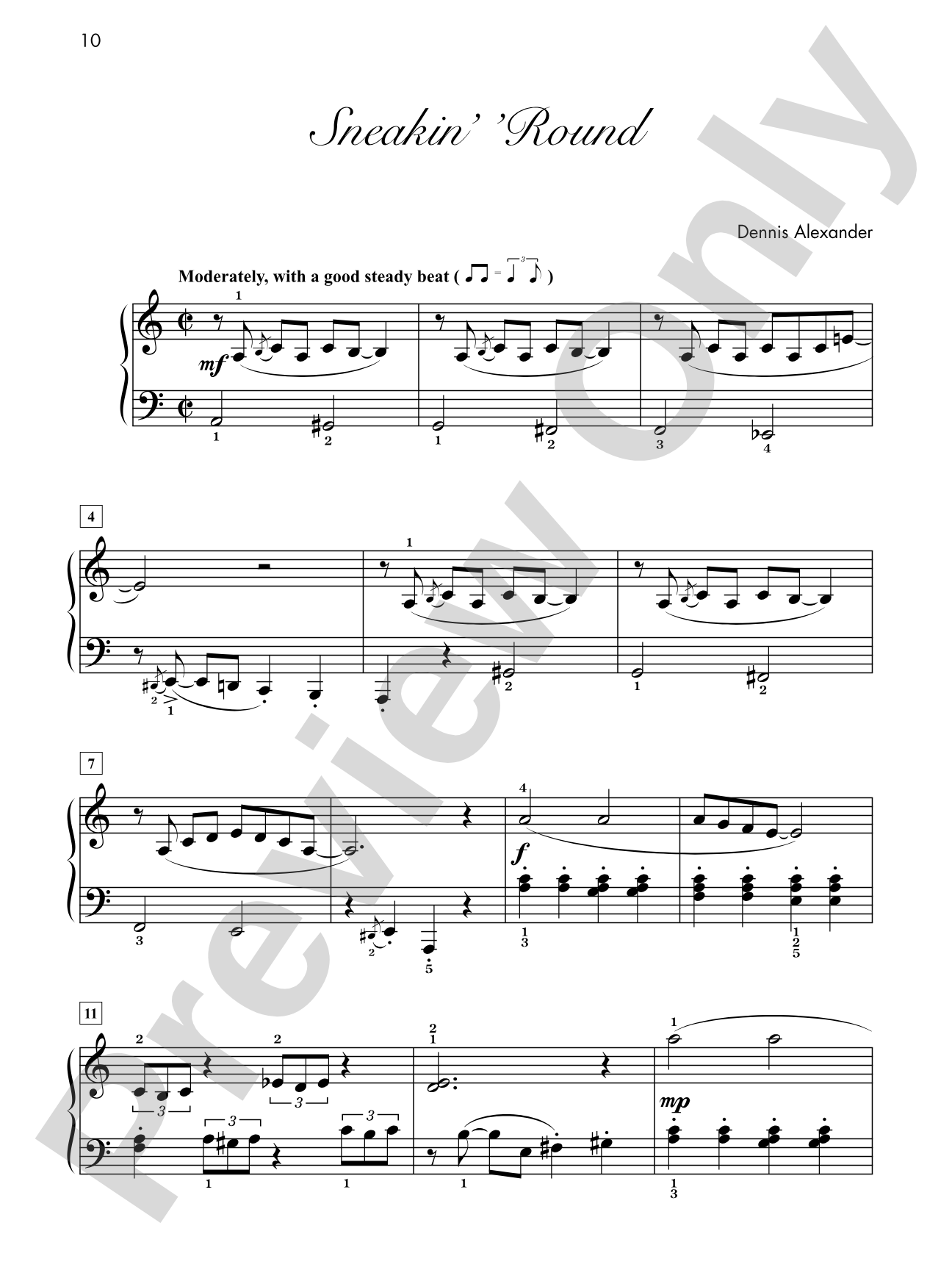

Sneakin' 'Round - Piano Solo: Piano Solo
11 Stylized Solos for Early Intermediate Pianists
By Dennis Alexander
Level: Early Intermediate
Item: 00-PS-0017562
$4.99
Pickup currently not available
Related Items
A Touch of Rhumba - Piano Solo: Piano Solo |
$4.99
|
View | |
As September Goes - Piano Solo: Piano Solo |
$4.99
|
View | |
Jazz Jam - Piano Solo: Piano Solo |
$4.99
|
View | |
Purple Sage - Piano Solo: Piano Solo |
$4.99
|
View | |
Rhythmicon - Piano Solo: Piano Solo |
$4.99
|
View | |
Smooth as Silk - Piano Solo: Piano Solo |
$4.99
|
View | |
Soft-Shoe Blues - Piano Solo: Piano Solo |
$4.99
|
View | |
Soul Searcher - Piano Solo: Piano Solo |
$4.99
|
View | |
Tahitian Nights - Piano Solo: Piano Solo |
$4.99
|
View | |
Valse du jour - Piano Solo: Piano Solo |
$7.99
|
View | |
Especially in Jazzy Style, Book 1: Piano Book |
$7.99
|
View |
Description
The goal of this series is to introduce students to the rhythms, harmonies and other unique characteristics of jazz. Students will be motivated by the variety of styles and sounds that have that special Dennis Alexander sound. From lyrical melodies to infectious rhythms and harmonies, playing jazz styles has never been more fun! Titles: As September Goes * Jazz Jam * Purple Sage * Rhythmicon * Smooth as Silk * Sneakin' 'Round * Soft-Shoe Blues * Soul Searcher * Tahitian Nights * A Touch of Rhumba * Valse du jour. A Federation Festivals 2024-2028 selection.


Sneakin' 'Round - Piano Solo: Piano Solo isn't in MakeMusic Cloud just yet...but it could be. Let us know you'd like to see it, and you'll help shape what comes next. In the meantime, start a free trial and dive into thousands of interactive titles your students can play along with today.
Request This Title
Tell us you want it.
Start Your Free Trial
Explore everything that's ready to play right now.
Sample Audio
1
A Touch of Rhumba
--:--
2
Purple Sage
--:--
A Touch of Rhumba
0:00
0:00
Sample Video
No sample videos found.
Additional Details
Series:
Especially
Publisher:
Alfred Music
Page Count:
24
SKU:
00-PS-0017562
More about this title
About the Composer: Dennis Alexander

Dennis Alexander has shaped American music education for nearly four decades, publishing over 400 compositions that have become standards in studios and practice rooms across the country. Since 1986, his work with Alfred Music Publishing has established him as a defining voice in pedagogical piano writing, balancing accessibility with genuine musical substance. Alexander's teaching career spanned 24 years at the University of Montana, where he chaired the piano department and mentored generations of teachers in how music instruction should actually work.
Beyond the classroom, Alexander maintains an active performance schedule as soloist, accompanist, and chamber musician. He has appeared at Carnegie Recital Hall, conducted master classes at the MTNA national convention, and toured internationally across Southeast Asia and the Far East. His compositions continue to be commissioned by state associations and music organizations, a testament to the trust educators place in his ear for what students need to play.
Why we love this
Alexander writes jazz that doesn't condescend. This collection respects early intermediate players while delivering grooves, harmonic colors, and rhythmic textures that sound genuinely musical, not simplified. Each piece in this series carries his signature balance between immediate playability and the kind of detail that rewards careful listening and repeat performances.
What to expect
Stepping into a room where the music shifts around you. One moment you're in a cool, understated blues; the next, a Latin rhythm takes over. The melodies are memorable enough to hum, but the harmonies underneath keep surprising you. Playing these pieces feels like being let in on something real.
Who it's for
Early intermediate students ready to move beyond classical repertoire and discover jazz on their own terms. Teachers looking for a curated collection where every piece delivers on the promise of fun without sacrificing musicality or variety.
How to get the most out of it
- Study the harmonic movement separate from the melody. Alexander layers sophisticated chord changes underneath accessible melodic lines, so understanding the harmony gives you the architecture the piece is built on.
- Let the rhythmic figures breathe. These aren't meant to be rushed; the infectious quality comes from clarity and pocket, not tempo.
- Listen to jazz piano recordings of the pieces you're learning. Alexander writes in recognizable styles; hearing how professionals interpret similar grooves deepens your instinct for phrasing and dynamics.
- Experiment with swing on the eighth notes where the style suggests it. Alexander's notation provides the framework, but your feel makes it live.
How to use it
Scatter these throughout the year as bridges between classical studies and improvisation. A piece like this works beautifully on a mixed recital, signaling to audiences that jazz is a legitimate language, not a detour. You might also use the collection as a source for student showcase programs where variety and style range matter as much as technical display.
Skills your students will build
- Reading and interpreting jazz articulations and phrasing marks
- Swing eighth notes and jazz rhythmic feel
- Chord symbol reading and jazz harmony recognition
- Left-hand comping patterns and stride figures
- Stylistic variety within a single genre
- Rubato and flexible pulse in jazz contexts