
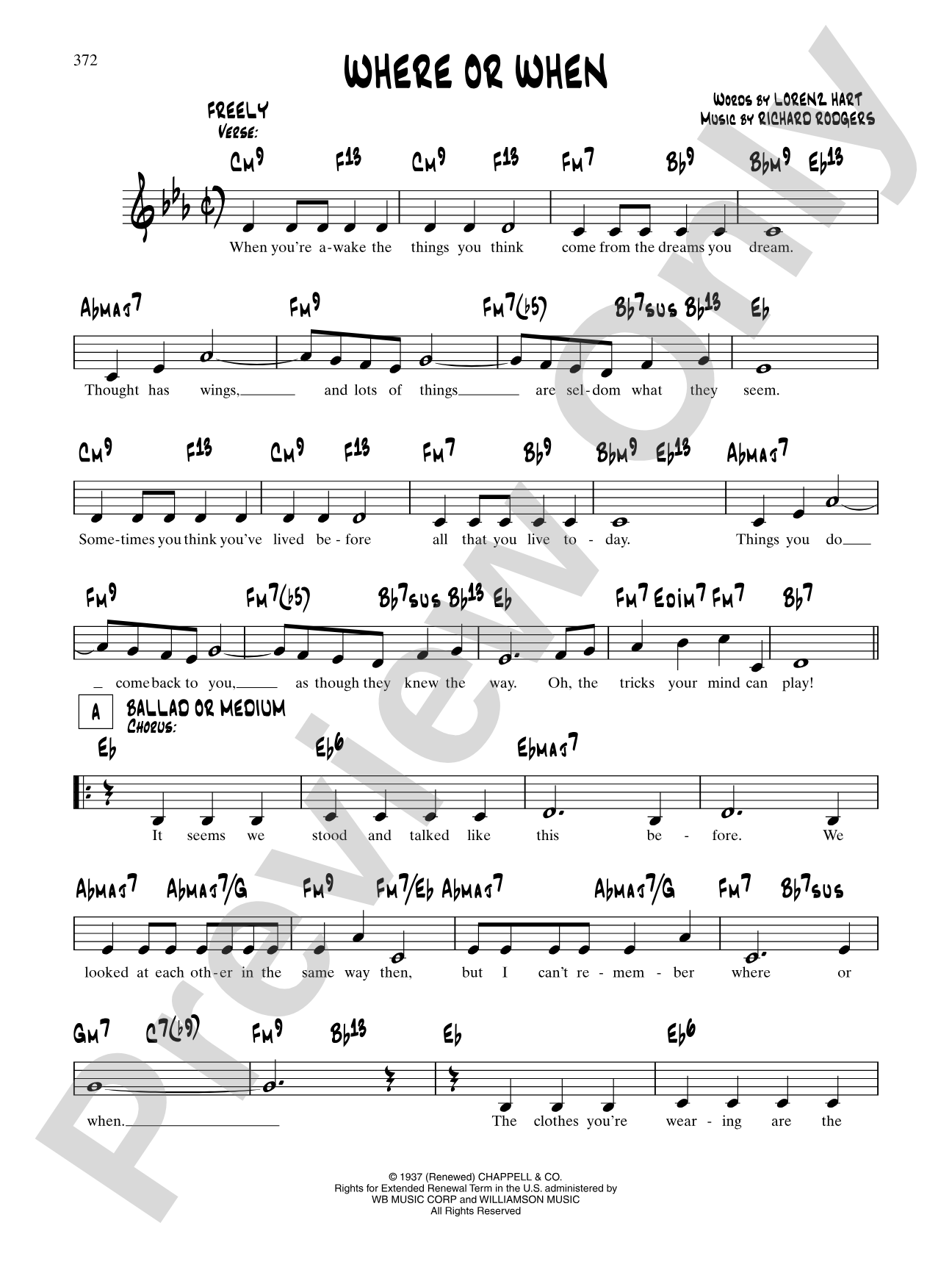

Where Or When (From "Babes In Arms"): Lead Sheet
Frank Sinatra
Item: 00-PSL-000239
$4.99
One moment…
Related Items
Day In Day Out: Lead Sheet |
$4.99
|
View | |
I Thought About You: Lead Sheet |
$4.99
|
View | |
Theme From "New York, New York": Lead Sheet |
$4.99
|
View | |
There's A Small Hotel (From "On Your Toes"): Lead Sheet |
$4.99
|
View | |
Nevertheless (I'm In Love With You): Lead Sheet |
$4.99
|
View | |
Falling In Love With Love (From "The Boys From Syracuse"): Lead Sheet |
$4.99
|
View | |
I Can't Get Started: Lead Sheet |
$4.99
|
View | |
I Could Write A Book (From "Pal Joey"): Lead Sheet |
$4.99
|
View | |
The Lady Is A Tramp: Lead Sheet |
$4.99
|
View | |
Love Is Here To Stay (From "Goldwyn Follies"): Lead Sheet |
$4.99
|
View | |
September Song (From "Knickerbocker Holiday"): Lead Sheet |
$4.99
|
View | |
The Birth Of The Blues (From "George White's Scandals"): Lead Sheet |
$4.99
|
View | |
Dancing On The Ceiling (He Dances On My Ceiling) (From "Evergreen"): Lead Sheet |
$4.99
|
View | |
What Is This Thing Called Love?: Lead Sheet |
$4.99
|
View | |
You Do Something To Me (From "50 Million Frenchmen"): Lead Sheet |
$4.99
|
View | |
Just One Of Those Things (From "High Society"): Lead Sheet |
$4.99
|
View | |
Night And Day: Lead Sheet |
$4.99
|
View | |
I Cover The Waterfront: Lead Sheet |
$4.99
|
View | |
It's Only A Paper Moon: Lead Sheet |
$4.99
|
View | |
I Get A Kick Out Of You (From "Anything Goes"): Lead Sheet |
$4.99
|
View | |
September In The Rain: Lead Sheet |
$4.99
|
View | |
Blues In The Night: Lead Sheet |
$4.99
|
View | |
Summer Wind: Lead Sheet |
$4.99
|
View | |
Embraceable You: Lead Sheet |
$4.99
|
View | |
Mack The Knife (English Version): Lead Sheet |
$4.99
|
View | |
My Kind Of Town (Chicago Is) (From "Robin & The 7 Hoods"): Lead Sheet |
$4.99
|
View | |
Just In Time: Lead Sheet |
$4.99
|
View | |
Speak Low Ne Folio: Lead Sheet |
$4.99
|
View | |
Come Rain Or Come Shine: Lead Sheet |
$4.99
|
View | |
At Long Last Love: Lead Sheet |
$4.99
|
View | |
In The Still Of The Night (From "Rosalie"): Lead Sheet |
$4.99
|
View | |
I've Got You Under My Skin: Lead Sheet |
$4.99
|
View | |
The Second Time Around: Lead Sheet |
$4.99
|
View | |
What Is This Thing Called Love?: Piano/Vocal/Chords |
$4.99
|
View | |
Just One Of Those Things (From "High Society"): Piano/Vocal/Chords |
$4.99
|
View | |
Night And Day: Piano/Vocal/Chords |
$4.99
|
View |
Description
This big folio contains seven pages of photos and a bio. Songs include: My Way * They Can't Take That Away from Me * Falling in Love with Love * The Lady Is a Tramp * Just in Time * New York, New York and many more!


Where Or When (From "Babes In Arms"): Lead Sheet isn't in MakeMusic Cloud just yet...but it could be. Let us know you'd like to see it, and you'll help shape what comes next. In the meantime, start a free trial and dive into thousands of interactive titles your students can play along with today.
Request This Title
Tell us you want it.
Start Your Free Trial
Explore everything that's ready to play right now.
Sample Audio
No sample audio found.
Sample Video
No sample videos found.
Additional Details
Publisher:
Alfred Music
Page Count:
360
SKU:
00-PSL-000239
More about this title
About the Artist: Mel Tormé
Mel Tormé (1946-1999) was a vocalist, composer, and arranger whose technical precision and harmonic sophistication made him one of the most respected interpreters of the American songbook. His distinctive vocal control, ability to scat with near-instrumental fluency, and deep knowledge of jazz and popular standards earned him the nickname "The Velvet Fog." He recorded prolifically across multiple decades and remained an active performer and recording artist well into his later years.
Beyond his work as a vocalist, Tormé composed songs, arranged charts for orchestras and small ensembles, and demonstrated an encyclopedic command of melody and harmony. His interpretations of classic standards set a high bar for phrasing, breath control, and emotional restraint. For music students and performers, his recordings and arrangements serve as masterclasses in how to approach the Great American Songbook with intelligence and artistry.
Why we love this
This lead sheet captures one of the most elegant and sinuous melodies from the Rodgers and Hart songbook. The harmonic language is sophisticated without being impenetrable, making it an excellent study for pianists and singers developing their understanding of how jazz harmony functions within a pop standard. Pairing it with Mel Tormé's own approach to the material gives performers a sophisticated reference point for phrasing and interpretation.
What to expect
The tune moves with a kind of wistful, conversational ease. There's a romantic question at the heart of it (the title itself), and the melody seems to search gently through the harmony before resolving with quiet certainty. The overall mood is intimate and reflective, neither bombastic nor overly sentimental.
Who it's for
Pianists and singers working on standard repertoire will find this lead sheet essential for learning the melody and chord changes. It suits intermediate to advanced performers who are already comfortable reading jazz chords and want to deepen their command of mid-twentieth-century pop songwriting.
How to get the most out of it
- Pay close attention to the harmonic rhythm in the bridge; the changes move quickly and reward a pianist who locks into the chord progression rather than relying solely on melody.
- Singers should experiment with time and phrasing across the lyric. This tune rewards rubato and subtle syncopation; listen to how Tormé places notes slightly behind or ahead of the beat for emotional effect.
- Work the dynamic shape across the entire form. Many performers flatten out the verse; building subtle intensity toward the chorus pays off.
- If accompanying a vocalist, resist the urge to comp too busily. Space and restraint make the harmony land harder.
How to use it
Program this alongside other Rodgers and Hart standards to explore how a single songwriting team shaped American melody and harmony. It works well in a set built around great jazz vocal standards or as a teaching piece for a jazz or popular music course.
Skills your students will build
- Reading jazz chord symbols and understanding their harmonic function
- Phrasing and interpretive choices in standard ballads
- Accompanying a vocalist with minimal but effective comping
- Understanding melody-harmony relationships in mid-twentieth-century pop composition