
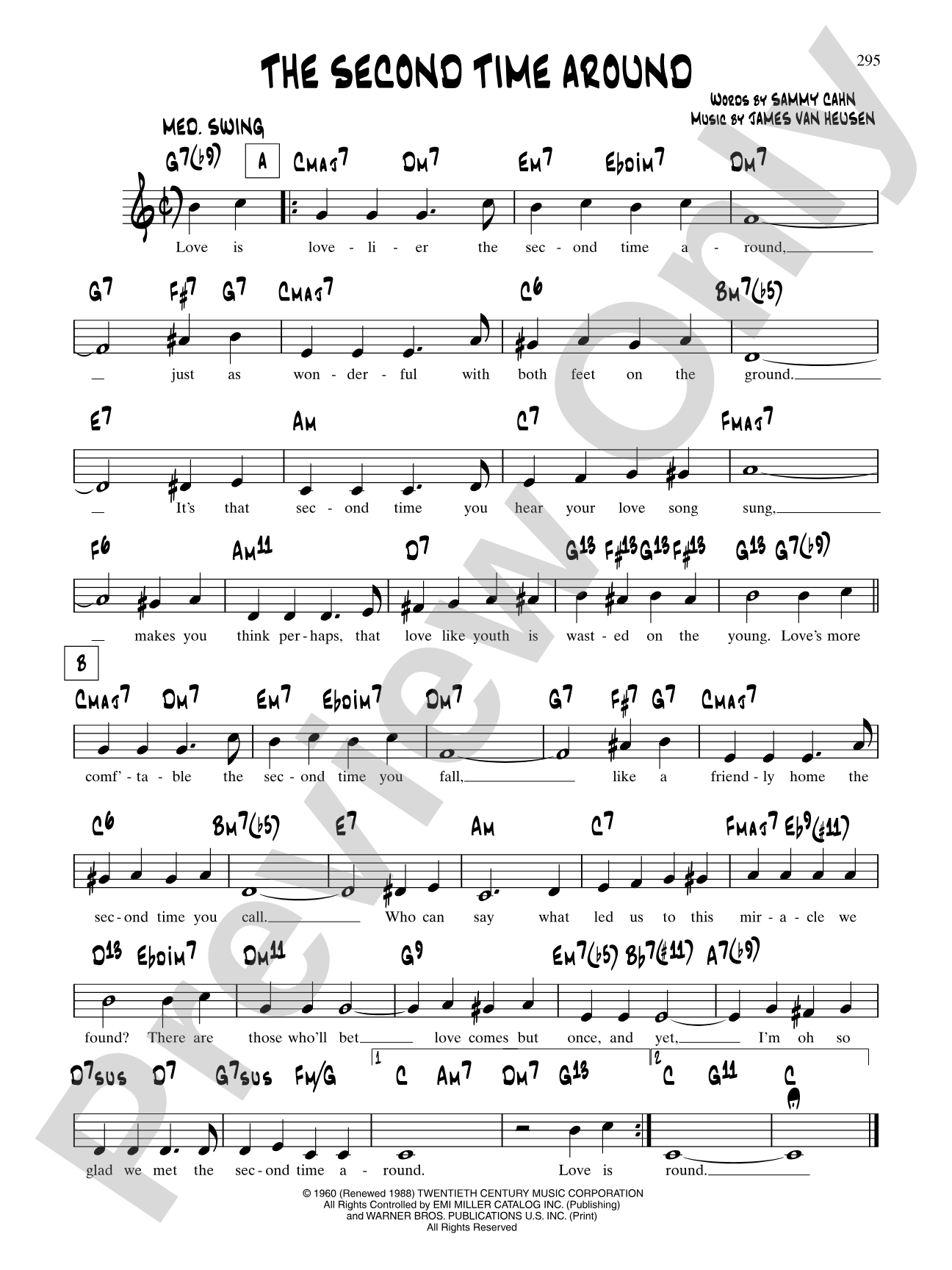

The Second Time Around: Lead Sheet
Frank Sinatra
Item: 00-PSL-000349
$4.99
One moment…
Related Items
Day In Day Out: Lead Sheet |
$4.99
|
View | |
I Thought About You: Lead Sheet |
$4.99
|
View | |
Theme From "New York, New York": Lead Sheet |
$4.99
|
View | |
There's A Small Hotel (From "On Your Toes"): Lead Sheet |
$4.99
|
View | |
Nevertheless (I'm In Love With You): Lead Sheet |
$4.99
|
View | |
Falling In Love With Love (From "The Boys From Syracuse"): Lead Sheet |
$4.99
|
View | |
I Can't Get Started: Lead Sheet |
$4.99
|
View | |
I Could Write A Book (From "Pal Joey"): Lead Sheet |
$4.99
|
View | |
The Lady Is A Tramp: Lead Sheet |
$4.99
|
View | |
Love Is Here To Stay (From "Goldwyn Follies"): Lead Sheet |
$4.99
|
View | |
September Song (From "Knickerbocker Holiday"): Lead Sheet |
$4.99
|
View | |
Where Or When (From "Babes In Arms"): Lead Sheet |
$4.99
|
View | |
The Birth Of The Blues (From "George White's Scandals"): Lead Sheet |
$4.99
|
View | |
Dancing On The Ceiling (He Dances On My Ceiling) (From "Evergreen"): Lead Sheet |
$4.99
|
View | |
What Is This Thing Called Love?: Lead Sheet |
$4.99
|
View | |
You Do Something To Me (From "50 Million Frenchmen"): Lead Sheet |
$4.99
|
View | |
Just One Of Those Things (From "High Society"): Lead Sheet |
$4.99
|
View | |
Night And Day: Lead Sheet |
$4.99
|
View | |
I Cover The Waterfront: Lead Sheet |
$4.99
|
View | |
It's Only A Paper Moon: Lead Sheet |
$4.99
|
View | |
I Get A Kick Out Of You (From "Anything Goes"): Lead Sheet |
$4.99
|
View | |
September In The Rain: Lead Sheet |
$4.99
|
View | |
Blues In The Night: Lead Sheet |
$4.99
|
View | |
Summer Wind: Lead Sheet |
$4.99
|
View | |
Embraceable You: Lead Sheet |
$4.99
|
View | |
Mack The Knife (English Version): Lead Sheet |
$4.99
|
View | |
My Kind Of Town (Chicago Is) (From "Robin & The 7 Hoods"): Lead Sheet |
$4.99
|
View | |
Just In Time: Lead Sheet |
$4.99
|
View | |
Speak Low Ne Folio: Lead Sheet |
$4.99
|
View | |
Come Rain Or Come Shine: Lead Sheet |
$4.99
|
View | |
At Long Last Love: Lead Sheet |
$4.99
|
View | |
In The Still Of The Night (From "Rosalie"): Lead Sheet |
$4.99
|
View | |
I've Got You Under My Skin: Lead Sheet |
$4.99
|
View | |
What Is This Thing Called Love?: Piano/Vocal/Chords |
$4.99
|
View | |
Just One Of Those Things (From "High Society"): Piano/Vocal/Chords |
$4.99
|
View | |
Night And Day: Piano/Vocal/Chords |
$4.99
|
View |
Description
This big folio contains seven pages of photos and a bio. Songs include: My Way * They Can't Take That Away from Me * Falling in Love with Love * The Lady Is a Tramp * Just in Time * New York, New York and many more!


The Second Time Around: Lead Sheet isn't in MakeMusic Cloud just yet...but it could be. Let us know you'd like to see it, and you'll help shape what comes next. In the meantime, start a free trial and dive into thousands of interactive titles your students can play along with today.
Request This Title
Tell us you want it.
Start Your Free Trial
Explore everything that's ready to play right now.
Sample Audio
No sample audio found.
Sample Video
No sample videos found.
Additional Details
Publisher:
Alfred Music
Page Count:
360
SKU:
00-PSL-000349
More about this title
About the Artist: George Shearing
George Shearing was a British jazz pianist and composer whose sophisticated harmonic sense and refined touch made him one of the most distinctive voices in mid-century jazz. Born in 1919 and blind from birth, Shearing brought classically trained technique to bebop and cool jazz, developing a signature sound that blended European musical sophistication with American jazz idiom. His small group recordings of the 1950s, particularly his interpretations of American standards, became jazz classics and influenced generations of pianists and vocalists.
Why we love this
Shearing's interpretations of these standards demonstrate how to honor a song's melodic integrity while reimagining its harmonic landscape. The lead sheet format captures his approach to comping and voicing choices, making it an invaluable resource for pianists and singers learning how sophisticated jazz arranging enhances rather than obscures a great tune.
What to expect
Elegant, conversational, and deeply musical. These standards feel refined and unhurried, with space for the lyric to land and the melody to sing through sophisticated but never cluttered harmony. Shearing's touch brings a pianistic elegance to songs often played in simpler ways, elevating the listening experience while remaining rooted in the song's essential character.
Who it's for
Pianists studying jazz standards and looking to deepen their harmonic vocabulary through a master's interpretations. Singers preparing to perform these classics with jazz accompaniment will find Shearing's chord choices and voicing suggestions particularly instructive for understanding how accompaniment shapes phrasing and emotional color.
How to get the most out of it
- Study Shearing's recorded versions before interpreting these lead sheets; his harmonic innovations are the main pedagogical point, and hearing them provides essential context for understanding the voicings notated here.
- Pay attention to the chord extensions and alterations marked throughout; they're not decorative but functional, showing how Shearing resolves tension and creates forward motion in his comping.
- Balance melody and accompaniment carefully, especially when playing and singing simultaneously; Shearing's sound depends on clarity rather than density, so leave space in your voicings for the vocal line to breathe.
How to use it
Include these lead sheets in a standards unit where students learn the difference between a tune's basic structure and how master musicians reimagine it. They work particularly well paired with listening assignments and transcription study, giving students both aural and written reference points for understanding jazz arranging choices.
Skills your students will build
- Reading and interpreting jazz chord symbols and extensions
- Understanding voice leading principles through harmonic analysis
- Adapting accompaniment patterns to support a vocalist's phrasing
- Recognizing how substitutions and alterations can enhance harmonic movement
- Balancing accompaniment and melody in ensemble playing