
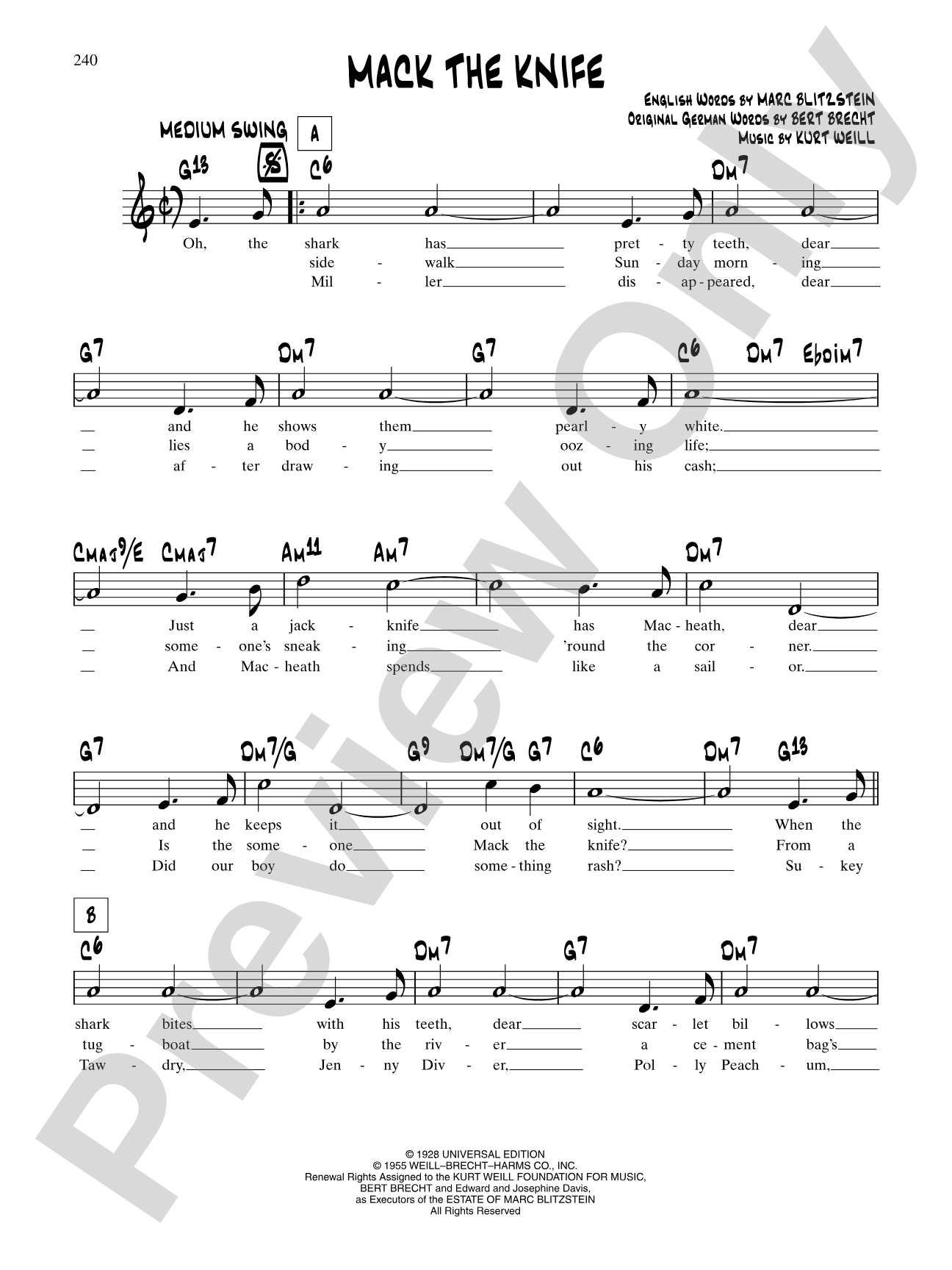

Mack The Knife (English Version): Lead Sheet
Frank Sinatra
Item: 00-PSL-000304
$4.99
One moment…
Related Items
Day In Day Out: Lead Sheet |
$4.99
|
View | |
I Thought About You: Lead Sheet |
$4.99
|
View | |
Theme From "New York, New York": Lead Sheet |
$4.99
|
View | |
There's A Small Hotel (From "On Your Toes"): Lead Sheet |
$4.99
|
View | |
Nevertheless (I'm In Love With You): Lead Sheet |
$4.99
|
View | |
Falling In Love With Love (From "The Boys From Syracuse"): Lead Sheet |
$4.99
|
View | |
I Can't Get Started: Lead Sheet |
$4.99
|
View | |
I Could Write A Book (From "Pal Joey"): Lead Sheet |
$4.99
|
View | |
The Lady Is A Tramp: Lead Sheet |
$4.99
|
View | |
Love Is Here To Stay (From "Goldwyn Follies"): Lead Sheet |
$4.99
|
View | |
September Song (From "Knickerbocker Holiday"): Lead Sheet |
$4.99
|
View | |
Where Or When (From "Babes In Arms"): Lead Sheet |
$4.99
|
View | |
The Birth Of The Blues (From "George White's Scandals"): Lead Sheet |
$4.99
|
View | |
Dancing On The Ceiling (He Dances On My Ceiling) (From "Evergreen"): Lead Sheet |
$4.99
|
View | |
What Is This Thing Called Love?: Lead Sheet |
$4.99
|
View | |
You Do Something To Me (From "50 Million Frenchmen"): Lead Sheet |
$4.99
|
View | |
Just One Of Those Things (From "High Society"): Lead Sheet |
$4.99
|
View | |
Night And Day: Lead Sheet |
$4.99
|
View | |
I Cover The Waterfront: Lead Sheet |
$4.99
|
View | |
It's Only A Paper Moon: Lead Sheet |
$4.99
|
View | |
I Get A Kick Out Of You (From "Anything Goes"): Lead Sheet |
$4.99
|
View | |
September In The Rain: Lead Sheet |
$4.99
|
View | |
Blues In The Night: Lead Sheet |
$4.99
|
View | |
Summer Wind: Lead Sheet |
$4.99
|
View | |
Embraceable You: Lead Sheet |
$4.99
|
View | |
My Kind Of Town (Chicago Is) (From "Robin & The 7 Hoods"): Lead Sheet |
$4.99
|
View | |
Just In Time: Lead Sheet |
$4.99
|
View | |
Speak Low Ne Folio: Lead Sheet |
$4.99
|
View | |
Come Rain Or Come Shine: Lead Sheet |
$4.99
|
View | |
At Long Last Love: Lead Sheet |
$4.99
|
View | |
In The Still Of The Night (From "Rosalie"): Lead Sheet |
$4.99
|
View | |
I've Got You Under My Skin: Lead Sheet |
$4.99
|
View | |
The Second Time Around: Lead Sheet |
$4.99
|
View | |
What Is This Thing Called Love?: Piano/Vocal/Chords |
$4.99
|
View | |
Just One Of Those Things (From "High Society"): Piano/Vocal/Chords |
$4.99
|
View | |
Night And Day: Piano/Vocal/Chords |
$4.99
|
View |
Description
This big folio contains seven pages of photos and a bio. Songs include: My Way * They Can't Take That Away from Me * Falling in Love with Love * The Lady Is a Tramp * Just in Time * New York, New York and many more!


Mack The Knife (English Version): Lead Sheet isn't in MakeMusic Cloud just yet...but it could be. Let us know you'd like to see it, and you'll help shape what comes next. In the meantime, start a free trial and dive into thousands of interactive titles your students can play along with today.
Request This Title
Tell us you want it.
Start Your Free Trial
Explore everything that's ready to play right now.
Sample Audio
No sample audio found.
Sample Video
No sample videos found.
Additional Details
Publisher:
Alfred Music
Page Count:
360
SKU:
00-PSL-000304
More about this title
About the Artist: Kurt Weill
Kurt Weill (1900-1950) was a German-American composer whose work bridged classical music and popular song. He collaborated with lyricist Bertolt Brecht on groundbreaking theatrical works like "The Threepenny Opera," which introduced audiences to a new kind of musical theater that was socially conscious, rhythmically innovative, and deeply singable.
After emigrating to the United States in 1935, Weill composed for Broadway and film, creating standards that remain central to the American songbook. His genius lay in writing memorable melodies with sophisticated harmonies, making complex musical ideas accessible to performers and audiences alike. For music educators, Weill's catalog offers rich material for teaching song interpretation, harmonic analysis, and the role of music in theatrical storytelling.
Why we love this
This lead sheet gives singers and pianists direct access to one of the most distinctive compositional voices in twentieth-century music. Weill's melodies are immediately memorable yet harmonically sophisticated, making these songs ideal for exploring how popular song can contain real musical depth.
What to expect
Weill's world is urban, witty, and tinged with melancholy. These songs have the directness of speech and the sophistication of art song combined, with a rhythmic edge that feels both European and distinctly American. Whether you're singing about love, ambition, or heartbreak, there's an intelligence and emotional honesty in the writing that rewards careful attention.
Who it's for
This resource serves vocalists preparing audition material, singers in jazz or cabaret settings, and pianists accompanying in lessons or performance. It's also valuable for music theory students examining how twentieth-century composers approached song form and harmonic language.
How to get the most out of it
- Balance the vocal line with the harmonic changes. Weill's chords often move faster than the melody, so pianists should voice changes smoothly while letting the singer's phrase breathe naturally.
- Pay attention to Weill's rhythmic language. Many of these songs sit just outside strict 4/4 phrasing; honor the slight syncopations and speech-like qualities that give the music its character.
- Treat the lyrics as a guide to phrasing and intent. Weill's melodies follow text inflection closely, so understanding what the song is saying helps shape where you place emphasis and when you breathe.
How to use it
Program these songs in recitals that showcase American musical theater standards, or use them as concert openers that bridge classical and popular repertoire. They work equally well in jazz-inflected settings or art song recitals, giving you flexibility in how you frame them for your audience.
Skills your students will build
- Reading lead sheets and interpreting chord symbols with flexibility
- Balancing lyrical phrasing with harmonic rhythm
- Understanding song form and sectional structure in theatrical music
- Analyzing and performing text-music relationships in twentieth-century composition
- Adapting melody and accompaniment for different vocal ranges and interpretive approaches