
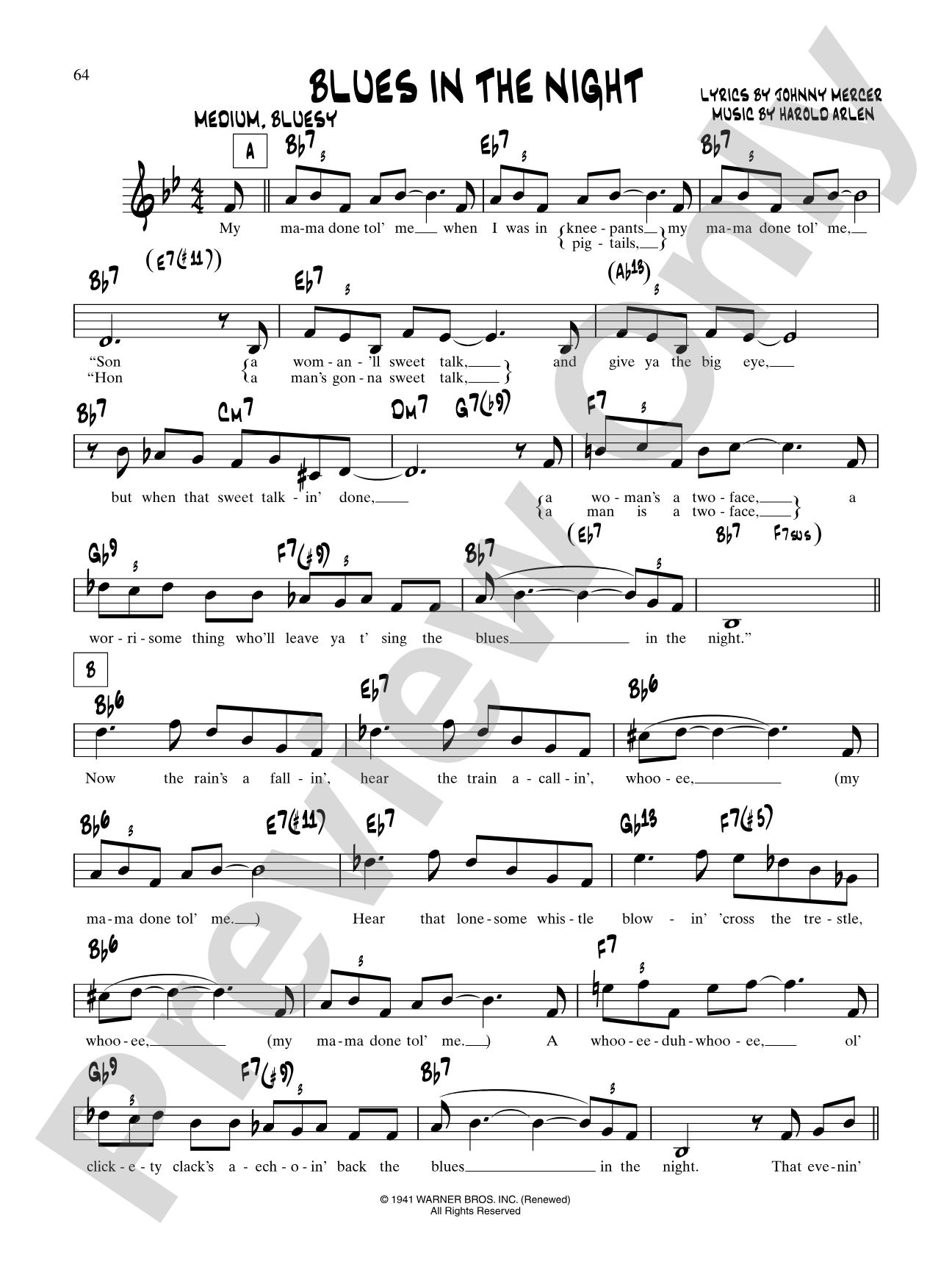

Blues In The Night: Lead Sheet
Frank Sinatra
Item: 00-PSL-000282
$4.99
One moment…
Related Items
Day In Day Out: Lead Sheet |
$4.99
|
View | |
I Thought About You: Lead Sheet |
$4.99
|
View | |
Theme From "New York, New York": Lead Sheet |
$4.99
|
View | |
There's A Small Hotel (From "On Your Toes"): Lead Sheet |
$4.99
|
View | |
Nevertheless (I'm In Love With You): Lead Sheet |
$4.99
|
View | |
Falling In Love With Love (From "The Boys From Syracuse"): Lead Sheet |
$4.99
|
View | |
I Can't Get Started: Lead Sheet |
$4.99
|
View | |
I Could Write A Book (From "Pal Joey"): Lead Sheet |
$4.99
|
View | |
The Lady Is A Tramp: Lead Sheet |
$4.99
|
View | |
Love Is Here To Stay (From "Goldwyn Follies"): Lead Sheet |
$4.99
|
View | |
September Song (From "Knickerbocker Holiday"): Lead Sheet |
$4.99
|
View | |
Where Or When (From "Babes In Arms"): Lead Sheet |
$4.99
|
View | |
The Birth Of The Blues (From "George White's Scandals"): Lead Sheet |
$4.99
|
View | |
Dancing On The Ceiling (He Dances On My Ceiling) (From "Evergreen"): Lead Sheet |
$4.99
|
View | |
What Is This Thing Called Love?: Lead Sheet |
$4.99
|
View | |
You Do Something To Me (From "50 Million Frenchmen"): Lead Sheet |
$4.99
|
View | |
Just One Of Those Things (From "High Society"): Lead Sheet |
$4.99
|
View | |
Night And Day: Lead Sheet |
$4.99
|
View | |
I Cover The Waterfront: Lead Sheet |
$4.99
|
View | |
It's Only A Paper Moon: Lead Sheet |
$4.99
|
View | |
I Get A Kick Out Of You (From "Anything Goes"): Lead Sheet |
$4.99
|
View | |
September In The Rain: Lead Sheet |
$4.99
|
View | |
Summer Wind: Lead Sheet |
$4.99
|
View | |
Embraceable You: Lead Sheet |
$4.99
|
View | |
Mack The Knife (English Version): Lead Sheet |
$4.99
|
View | |
My Kind Of Town (Chicago Is) (From "Robin & The 7 Hoods"): Lead Sheet |
$4.99
|
View | |
Just In Time: Lead Sheet |
$4.99
|
View | |
Speak Low Ne Folio: Lead Sheet |
$4.99
|
View | |
Come Rain Or Come Shine: Lead Sheet |
$4.99
|
View | |
At Long Last Love: Lead Sheet |
$4.99
|
View | |
In The Still Of The Night (From "Rosalie"): Lead Sheet |
$4.99
|
View | |
I've Got You Under My Skin: Lead Sheet |
$4.99
|
View | |
The Second Time Around: Lead Sheet |
$4.99
|
View | |
What Is This Thing Called Love?: Piano/Vocal/Chords |
$4.99
|
View | |
Just One Of Those Things (From "High Society"): Piano/Vocal/Chords |
$4.99
|
View | |
Night And Day: Piano/Vocal/Chords |
$4.99
|
View |
Description
This big folio contains seven pages of photos and a bio. Songs include: My Way * They Can't Take That Away from Me * Falling in Love with Love * The Lady Is a Tramp * Just in Time * New York, New York and many more!


Blues In The Night: Lead Sheet isn't in MakeMusic Cloud just yet...but it could be. Let us know you'd like to see it, and you'll help shape what comes next. In the meantime, start a free trial and dive into thousands of interactive titles your students can play along with today.
Request This Title
Tell us you want it.
Start Your Free Trial
Explore everything that's ready to play right now.
Sample Audio
No sample audio found.
Sample Video
No sample videos found.
Additional Details
Publisher:
Alfred Music
Page Count:
360
SKU:
00-PSL-000282
More about this title
About the Artist: Johnny Mercer
Johnny Mercer stands among the most prolific and versatile lyricists in American popular music. Over a career spanning five decades, he wrote lyrics for Broadway shows, Hollywood films, and jazz standards that defined the Great American Songbook. His gift for conversational melody married to witty, memorable text made his work instantly singable and enduringly popular across generations of performers.
Mercer's influence on music education extends beyond the songs themselves. His lyrics model sophisticated rhyme schemes, clever internal rhymes, and storytelling that reward close listening and careful interpretation. For singers and pianists, his catalog offers a masterclass in how words and music can enhance each other, making his compositions ideal for developing artistry in both jazz and vocal music contexts.
Why we love this
This collection gathers some of the most enduring standards in the American songbook, each one offering singers and pianists authentic chord charts and lyrical text for genuine performance work. The breadth of styles represented here (from the bluesy title track to the bright swing of New York, New York) gives you multiple entry points for different skill levels and musical interests. Having these songs in lead sheet format means your students can explore jazz interpretation, improvisation, and vocal phrasing while staying true to Mercer's original melodic and harmonic intent.
What to expect
These songs carry the sophistication and wit of mid-century popular music. Whether you're drawn to the sultry blues feel of the title track or the brassy optimism of New York, New York, each selection captures a distinct emotional landscape while maintaining the melodic elegance and harmonic richness that made these standards timeless.
Who it's for
Pianists and singers preparing repertoire for recitals, jazz ensembles, or auditions will find these lead sheets essential. This collection works equally well for music teachers building a standards-based curriculum and for advanced students exploring the Great American Songbook on their own.
How to get the most out of it
- Study the lyrical content before diving into phrasing decisions. Mercer's words contain specific emotional beats that should shape where you breathe, how you shape a phrase, and which syllables receive weight.
- Treat the chord symbols as a starting point, not a boundary. Lead sheets invite pianists to voice chords musically and singers to find conversational rhythmic freedom within the harmonic framework.
- Listen to multiple recorded versions of these standards. Comparing how different artists approach the same song teaches you how much personal interpretation is possible while respecting the original composition.
How to use it
Use selections from this collection as anchors for a jazz standards or American songbook unit. Pairing several of these lead sheets with historical listening and performer research creates rich context for both formal recitals and informal classroom performance. These songs also serve well as stepping stones for students transitioning from classical training into jazz and popular music styles.
Skills your students will build
- Reading lead sheet notation and chord symbols
- Interpreting lyrics expressively and connecting text to melodic phrasing
- Harmonic analysis and voice leading from jazz chord charts
- Improvisation and reharmonization over standard changes
- Stylistic awareness of mid-century popular and jazz idioms