
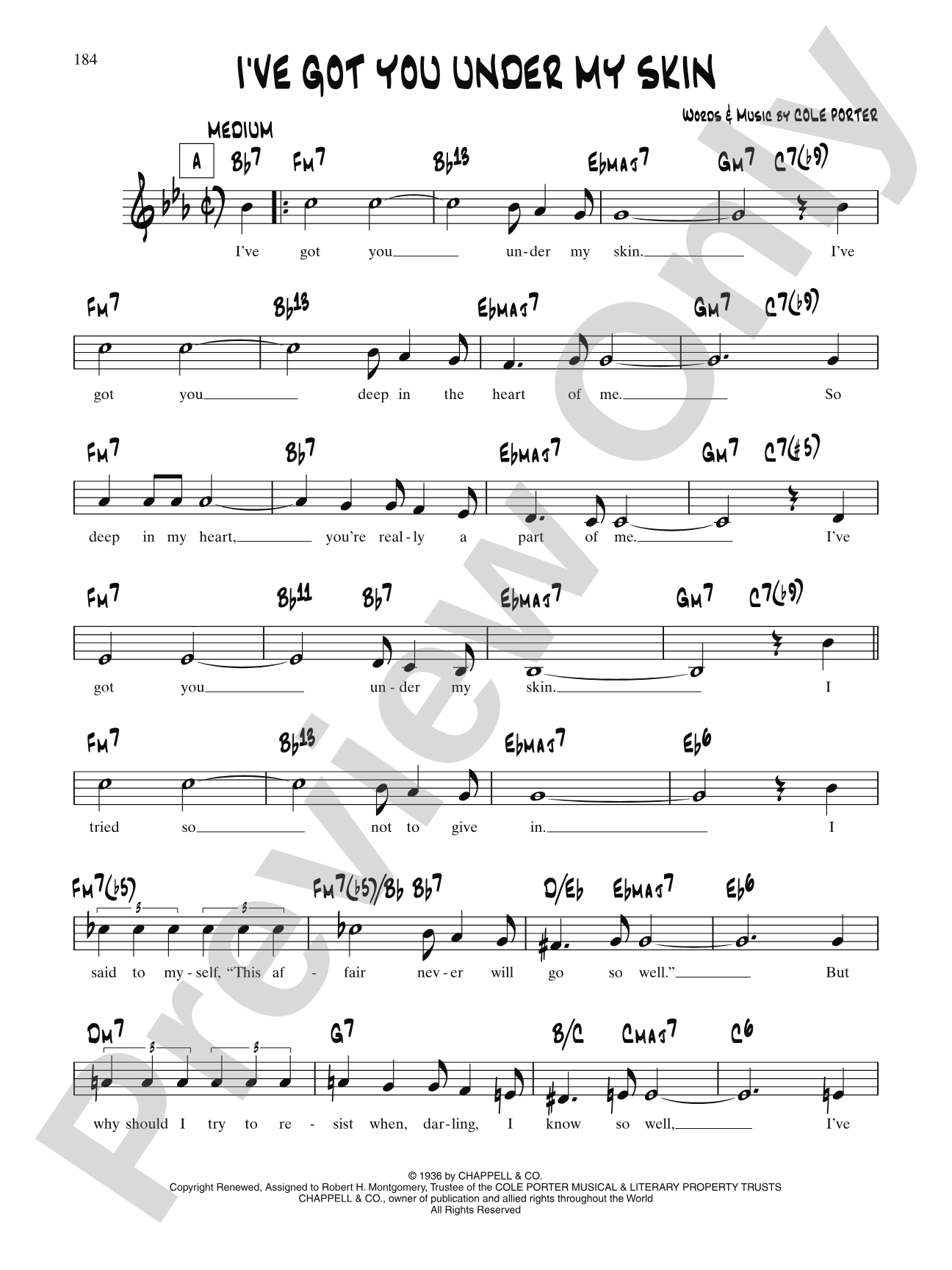

I've Got You Under My Skin: Lead Sheet
Frank Sinatra
Item: 00-PSL-000348
$4.99
One moment…
Related Items
Day In Day Out: Lead Sheet |
$4.99
|
View | |
I Thought About You: Lead Sheet |
$4.99
|
View | |
Theme From "New York, New York": Lead Sheet |
$4.99
|
View | |
There's A Small Hotel (From "On Your Toes"): Lead Sheet |
$4.99
|
View | |
Nevertheless (I'm In Love With You): Lead Sheet |
$4.99
|
View | |
Falling In Love With Love (From "The Boys From Syracuse"): Lead Sheet |
$4.99
|
View | |
I Can't Get Started: Lead Sheet |
$4.99
|
View | |
I Could Write A Book (From "Pal Joey"): Lead Sheet |
$4.99
|
View | |
The Lady Is A Tramp: Lead Sheet |
$4.99
|
View | |
Love Is Here To Stay (From "Goldwyn Follies"): Lead Sheet |
$4.99
|
View | |
September Song (From "Knickerbocker Holiday"): Lead Sheet |
$4.99
|
View | |
Where Or When (From "Babes In Arms"): Lead Sheet |
$4.99
|
View | |
The Birth Of The Blues (From "George White's Scandals"): Lead Sheet |
$4.99
|
View | |
Dancing On The Ceiling (He Dances On My Ceiling) (From "Evergreen"): Lead Sheet |
$4.99
|
View | |
What Is This Thing Called Love?: Lead Sheet |
$4.99
|
View | |
You Do Something To Me (From "50 Million Frenchmen"): Lead Sheet |
$4.99
|
View | |
Just One Of Those Things (From "High Society"): Lead Sheet |
$4.99
|
View | |
Night And Day: Lead Sheet |
$4.99
|
View | |
I Cover The Waterfront: Lead Sheet |
$4.99
|
View | |
It's Only A Paper Moon: Lead Sheet |
$4.99
|
View | |
I Get A Kick Out Of You (From "Anything Goes"): Lead Sheet |
$4.99
|
View | |
September In The Rain: Lead Sheet |
$4.99
|
View | |
Blues In The Night: Lead Sheet |
$4.99
|
View | |
Summer Wind: Lead Sheet |
$4.99
|
View | |
Embraceable You: Lead Sheet |
$4.99
|
View | |
Mack The Knife (English Version): Lead Sheet |
$4.99
|
View | |
My Kind Of Town (Chicago Is) (From "Robin & The 7 Hoods"): Lead Sheet |
$4.99
|
View | |
Just In Time: Lead Sheet |
$4.99
|
View | |
Speak Low Ne Folio: Lead Sheet |
$4.99
|
View | |
Come Rain Or Come Shine: Lead Sheet |
$4.99
|
View | |
At Long Last Love: Lead Sheet |
$4.99
|
View | |
In The Still Of The Night (From "Rosalie"): Lead Sheet |
$4.99
|
View | |
The Second Time Around: Lead Sheet |
$4.99
|
View | |
What Is This Thing Called Love?: Piano/Vocal/Chords |
$4.99
|
View | |
Just One Of Those Things (From "High Society"): Piano/Vocal/Chords |
$4.99
|
View | |
Night And Day: Piano/Vocal/Chords |
$4.99
|
View |
Description
This big folio contains seven pages of photos and a bio. Songs include: My Way * They Can't Take That Away from Me * Falling in Love with Love * The Lady Is a Tramp * Just in Time * New York, New York and many more!


I've Got You Under My Skin: Lead Sheet isn't in MakeMusic Cloud just yet...but it could be. Let us know you'd like to see it, and you'll help shape what comes next. In the meantime, start a free trial and dive into thousands of interactive titles your students can play along with today.
Request This Title
Tell us you want it.
Start Your Free Trial
Explore everything that's ready to play right now.
Sample Audio
No sample audio found.
Sample Video
No sample videos found.
Additional Details
Publisher:
Alfred Music
Page Count:
360
SKU:
00-PSL-000348
More about this title
About the Artist: Cole Porter
Cole Porter (1891-1964) stands among the most sophisticated songwriters of the American musical theater. His melodies combined elegant simplicity with unexpected harmonic turns, while his lyrics demonstrated wit, wordplay, and genuine emotional depth. Porter wrote for Broadway shows and Hollywood films across four decades, creating standards that remain central to jazz, cabaret, and vocal repertoire today.
Porter's influence on music education extends beyond his catalog. His songs teach harmonic complexity, sophisticated lyric writing, and the balance between accessibility and artistic ambition. Pianists encounter challenging chord progressions and voice-leading; singers develop interpretive skills through material that rewards both technical precision and emotional nuance.
Why we love this
Lead sheets ground singers and pianists in the songs that defined American popular music. Porter's melodic and harmonic sophistication means these standards reward repeated engagement, revealing new layers with each learning phase. The combination of accessible melodies with subtle chromatic movement makes these pieces ideal for students transitioning into jazz vocabulary and professional cabaret literature.
What to expect
These songs possess a kind of urbane sophistication, balancing romantic sentiment with clever irony. Melodies often sit comfortably in the voice yet contain surprising intervallic leaps; harmonies reference both classical tradition and early jazz vocabulary, creating a sound both familiar and subtly complex. There is elegance here, but never coldness.
Who it's for
This collection serves pianists accompanying singers in recital or studio settings, vocalists building a standards repertoire, and musicians studying jazz harmony and American songwriting craft. It suits intermediate to advanced students who read chord charts and can navigate the harmonic language of mid-20th-century popular song.
How to get the most out of it
- Treat the chord symbols as conversational partners with the melody; Porter often layers chromatic passing chords that can shift the emotional color of a phrase if underplayed or overemphasized.
- Work the rhythm section and vocalist separately first, then integrate. The interplay between guide tones and the vocal line determines whether the standard swings or drags.
- Sing through the lyrics repeatedly before performing; Porter's vocabulary and internal rhyme schemes reveal harmonic intention that notation alone might obscure.
- Notice where Porter places accidentals and altered chords. These moments often signal a shift in lyrical meaning or emotional landscape.
How to use it
Program a Porter standard as a centerpiece in a vocal recital, either alone or paired with other Great American Songbook composers. In a jazz context, use lead sheets as teaching scores for comping and voice-leading study. For piano students, these pieces bridge classical training and improvisation, especially in developing sensitivity to harmonic color.
Skills your students will build
- Reading chord symbols and Roman numeral analysis
- Voice-leading across jazz and popular harmony
- Navigating chromatic alterations and secondary dominants
- Synchronizing rhythm section and vocalist
- Interpreting lyrics as a guide to harmonic choices
- Stylistically appropriate comping and arrangement
- Singing with clear diction while maintaining phrasing across complex harmonies