
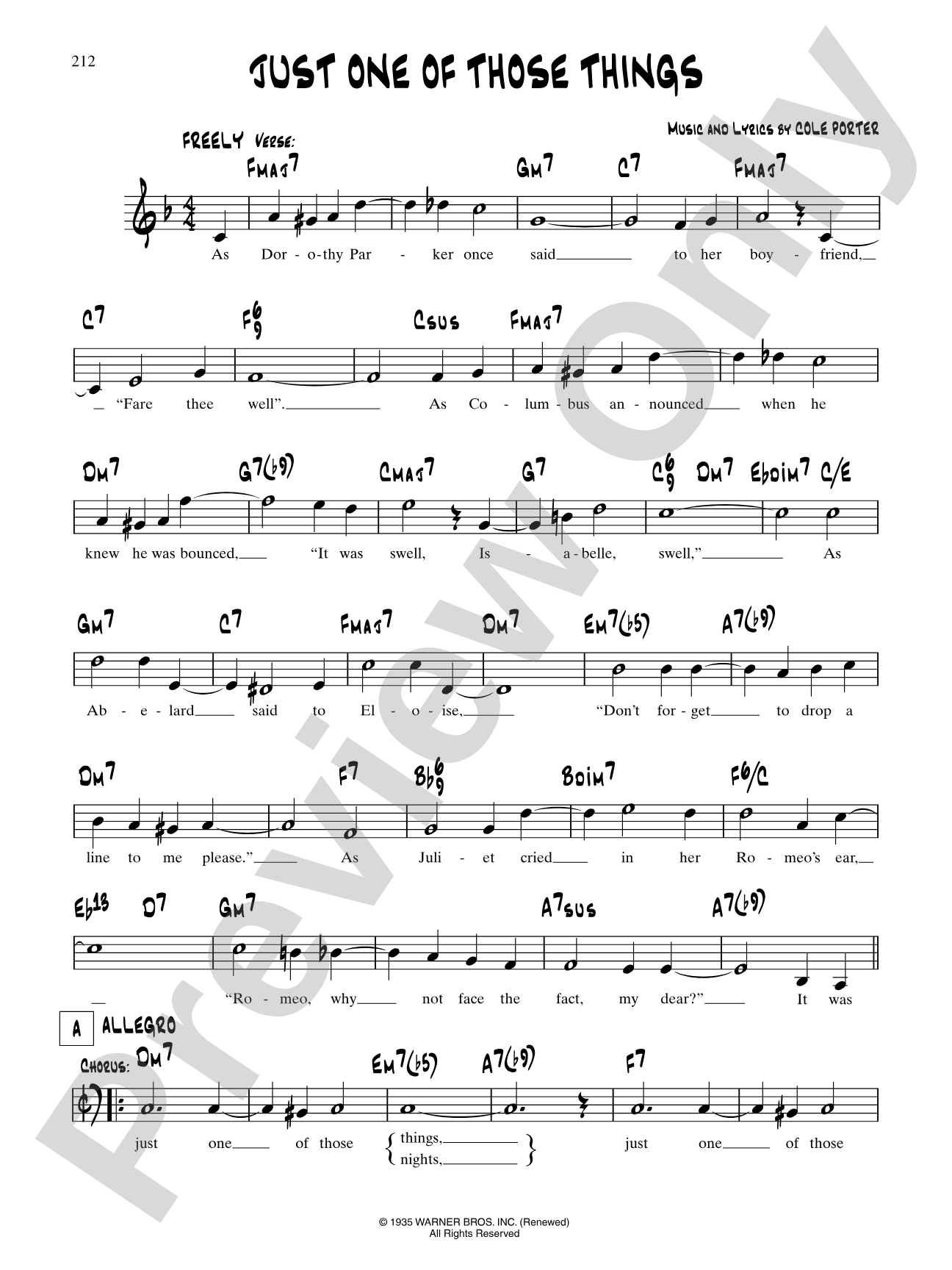

Just One Of Those Things (From "High Society"): Lead Sheet
Frank Sinatra
Item: 00-PSL-000259
$4.99
One moment…
Related Items
Day In Day Out: Lead Sheet |
$4.99
|
View | |
I Thought About You: Lead Sheet |
$4.99
|
View | |
Theme From "New York, New York": Lead Sheet |
$4.99
|
View | |
There's A Small Hotel (From "On Your Toes"): Lead Sheet |
$4.99
|
View | |
Nevertheless (I'm In Love With You): Lead Sheet |
$4.99
|
View | |
Falling In Love With Love (From "The Boys From Syracuse"): Lead Sheet |
$4.99
|
View | |
I Can't Get Started: Lead Sheet |
$4.99
|
View | |
I Could Write A Book (From "Pal Joey"): Lead Sheet |
$4.99
|
View | |
The Lady Is A Tramp: Lead Sheet |
$4.99
|
View | |
Love Is Here To Stay (From "Goldwyn Follies"): Lead Sheet |
$4.99
|
View | |
September Song (From "Knickerbocker Holiday"): Lead Sheet |
$4.99
|
View | |
Where Or When (From "Babes In Arms"): Lead Sheet |
$4.99
|
View | |
The Birth Of The Blues (From "George White's Scandals"): Lead Sheet |
$4.99
|
View | |
Dancing On The Ceiling (He Dances On My Ceiling) (From "Evergreen"): Lead Sheet |
$4.99
|
View | |
What Is This Thing Called Love?: Lead Sheet |
$4.99
|
View | |
You Do Something To Me (From "50 Million Frenchmen"): Lead Sheet |
$4.99
|
View | |
Night And Day: Lead Sheet |
$4.99
|
View | |
I Cover The Waterfront: Lead Sheet |
$4.99
|
View | |
It's Only A Paper Moon: Lead Sheet |
$4.99
|
View | |
I Get A Kick Out Of You (From "Anything Goes"): Lead Sheet |
$4.99
|
View | |
September In The Rain: Lead Sheet |
$4.99
|
View | |
Blues In The Night: Lead Sheet |
$4.99
|
View | |
Summer Wind: Lead Sheet |
$4.99
|
View | |
Embraceable You: Lead Sheet |
$4.99
|
View | |
Mack The Knife (English Version): Lead Sheet |
$4.99
|
View | |
My Kind Of Town (Chicago Is) (From "Robin & The 7 Hoods"): Lead Sheet |
$4.99
|
View | |
Just In Time: Lead Sheet |
$4.99
|
View | |
Speak Low Ne Folio: Lead Sheet |
$4.99
|
View | |
Come Rain Or Come Shine: Lead Sheet |
$4.99
|
View | |
At Long Last Love: Lead Sheet |
$4.99
|
View | |
In The Still Of The Night (From "Rosalie"): Lead Sheet |
$4.99
|
View | |
I've Got You Under My Skin: Lead Sheet |
$4.99
|
View | |
The Second Time Around: Lead Sheet |
$4.99
|
View | |
What Is This Thing Called Love?: Piano/Vocal/Chords |
$4.99
|
View | |
Just One Of Those Things (From "High Society"): Piano/Vocal/Chords |
$4.99
|
View | |
Night And Day: Piano/Vocal/Chords |
$4.99
|
View |
Description
This big folio contains seven pages of photos and a bio. Songs include: My Way * They Can't Take That Away from Me * Falling in Love with Love * The Lady Is a Tramp * Just in Time * New York, New York and many more!


Just One Of Those Things (From "High Society"): Lead Sheet isn't in MakeMusic Cloud just yet...but it could be. Let us know you'd like to see it, and you'll help shape what comes next. In the meantime, start a free trial and dive into thousands of interactive titles your students can play along with today.
Request This Title
Tell us you want it.
Start Your Free Trial
Explore everything that's ready to play right now.
Sample Audio
No sample audio found.
Sample Video
No sample videos found.
Additional Details
Publisher:
Alfred Music
Page Count:
360
SKU:
00-PSL-000259
More about this title
About the Artist: Cole Porter
Cole Porter (1891-1964) was an American composer and lyricist who fundamentally shaped the golden age of musical theater and the American songbook. Born into wealth in Indiana, Porter studied at Yale and later in Paris, where he absorbed European musical sophistication while maintaining a distinctly American voice. His songs are prized in music education for their harmonic complexity, witty lyrics, and enduring melodic appeal.
Porter's ability to write both music and words gave his compositions a seamless unity rare in theater music. His catalog includes standards that remain central to jazz, cabaret, and vocal repertoire instruction. Teachers value his work for demonstrating how song craft, harmonic innovation, and linguistic precision work together to create memorable art.
Why we love this
This lead sheet distills one of Porter's most elegant standards into a format that serves singers, pianists, and ensemble musicians equally well. The harmonic language rewards close attention; students encounter sophisticated chord changes and voice leading that improve their understanding of functional harmony and jazz tonality. Programming this alongside other American Songbook standards creates natural programming opportunities for vocal recitals, jazz ensembles, and cabaret-style concerts.
What to expect
Suave and observant, with the polish of a sophisticated conversation set to music. Porter's melody has a natural lilt that feels conversational rather than theatrical, and the harmonic palette suggests late-night venues, cocktail lounges, and the urbane New York sophistication for which he became known. The song breathes with an understated confidence that rewards singing without oversinging.
Who it's for
This lead sheet serves vocalists preparing standards repertoire, pianists accompanying singers in lessons or recitals, and jazz musicians exploring American Songbook material. It works equally well for music students developing sight-reading fluency with chord symbols and for experienced performers seeking a clean, accessible reference for arrangement or interpretation work.
How to get the most out of it
- Shape the melody with attention to Porter's lyrical phrasing rather than mechanical rhythmic accuracy; the natural speech rhythms of the lyric guide phrasing decisions.
- Approach the chord symbols as suggestions for harmonic color and reharmonization rather than fixed instructions; jazz conventions allow tasteful substitutions and voicing choices.
- Balance the piano accompaniment so it supports rather than overwhelms the vocal line; lead sheets work best when the accompaniment remains transparent.
- Honor the song's urbane, sophisticated character; avoid sentimental or overly emotional interpretations that contradict Porter's witty, observant tone.
How to use it
Feature this as a solo in a vocal recital or jazz concert exploring American songwriting across decades. It pairs naturally with other Porter standards or with songs by Gershwin and Rodgers to create a thematic concert around sophisticated lyric writing. The song also works well as a teaching piece in upper-level vocal or jazz harmony classes where students can analyze chord function and explore performance choices within the lead sheet format.
Skills your students will build
- Reading and interpreting chord symbols and jazz notation
- Harmonic analysis of chromatic movement and functional harmony in American standards
- Shaping vocal phrasing to match lyrical content and conversational rhythm
- Accompanying singers while maintaining rhythmic independence and harmonic flexibility