
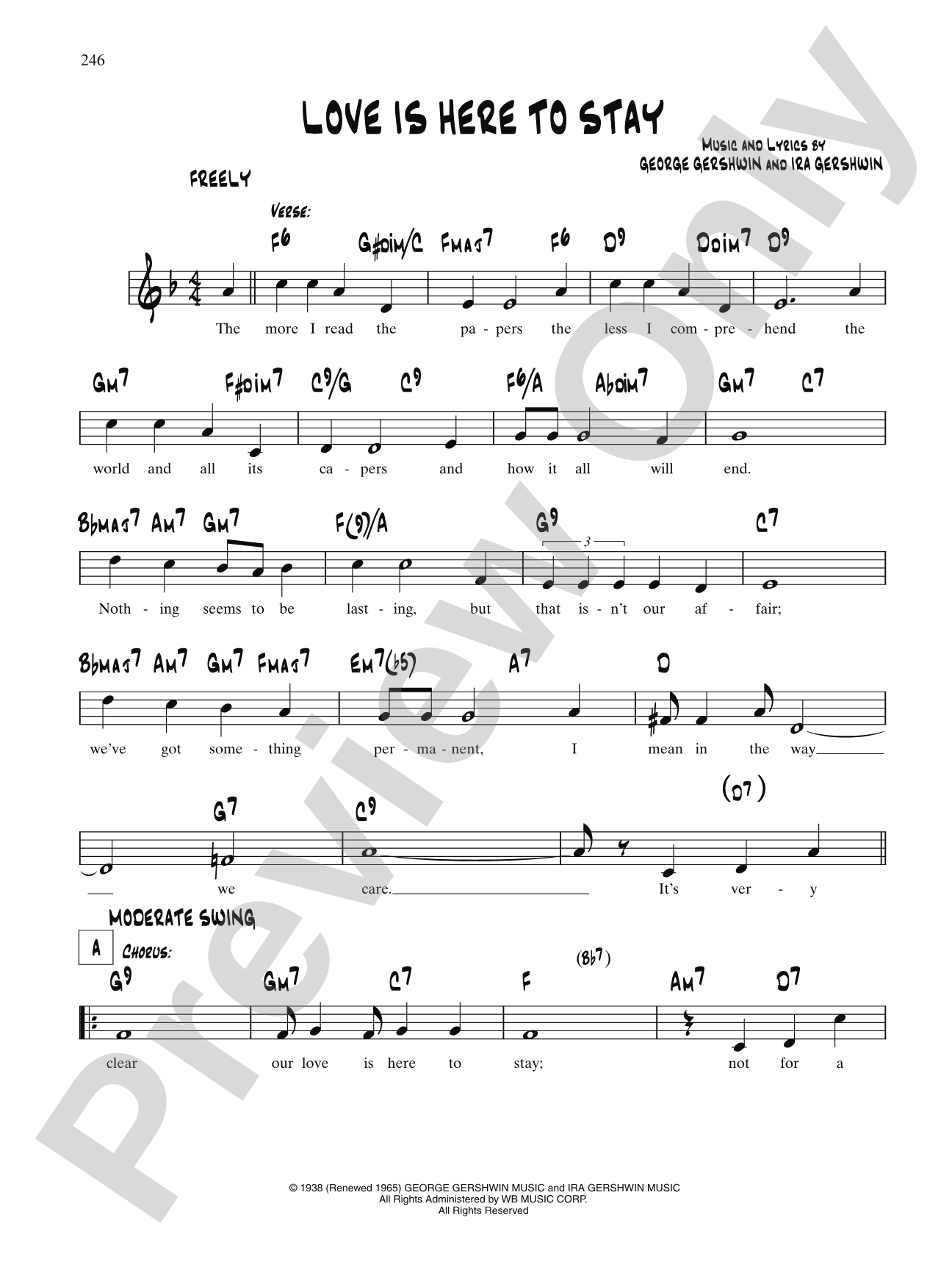

Love Is Here To Stay (From "Goldwyn Follies"): Lead Sheet
Frank Sinatra
Item: 00-PSL-000229
$4.99
One moment…
Related Items
Day In Day Out: Lead Sheet |
$4.99
|
View | |
I Thought About You: Lead Sheet |
$4.99
|
View | |
Theme From "New York, New York": Lead Sheet |
$4.99
|
View | |
There's A Small Hotel (From "On Your Toes"): Lead Sheet |
$4.99
|
View | |
Nevertheless (I'm In Love With You): Lead Sheet |
$4.99
|
View | |
Falling In Love With Love (From "The Boys From Syracuse"): Lead Sheet |
$4.99
|
View | |
I Can't Get Started: Lead Sheet |
$4.99
|
View | |
I Could Write A Book (From "Pal Joey"): Lead Sheet |
$4.99
|
View | |
The Lady Is A Tramp: Lead Sheet |
$4.99
|
View | |
September Song (From "Knickerbocker Holiday"): Lead Sheet |
$4.99
|
View | |
Where Or When (From "Babes In Arms"): Lead Sheet |
$4.99
|
View | |
The Birth Of The Blues (From "George White's Scandals"): Lead Sheet |
$4.99
|
View | |
Dancing On The Ceiling (He Dances On My Ceiling) (From "Evergreen"): Lead Sheet |
$4.99
|
View | |
What Is This Thing Called Love?: Lead Sheet |
$4.99
|
View | |
You Do Something To Me (From "50 Million Frenchmen"): Lead Sheet |
$4.99
|
View | |
Just One Of Those Things (From "High Society"): Lead Sheet |
$4.99
|
View | |
Night And Day: Lead Sheet |
$4.99
|
View | |
I Cover The Waterfront: Lead Sheet |
$4.99
|
View | |
It's Only A Paper Moon: Lead Sheet |
$4.99
|
View | |
I Get A Kick Out Of You (From "Anything Goes"): Lead Sheet |
$4.99
|
View | |
September In The Rain: Lead Sheet |
$4.99
|
View | |
Blues In The Night: Lead Sheet |
$4.99
|
View | |
Summer Wind: Lead Sheet |
$4.99
|
View | |
Embraceable You: Lead Sheet |
$4.99
|
View | |
Mack The Knife (English Version): Lead Sheet |
$4.99
|
View | |
My Kind Of Town (Chicago Is) (From "Robin & The 7 Hoods"): Lead Sheet |
$4.99
|
View | |
Just In Time: Lead Sheet |
$4.99
|
View | |
Speak Low Ne Folio: Lead Sheet |
$4.99
|
View | |
Come Rain Or Come Shine: Lead Sheet |
$4.99
|
View | |
At Long Last Love: Lead Sheet |
$4.99
|
View | |
In The Still Of The Night (From "Rosalie"): Lead Sheet |
$4.99
|
View | |
I've Got You Under My Skin: Lead Sheet |
$4.99
|
View | |
The Second Time Around: Lead Sheet |
$4.99
|
View | |
What Is This Thing Called Love?: Piano/Vocal/Chords |
$4.99
|
View | |
Just One Of Those Things (From "High Society"): Piano/Vocal/Chords |
$4.99
|
View | |
Night And Day: Piano/Vocal/Chords |
$4.99
|
View |
Description
This big folio contains seven pages of photos and a bio. Songs include: My Way * They Can't Take That Away from Me * Falling in Love with Love * The Lady Is a Tramp * Just in Time * New York, New York and many more!


Love Is Here To Stay (From "Goldwyn Follies"): Lead Sheet isn't in MakeMusic Cloud just yet...but it could be. Let us know you'd like to see it, and you'll help shape what comes next. In the meantime, start a free trial and dive into thousands of interactive titles your students can play along with today.
Request This Title
Tell us you want it.
Start Your Free Trial
Explore everything that's ready to play right now.
Sample Audio
No sample audio found.
Sample Video
No sample videos found.
Additional Details
Publisher:
Alfred Music
Page Count:
360
SKU:
00-PSL-000229
More about this title
About the Artist: George Gershwin
George Gershwin (1898-1937) bridged classical and popular music with a fluency that few composers have matched. His command of jazz idioms, sophisticated harmonies, and memorable melodies made him a central figure in American music, equally at home writing concert works like Rhapsody in Blue and creating standards for Broadway and Hollywood that remain central to the jazz and vocal repertoire today.
As both composer and pianist, Gershwin understood how to write for singers and jazz musicians. His work with lyricist Ira Gershwin produced some of the twentieth century's most enduring songs, pieces that reward close harmonic study and offer performers endless interpretive possibility.
Why we love this
This collection gathers some of the most essential American standards in a single, practical volume. Singers and pianists will find themselves returning to these pieces throughout their performing lives, and the lead sheet format gives both performers the harmonic transparency needed to develop personal interpretations. The Gershwin catalog here represents the gold standard for what great popular song writing can accomplish.
What to expect
These songs carry the sophisticated elegance of 1930s New York and Hollywood—witty, urbane, and deeply romantic by turns. There is a clarity and directness to the melody writing that makes these pieces immediately singable, yet the harmonic language beneath suggests depths that reward repeated listening and study.
Who it's for
Vocalists building a standards repertoire and pianists who accompany singers will find this collection indispensable. Jazz students, musical theater performers, and any musician exploring American popular song deserve ready access to these melodies and chord changes.
How to get the most out of it
- Honor the implicit swing in the rhythmic notation; these songs breathe more freely than a strict reading suggests, especially in the verses and transitions.
- Study the chord extensions and substitutions carefully—they reveal Gershwin's jazz sophistication and offer harmonic landing points that will deepen your interpretation.
- Treat the melody as a conversation with the harmony rather than a separate element; the interplay between them is where much of the song's personality lives.
- Work from a recorded reference to absorb the traditional phrasing and rubato, then make deliberate choices about where to honor or reshape those conventions.
How to use it
Include selections from this collection in jazz recitals, cabaret-style programs, or as encore material in vocal concerts. This material also serves beautifully in collaborative student recitals pairing singers with pianists, and individual songs work well as pedagogical pieces for exploring jazz harmony and American song style.
Skills your students will build
- Reading chord symbols and realizing jazz harmonies on piano
- Understanding the relationship between melody and underlying harmonic movement
- Interpreting swing rhythms and jazz phrasing in a vocal context
- Developing stylistically informed accompaniment that supports but doesn't overwhelm the singer
- Building fluency with the harmonic language of mid-century American popular song