
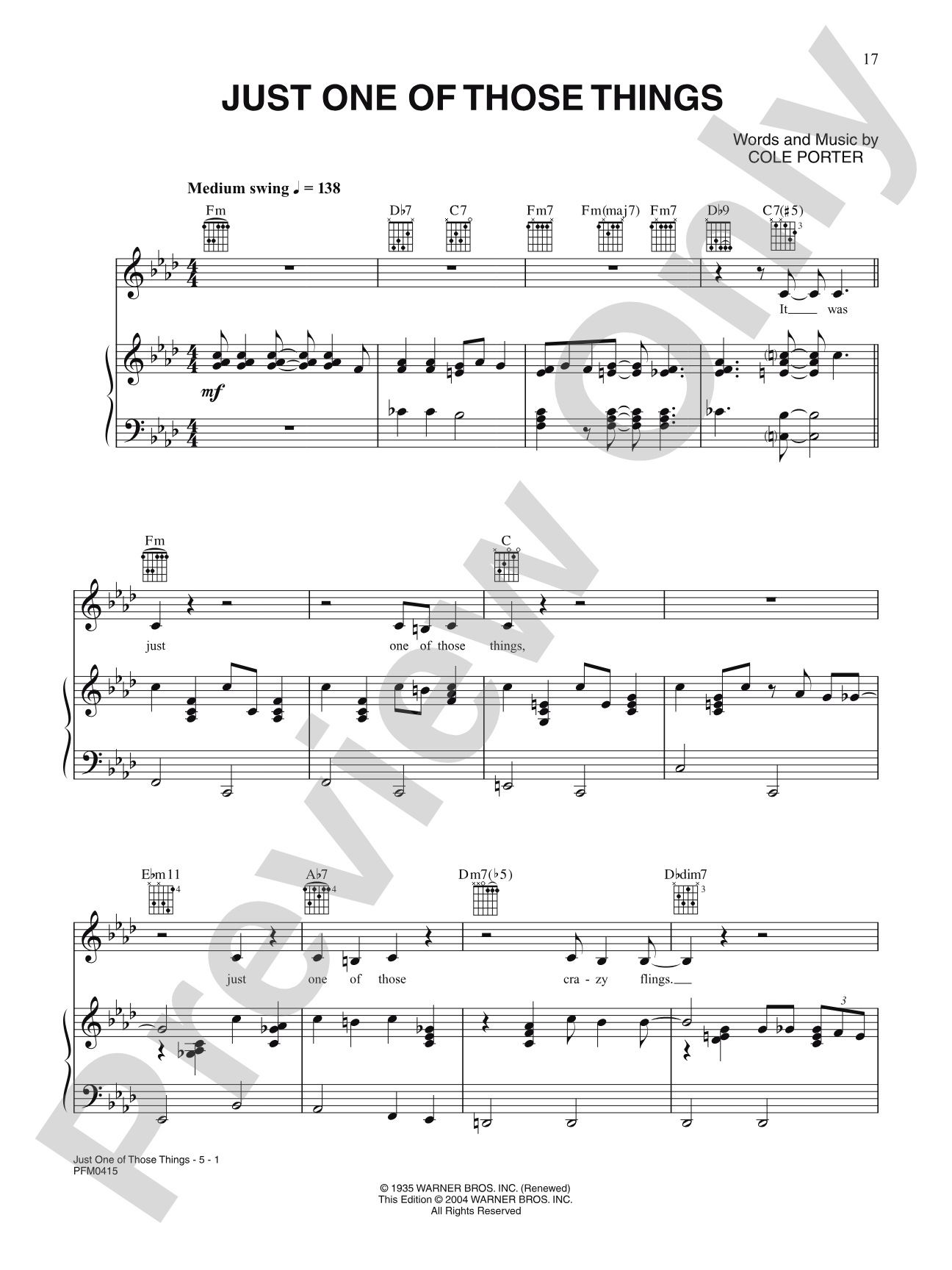

Just One Of Those Things (From "High Society"): Piano/Vocal/Chords
Frank Sinatra
Item: 00-PSP-000334
$4.99
One moment…
Related Items
Day In Day Out: Lead Sheet |
$4.99
|
View | |
I Thought About You: Lead Sheet |
$4.99
|
View | |
Theme From "New York, New York": Lead Sheet |
$4.99
|
View | |
There's A Small Hotel (From "On Your Toes"): Lead Sheet |
$4.99
|
View | |
Nevertheless (I'm In Love With You): Lead Sheet |
$4.99
|
View | |
Falling In Love With Love (From "The Boys From Syracuse"): Lead Sheet |
$4.99
|
View | |
I Can't Get Started: Lead Sheet |
$4.99
|
View | |
I Could Write A Book (From "Pal Joey"): Lead Sheet |
$4.99
|
View | |
The Lady Is A Tramp: Lead Sheet |
$4.99
|
View | |
Love Is Here To Stay (From "Goldwyn Follies"): Lead Sheet |
$4.99
|
View | |
September Song (From "Knickerbocker Holiday"): Lead Sheet |
$4.99
|
View | |
Where Or When (From "Babes In Arms"): Lead Sheet |
$4.99
|
View | |
The Birth Of The Blues (From "George White's Scandals"): Lead Sheet |
$4.99
|
View | |
Dancing On The Ceiling (He Dances On My Ceiling) (From "Evergreen"): Lead Sheet |
$4.99
|
View | |
What Is This Thing Called Love?: Lead Sheet |
$4.99
|
View | |
You Do Something To Me (From "50 Million Frenchmen"): Lead Sheet |
$4.99
|
View | |
Just One Of Those Things (From "High Society"): Lead Sheet |
$4.99
|
View | |
Night And Day: Lead Sheet |
$4.99
|
View | |
I Cover The Waterfront: Lead Sheet |
$4.99
|
View | |
It's Only A Paper Moon: Lead Sheet |
$4.99
|
View | |
I Get A Kick Out Of You (From "Anything Goes"): Lead Sheet |
$4.99
|
View | |
September In The Rain: Lead Sheet |
$4.99
|
View | |
Blues In The Night: Lead Sheet |
$4.99
|
View | |
Summer Wind: Lead Sheet |
$4.99
|
View | |
Embraceable You: Lead Sheet |
$4.99
|
View | |
Mack The Knife (English Version): Lead Sheet |
$4.99
|
View | |
My Kind Of Town (Chicago Is) (From "Robin & The 7 Hoods"): Lead Sheet |
$4.99
|
View | |
Just In Time: Lead Sheet |
$4.99
|
View | |
Speak Low Ne Folio: Lead Sheet |
$4.99
|
View | |
Come Rain Or Come Shine: Lead Sheet |
$4.99
|
View | |
At Long Last Love: Lead Sheet |
$4.99
|
View | |
In The Still Of The Night (From "Rosalie"): Lead Sheet |
$4.99
|
View | |
I've Got You Under My Skin: Lead Sheet |
$4.99
|
View | |
The Second Time Around: Lead Sheet |
$4.99
|
View | |
What Is This Thing Called Love?: Piano/Vocal/Chords |
$4.99
|
View | |
Night And Day: Piano/Vocal/Chords |
$4.99
|
View |
Description
This big folio contains seven pages of photos and a bio. Songs include: My Way * They Can't Take That Away from Me * Falling in Love with Love * The Lady Is a Tramp * Just in Time * New York, New York and many more!


Just One Of Those Things (From "High Society"): Piano/Vocal/Chords isn't in MakeMusic Cloud just yet...but it could be. Let us know you'd like to see it, and you'll help shape what comes next. In the meantime, start a free trial and dive into thousands of interactive titles your students can play along with today.
Request This Title
Tell us you want it.
Start Your Free Trial
Explore everything that's ready to play right now.
Sample Audio
No sample audio found.
Sample Video
No sample videos found.
Additional Details
Publisher:
Alfred Music
Page Count:
360
SKU:
00-PSP-000334
More about this title
About the Artist: Cole Porter
Cole Porter (1891-1964) was an American composer and lyricist whose sophisticated wit and inventive harmonies defined the Golden Age of musical theater. Born into wealth in Peru, Indiana, Porter studied at Yale and Harvard before establishing himself on Broadway and in Hollywood, where his songs became standards performed by everyone from Ella Fitzgerald to Frank Sinatra. His ability to marry elegant, often complex musical ideas with clever, urbane lyrics set him apart from his contemporaries and made his work enduringly popular in jazz, pop, and theater contexts.
Porter's catalog includes some of the most frequently performed songs in American music education and performance. His harmonic language rewards careful study: unexpected chord progressions, chromatic movements, and jazz influences run through pieces like "Just One of Those Things" and "The Lady Is a Tramp." For pianists and vocalists, his music demands both technical facility and interpretive sophistication.
Why we love this
Porter's standards represent some of the most rewarding material for student pianists and singers who are ready for jazz-influenced harmony and sophisticated phrasing. The piano arrangements provide excellent grounding in jazz voicings and comping patterns while the vocal line sits naturally in the voice, allowing singers to focus on interpretation and style rather than vocal strain. These songs open doors to understanding American popular music as serious artistic material.
What to expect
Porter's world is urbane, witty, and unmistakably sophisticated. These songs move with the ease of conversation, yet every harmonic turn and lyrical phrase carries intention. There's an elegance here that never feels stiff; instead, these pieces invite playfulness and personal expression within their carefully crafted structures.
Who it's for
This collection serves pianists and singers with intermediate to advanced skills who are exploring the American songbook and jazz standards repertoire. It works equally well for solo vocalists preparing recital material, accompanists developing their skill with jazz chords, and students studying the harmonic language of early-to-mid 20th-century popular music.
How to get the most out of it
- Pay close attention to Porter's harmonic movement in the chord symbols. Many changes happen quickly, and slight hesitations between chords can disrupt the song's flow; practice moving smoothly through progressions before adding tempo.
- Treat the melody as a conversation with the accompaniment rather than a separate line. Porter's arrangements often weave the piano part into the vocal phrasing, so coordinate dynamics and breathing with what the keyboard is doing.
- Listen to multiple recordings (Sinatra, Fitzgerald, Tony Bennett) to hear how different performers navigate the rhythmic flexibility and phrasing of each song. Porter's music invites personal interpretation.
How to use it
Program Porter standards as the centerpiece of a jazz or American songbook recital, or integrate individual pieces into a variety concert to demonstrate how classical training applies to popular repertoire. These songs also work beautifully as encore material or in cabaret-style programming where smaller, intimate settings highlight the wit and sophistication of the writing.
Skills your students will build
- Reading and comping jazz chord progressions and extended harmonies
- Phrasing and rhythmic flexibility across different tempos and styles
- Coordinating vocal line with piano accompaniment in standards-based repertoire
- Interpreting text and translating lyrical meaning into musical expression
- Navigating chromatic movement and unexpected harmonic resolutions