
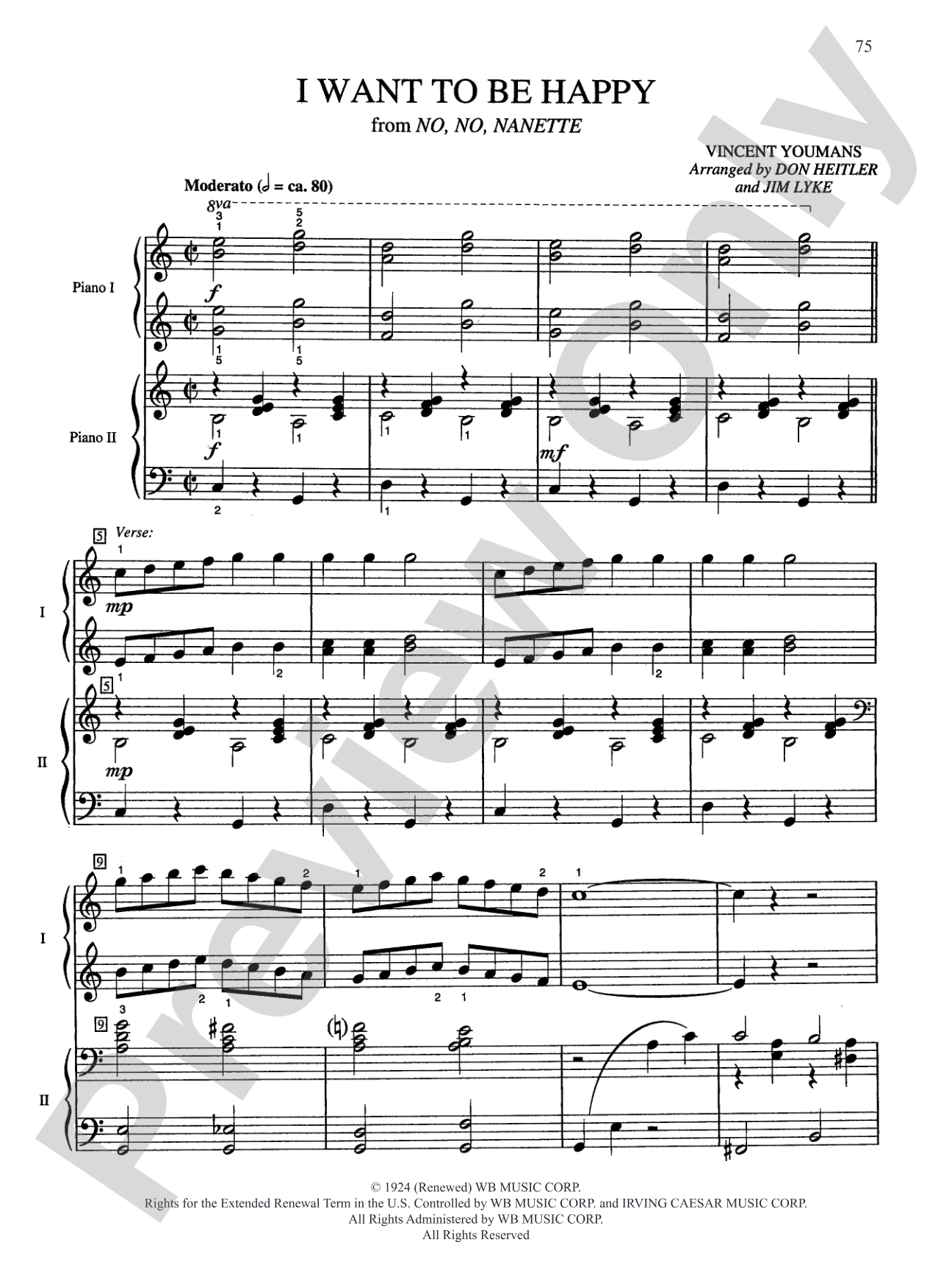
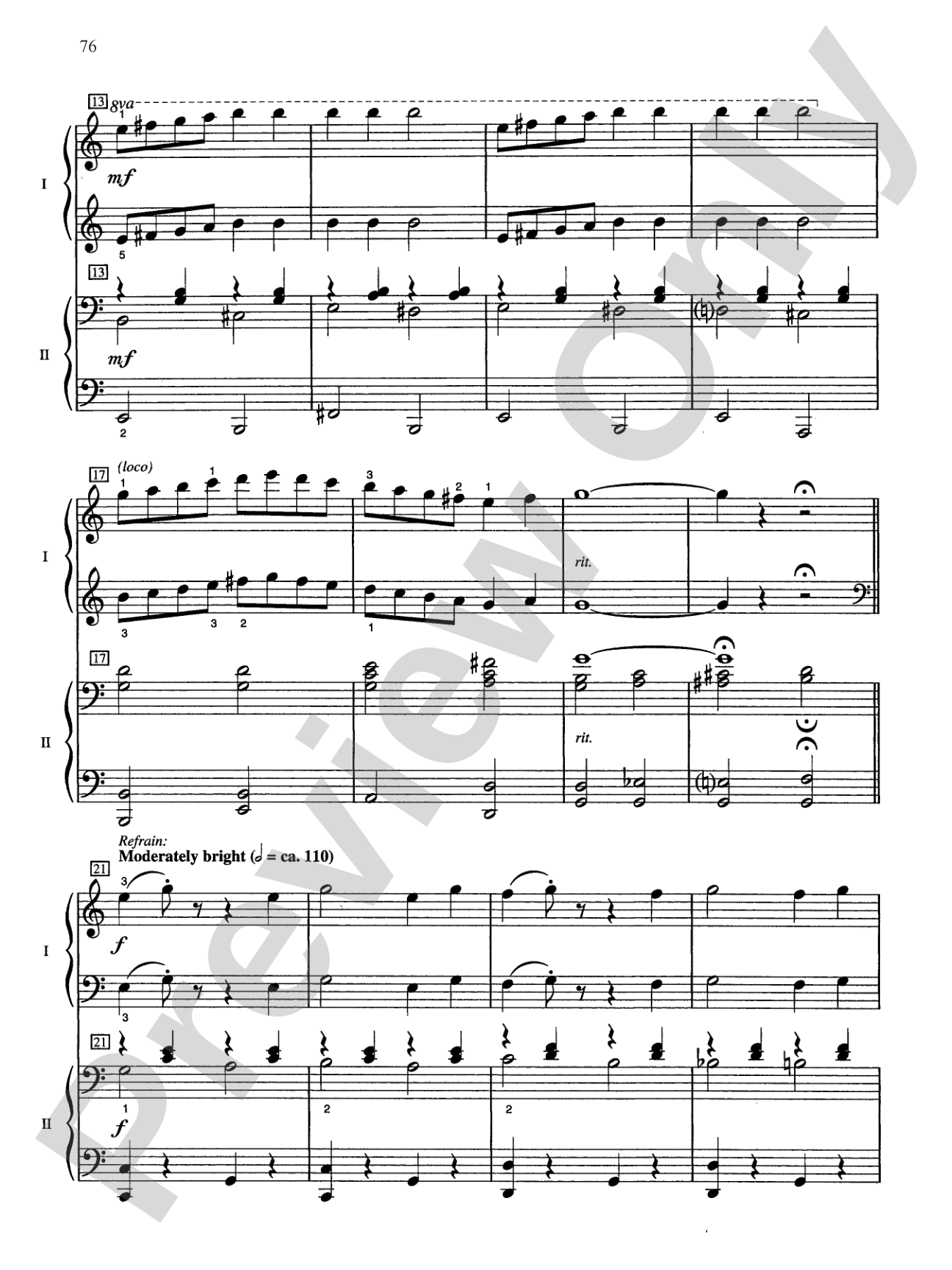

I Want to Be Happy (from "No, No, Nanette") - Piano Duo (2 Pianos, 4 Hands): Piano Duo (2 Pianos, 4 Hands)
Selections by George and Ira Gershwin, Thomas "Fats" Waller, Scott Joplin, Irving Berlin, Jerome Kern and More
Arr. Jim Lyke, Geoff Haydon, Don Heitler, and John Arpin
Level: Intermediate / Late Intermediate
Item: 00-PS-0017299
$5.99
One moment…
Related Items
Ain't Misbehavin' (from "Ain't Misbehavin'") - Piano Duo (2 Pianos, 4 Hands): Piano Duo (2 Pianos, 4 Hands) |
$5.99
|
View | |
Alexander's Ragtime Band - Piano Duo (2 Pianos, 4 Hands): Piano Duo (2 Pianos, 4 Hands) |
$9.99
|
View | |
America, the Beautiful - Piano Duo (2 Pianos, 4 Hands): Piano Duo (2 Pianos, 4 Hands) |
$5.99
|
View | |
By Strauss (from "The Show Is On") - Piano Duo (2 Pianos, 4 Hands): Piano Duo (2 Pianos, 4 Hands) |
$5.99
|
View | |
Everybody's Doing It Now - Piano Duo (2 Pianos, 4 Hands): Piano Duo (2 Pianos, 4 Hands) |
$5.99
|
View | |
Look for the Silver Lining - Piano Duo (2 Pianos, 4 Hands): Piano Duo (2 Pianos, 4 Hands) |
$5.99
|
View | |
Nobody but You (from "La La Lucille") - Piano Duo (2 Pianos, 4 Hands): Piano Duo (2 Pianos, 4 Hands) |
$4.99
|
View | |
Pineapple Rag - Piano Duo (2 Pianos, 4 Hands): Piano Duo (2 Pianos, 4 Hands) |
$9.99
|
View | |
Solace - A Mexican Serenade - Piano Duo (2 Pianos, 4 Hands): Piano Duo (2 Pianos, 4 Hands) |
$9.99
|
View | |
Swanee - Piano Duo (2 Pianos, 4 Hands): Piano Duo (2 Pianos, 4 Hands) |
$5.99
|
View | |
The Easy Winners - Piano Duo (2 Pianos, 4 Hands): Piano Duo (2 Pianos, 4 Hands) |
$9.99
|
View | |
When the Midnight Choo Choo Leaves for Alabam' - Piano Duo (2 Pianos, 4 Hands): Piano Duo (2 Pianos, 4 Hands) |
$5.99
|
View | |
15 Arrangements of American Classics for Two Pianos, Four Hands: Piano Duo (2 Pianos, 4 Hands) Book (2 copies required) |
$17.95
|
View |
Description
The 15 American classics in this collection have been masterfully arranged for two pianos, four hands. Titles: Ain't Misbehavin' (Fats Waller) * Alexander's Ragtime Band (Irving Berlin) * America, the Beautiful (Katherine Lee Bates and Samuel A. Ward) * By Strauss (George Gershwin and Ira Gershwin) * The Easy Winners (Scott Joplin) * Everybody's Doing It Now (Irving Berlin) * Gladiolus Rag (Scott Joplin) * I Want to be Happy (Vincent Youmans) * Look for the Silver Lining (Jerome Kern) * Medley: Yankee Doodle Boy; Over There; You're a Grand Old Flag (George M. Cohan) * Nobody But You (George Gershwin) * Pineapple Rag (Scott Joplin) * Solace (Scott Joplin) * Swanee (George Gershwin) * When the Midnight Choo-Choo Leaves for Alabam' (Irving Berlin). 128 pages. A Federation Festivals 2024-2028 selection.


Discover MakeMusic Cloud: thousands of interactive titles your students can play along with today.
Sample Audio
No sample audio found.
Sample Video
No sample videos found.
Additional Details
Series:
Alfred's Classic Editions
Publisher:
Alfred Music
Page Count:
128
SKU:
00-PS-0017299
More about this title
About the Composer: Vincent Youmans
Vincent Youmans (1898–1946) composed some of Broadway's most enduring melodies during the 1920s and early 1930s. His gift for writing singable, memorable tunes made shows like "No, No, Nanette" and "Tea for Two" standards that have outlasted the theatrical trends of their era. Youmans worked across operetta, musical comedy, and film, leaving a catalog that rewards both performers and audiences with elegant harmonic language and dance-friendly rhythms.
For music education, Youmans' work offers accessible yet sophisticated material. His melodies sit naturally for singers, his harmonies teach functional tonality without heavy theory, and his rhythmic vitality keeps ensembles engaged. "I Want to Be Happy" exemplifies why his music remains standard repertoire in school and community settings.
Why we love this
This arrangement captures the snap and sophistication of early American popular song in a format that builds genuine collaboration between two pianists. Heitler and Lyke have distributed the material so both players stay engaged and visible, avoiding the typical primo-plus-accompaniment hierarchy. The collection's breadth, spanning rags, patriotic songs, and Broadway hits, gives intermediate pianists a chance to explore the American songbook together without requiring advanced technique.
What to expect
Bright, spirited, and full of forward momentum. These are tunes written to move bodies and lift spirits, arranged here so both performers feel the rhythmic energy and harmonic warmth. There's a conversational quality throughout, as if two friends are trading solos and weaving threads of melody back and forth across the two pianos.
Who it's for
Two intermediate to late-intermediate pianists working together in a studio setting or preparing for a duo recital. This collection appeals to pianists who want to build their ensemble skills while exploring accessible American repertoire without heavy technical demands. It's also ideal for music teachers and advanced students seeking quality duet material that's singable, engaging, and stylistically varied.
How to get the most out of it
- Balance the melodic line between the two pianos. If the arrangement splits the tune, resist the urge to spotlight one player; instead, listen carefully so the melody emerges as a single voice even when it's distributed across the keyboards.
- Lock the rhythmic foundation first. Before polishing dynamics or phrasing, sit down and play slowly enough to coordinate articulation in the accompaniment figures, especially in ragtime pieces where syncopation can cloud the beat.
- Shape the phrasing as if you were singing the tune together. Breathe at natural phrase breaks, taper toward cadences, and resist mechanical repetition of accompanimental patterns, even when the notation stays the same for several measures.
- Record yourselves and listen back. Piano duo textures can sound muddy if players aren't hearing the full harmonic picture; a playback often reveals balance issues that are harder to catch in real time.
How to use it
Program individual pieces from this collection as audience warmers at the top of a recital, or build an entire set around American song styles. Pair selections with works in similar styles by other composers, or use them to open a themed concert on popular music and musical theater. The variety also makes this useful for studio recitals where multiple two-piano duos perform in one evening.
Skills your students will build
- Listening and balancing texture between two keyboard instruments
- Coordinating rhythmic figures and syncopation across two separate pianos
- Shaping melodic phrasing collaboratively rather than as soloist-plus-accompaniment
- Sight-reading duet scores and understanding the relationship between primo and secondo parts
- Interpreting styles from ragtime, Broadway, and early 20th-century American song