
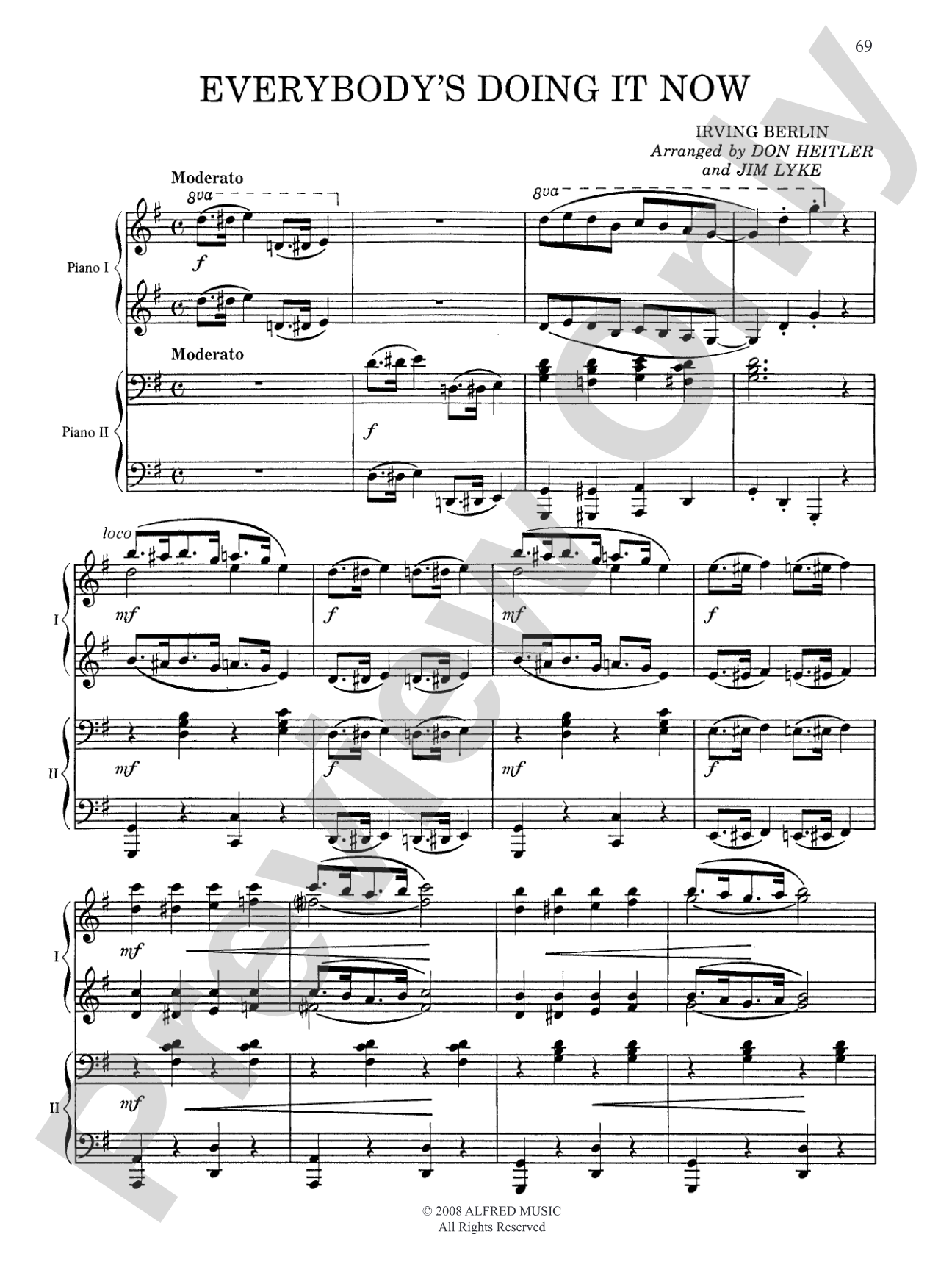
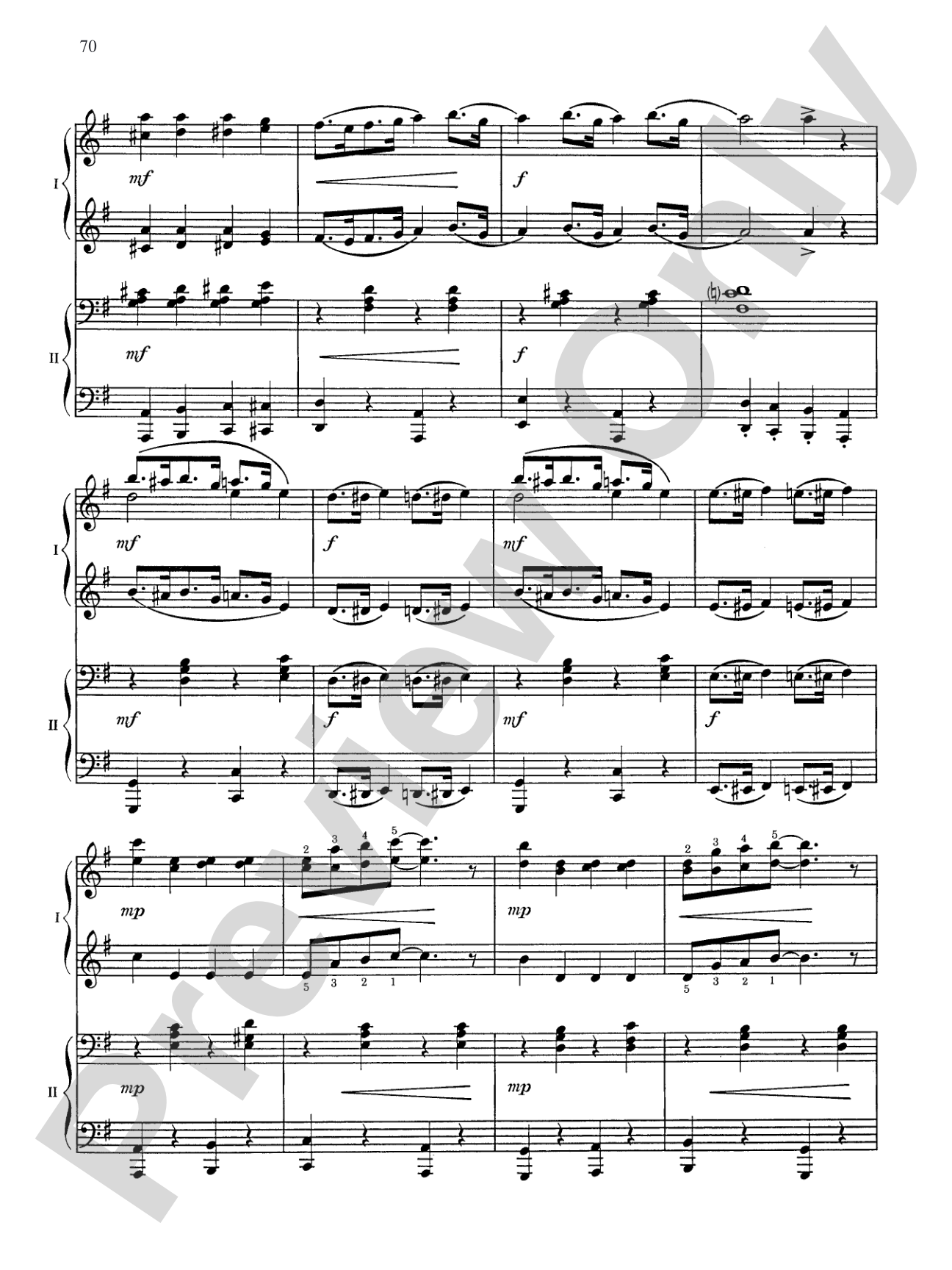

Everybody's Doing It Now - Piano Duo (2 Pianos, 4 Hands): Piano Duo (2 Pianos, 4 Hands)
Selections by George and Ira Gershwin, Thomas "Fats" Waller, Scott Joplin, Irving Berlin, Jerome Kern and More
Arr. Jim Lyke, Geoff Haydon, Don Heitler, and John Arpin
Level: Intermediate / Late Intermediate
Item: 00-PS-0017298
$5.99
One moment…
Related Items
Ain't Misbehavin' (from "Ain't Misbehavin'") - Piano Duo (2 Pianos, 4 Hands): Piano Duo (2 Pianos, 4 Hands) |
$5.99
|
View | |
Alexander's Ragtime Band - Piano Duo (2 Pianos, 4 Hands): Piano Duo (2 Pianos, 4 Hands) |
$9.99
|
View | |
America, the Beautiful - Piano Duo (2 Pianos, 4 Hands): Piano Duo (2 Pianos, 4 Hands) |
$5.99
|
View | |
By Strauss (from "The Show Is On") - Piano Duo (2 Pianos, 4 Hands): Piano Duo (2 Pianos, 4 Hands) |
$5.99
|
View | |
I Want to Be Happy (from "No, No, Nanette") - Piano Duo (2 Pianos, 4 Hands): Piano Duo (2 Pianos, 4 Hands) |
$5.99
|
View | |
Look for the Silver Lining - Piano Duo (2 Pianos, 4 Hands): Piano Duo (2 Pianos, 4 Hands) |
$5.99
|
View | |
Nobody but You (from "La La Lucille") - Piano Duo (2 Pianos, 4 Hands): Piano Duo (2 Pianos, 4 Hands) |
$4.99
|
View | |
Pineapple Rag - Piano Duo (2 Pianos, 4 Hands): Piano Duo (2 Pianos, 4 Hands) |
$9.99
|
View | |
Solace - A Mexican Serenade - Piano Duo (2 Pianos, 4 Hands): Piano Duo (2 Pianos, 4 Hands) |
$9.99
|
View | |
Swanee - Piano Duo (2 Pianos, 4 Hands): Piano Duo (2 Pianos, 4 Hands) |
$5.99
|
View | |
The Easy Winners - Piano Duo (2 Pianos, 4 Hands): Piano Duo (2 Pianos, 4 Hands) |
$9.99
|
View | |
When the Midnight Choo Choo Leaves for Alabam' - Piano Duo (2 Pianos, 4 Hands): Piano Duo (2 Pianos, 4 Hands) |
$5.99
|
View | |
15 Arrangements of American Classics for Two Pianos, Four Hands: Piano Duo (2 Pianos, 4 Hands) Book (2 copies required) |
$17.95
|
View |
Description
The 15 American classics in this collection have been masterfully arranged for two pianos, four hands. Titles: Ain't Misbehavin' (Fats Waller) * Alexander's Ragtime Band (Irving Berlin) * America, the Beautiful (Katherine Lee Bates and Samuel A. Ward) * By Strauss (George Gershwin and Ira Gershwin) * The Easy Winners (Scott Joplin) * Everybody's Doing It Now (Irving Berlin) * Gladiolus Rag (Scott Joplin) * I Want to be Happy (Vincent Youmans) * Look for the Silver Lining (Jerome Kern) * Medley: Yankee Doodle Boy; Over There; You're a Grand Old Flag (George M. Cohan) * Nobody But You (George Gershwin) * Pineapple Rag (Scott Joplin) * Solace (Scott Joplin) * Swanee (George Gershwin) * When the Midnight Choo-Choo Leaves for Alabam' (Irving Berlin). 128 pages. A Federation Festivals 2024-2028 selection.


Discover MakeMusic Cloud: thousands of interactive titles your students can play along with today.
Sample Audio
No sample audio found.
Sample Video
No sample videos found.
Additional Details
Series:
Alfred's Classic Editions
Publisher:
Alfred Music
Page Count:
128
SKU:
00-PS-0017298
More about this title
About the Composer: Irving Berlin
Irving Berlin (1888-1989) composed some of the most recognizable melodies in American popular music, with a catalog spanning Broadway, film, and Tin Pan Alley standards. Self-taught as a musician, Berlin developed an instinctive gift for melody and rhythm that made his songs immediately singable and enduringly memorable. His work defined the sound of early 20th-century American music and continues to anchor repertoire for performers at every level.
Berlin's compositions appear in concert halls, rehearsal rooms, and recital studios worldwide because they balance accessibility with genuine sophistication. Teachers and students value his music for its historical importance, its technical clarity, and the pure joy it brings to performers and audiences alike.
Why we love this
This collection captures the brilliance of Berlin and his contemporaries (Gershwin, Joplin, Kern, Youmans) in arrangements that let two pianists share the spotlight equally. The mix of rags, standards, and patriotic favorites gives ensembles genuine variety within a single book, making it ideal for recitals, competitions, or collaborative programming without feeling scattered or theme-bound.
What to expect
These 15 selections pulse with the optimism and infectious energy of early American popular song. Ragtime syncopation sits comfortably alongside Broadway elegance, creating a collection that feels both nostalgic and immediately engaging—music that makes pianists want to move and audiences want to listen.
Who it's for
Intermediate and late-intermediate pianists looking for compelling duet repertoire that reflects real American songwriting tradition. Two pianists preparing for recitals, competitions, or ensemble performances will find music that rewards collaborative practice while remaining technically accessible.
How to get the most out of it
- Establish clear leadership between players before rehearsing passages where one pianist carries the melody and the other provides rhythmic or harmonic support. Consistent eye contact during these transitions prevents hesitation and maintains forward momentum.
- Listen actively to balance the two pianos, especially in pieces where one instrument plays ragtime syncopation while the other anchors the harmonic foundation. Neither pianist should dominate; the music lives in the conversation between the two.
- Work through tempo and dynamic markings together as a team. What reads as "moderate" at one piano may feel quite different at the other, so agree on a shared interpretation before the final run-through.
- Pay particular attention to rhythm sections where the ensemble straddles stride patterns and syncopation. Precision here gives the arrangement its swagger and prevents the piece from feeling loose or rhythmically uncertain.
How to use it
Program selections from this book as a complete set for a recital devoted to American standards, or build a mixed concert by pairing individual pieces with solo repertoire or other ensembles. Its breadth makes it equally useful for a themed competition class or a festival program celebrating American music.
Skills your students will build
- Two-piano coordination and ensemble communication
- Ragtime syncopation and stride piano techniques
- Rhythmic independence between left and right hands across two instruments
- Balancing melody and accompaniment roles within a duet texture
- Sight-reading and score literacy for intermediate pianists