
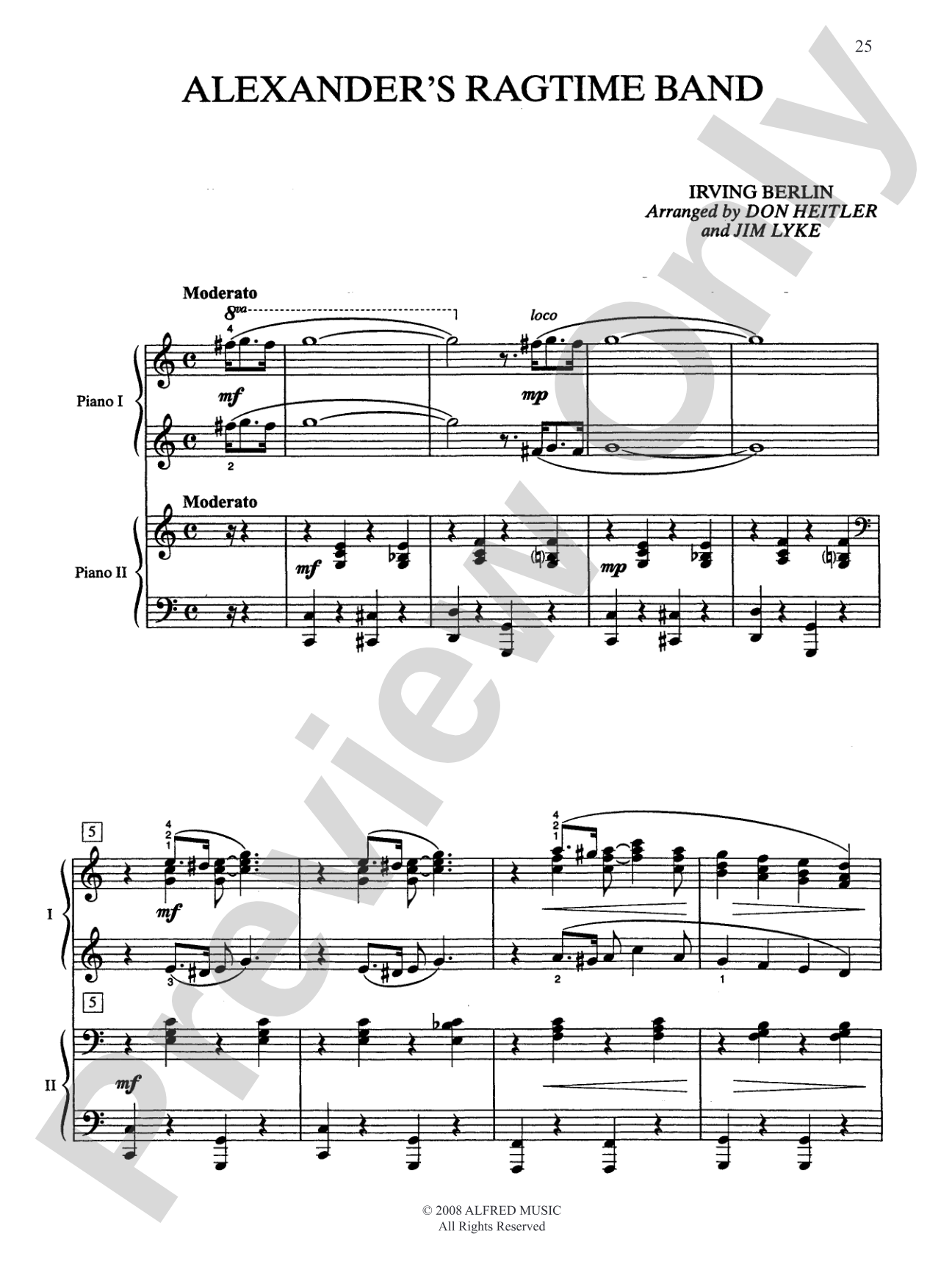
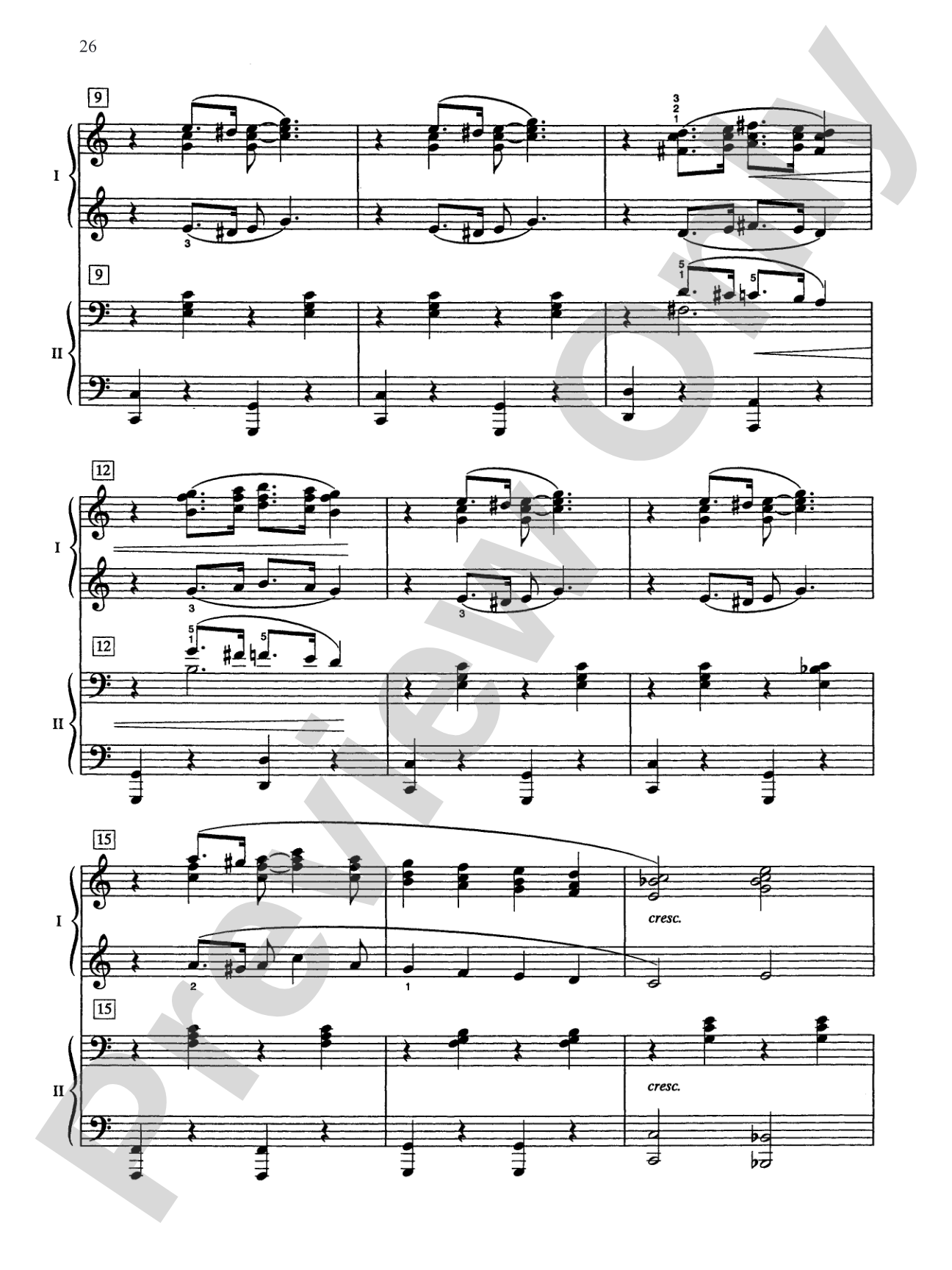

Alexander's Ragtime Band - Piano Duo (2 Pianos, 4 Hands): Piano Duo (2 Pianos, 4 Hands)
Selections by George and Ira Gershwin, Thomas "Fats" Waller, Scott Joplin, Irving Berlin, Jerome Kern and More
Arr. Jim Lyke, Geoff Haydon, Don Heitler, and John Arpin
Level: Intermediate / Late Intermediate
Item: 00-PS-0017295
$9.99
One moment…
Related Items
Ain't Misbehavin' (from "Ain't Misbehavin'") - Piano Duo (2 Pianos, 4 Hands): Piano Duo (2 Pianos, 4 Hands) |
$5.99
|
View | |
America, the Beautiful - Piano Duo (2 Pianos, 4 Hands): Piano Duo (2 Pianos, 4 Hands) |
$5.99
|
View | |
By Strauss (from "The Show Is On") - Piano Duo (2 Pianos, 4 Hands): Piano Duo (2 Pianos, 4 Hands) |
$5.99
|
View | |
Everybody's Doing It Now - Piano Duo (2 Pianos, 4 Hands): Piano Duo (2 Pianos, 4 Hands) |
$5.99
|
View | |
I Want to Be Happy (from "No, No, Nanette") - Piano Duo (2 Pianos, 4 Hands): Piano Duo (2 Pianos, 4 Hands) |
$5.99
|
View | |
Look for the Silver Lining - Piano Duo (2 Pianos, 4 Hands): Piano Duo (2 Pianos, 4 Hands) |
$5.99
|
View | |
Nobody but You (from "La La Lucille") - Piano Duo (2 Pianos, 4 Hands): Piano Duo (2 Pianos, 4 Hands) |
$4.99
|
View | |
Pineapple Rag - Piano Duo (2 Pianos, 4 Hands): Piano Duo (2 Pianos, 4 Hands) |
$9.99
|
View | |
Solace - A Mexican Serenade - Piano Duo (2 Pianos, 4 Hands): Piano Duo (2 Pianos, 4 Hands) |
$9.99
|
View | |
Swanee - Piano Duo (2 Pianos, 4 Hands): Piano Duo (2 Pianos, 4 Hands) |
$5.99
|
View | |
The Easy Winners - Piano Duo (2 Pianos, 4 Hands): Piano Duo (2 Pianos, 4 Hands) |
$9.99
|
View | |
When the Midnight Choo Choo Leaves for Alabam' - Piano Duo (2 Pianos, 4 Hands): Piano Duo (2 Pianos, 4 Hands) |
$5.99
|
View | |
15 Arrangements of American Classics for Two Pianos, Four Hands: Piano Duo (2 Pianos, 4 Hands) Book (2 copies required) |
$17.95
|
View |
Description
The 15 American classics in this collection have been masterfully arranged for two pianos, four hands. Titles: Ain't Misbehavin' (Fats Waller) * Alexander's Ragtime Band (Irving Berlin) * America, the Beautiful (Katherine Lee Bates and Samuel A. Ward) * By Strauss (George Gershwin and Ira Gershwin) * The Easy Winners (Scott Joplin) * Everybody's Doing It Now (Irving Berlin) * Gladiolus Rag (Scott Joplin) * I Want to be Happy (Vincent Youmans) * Look for the Silver Lining (Jerome Kern) * Medley: Yankee Doodle Boy; Over There; You're a Grand Old Flag (George M. Cohan) * Nobody But You (George Gershwin) * Pineapple Rag (Scott Joplin) * Solace (Scott Joplin) * Swanee (George Gershwin) * When the Midnight Choo-Choo Leaves for Alabam' (Irving Berlin). 128 pages. A Federation Festivals 2024-2028 selection.


Discover MakeMusic Cloud: thousands of interactive titles your students can play along with today.
Sample Audio
No sample audio found.
Sample Video
No sample videos found.
Additional Details
Series:
Alfred's Classic Editions
Publisher:
Alfred Music
Page Count:
128
SKU:
00-PS-0017295
More about this title
About the Composer: Irving Berlin
Irving Berlin (1888-1989) composed some of the most recognizable melodies in American popular music, from Broadway theater songs to patriotic standards. His gift for crafting singable, memorable tunes that appealed to mass audiences made him one of the most prolific and commercially successful composers of the 20th century. Berlin's work defined the sound of American popular song and remains a cornerstone of the standard repertoire that musicians of all ages encounter in rehearsal rooms and practice studios.
Beyond his compositional talent, Berlin was an innovator who understood exactly what audiences wanted to hear. His influence extends across generations of musicians because his melodies are genuinely good; they sit well on instruments, they engage performers and listeners alike, and they have proven their staying power across nearly a century and a half.
Why we love this
This collection offers something genuinely rare: a curated set of American classics that works beautifully across two pianos without sacrificing musical integrity. The arrangement choices by Heitler and Lyke preserve the character of each piece while creating engaging parts that keep both pianists equally invested. Programming these pieces allows ensembles to celebrate American musical heritage while building ensemble skills that often get overlooked in standard two-piano repertoire.
What to expect
These arrangements capture the energy, charm, and rhythmic vitality of early 20th-century American popular music without oversimplifying the piano writing. The rags shimmy with syncopation while maintaining musical respect for Joplin's compositional craft; the Berlin and Gershwin songs sparkle with wit and melodic appeal. Playing through this collection feels like stepping into a living room concert from a bygone era, complete with all the joy and personality that made these pieces beloved.
Who it's for
Piano duo partners at the intermediate to late intermediate level who want repertoire that showcases American song traditions and gives both players equally satisfying material to perform. Teachers and coaches working with advanced high school pianists or undergraduate music majors will find this collection offers excellent variety for recitals, festivals, and competitions. This book also serves pianists preparing for chamber music requirements or those looking to expand beyond European classical duet repertoire.
How to get the most out of it
- Balance the melodic lines between the two pianos by listening closely during rehearsals; the arrangement passes material between the instruments, and clarity depends on both players understanding who carries the tune at each moment.
- Establish a clear hierarchy for the rag selections, where the stride piano patterns need steady support from the second piano so the syncopation feels relaxed rather than rushed.
- Work out cueing and ensemble entrances by marking the score where one pianist needs visual confirmation from the other, especially in the sectional transitions within the medley.
- Rehearse the lyrical pieces (such as "Look for the Silver Lining" and "Solace") with attention to phrase breathing; even though you have two pianos, the musical line should feel as connected as a single sustained voice.
How to use it
Build an entire recital around American popular song standards, using these pieces to bracket classical selections or to create a dedicated "Great American Songbook" concert. These arrangements work particularly well for spring recitals, festival competitions, or special events celebrating American cultural history. The 15-piece collection gives you flexible programming options; you might perform the entire book, select a subset of contrasting pieces, or feature just the rags or just the parlor songs depending on your concert theme.
Skills your students will build
- Ensemble listening and balance between two pianos
- Syncopation and ragtime rhythmic patterns
- Coordination of stride piano technique with a partner's accompaniment
- Following visual cues and maintaining unified tempos across independent instruments
- Stylistic understanding of early American popular song forms and conventions
- Voicing and inner voice clarity in arrangements scored for two complete keyboard lines