
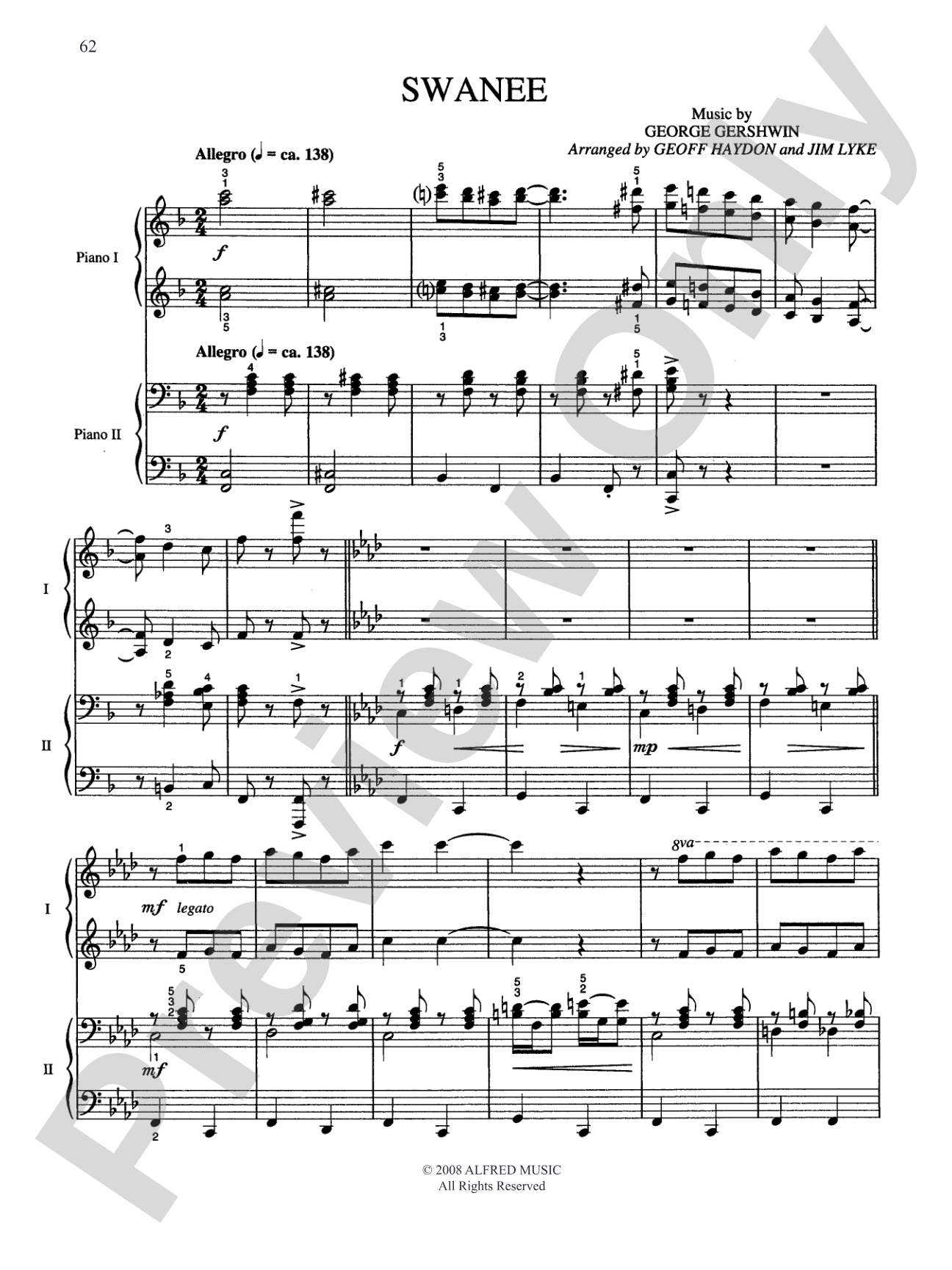
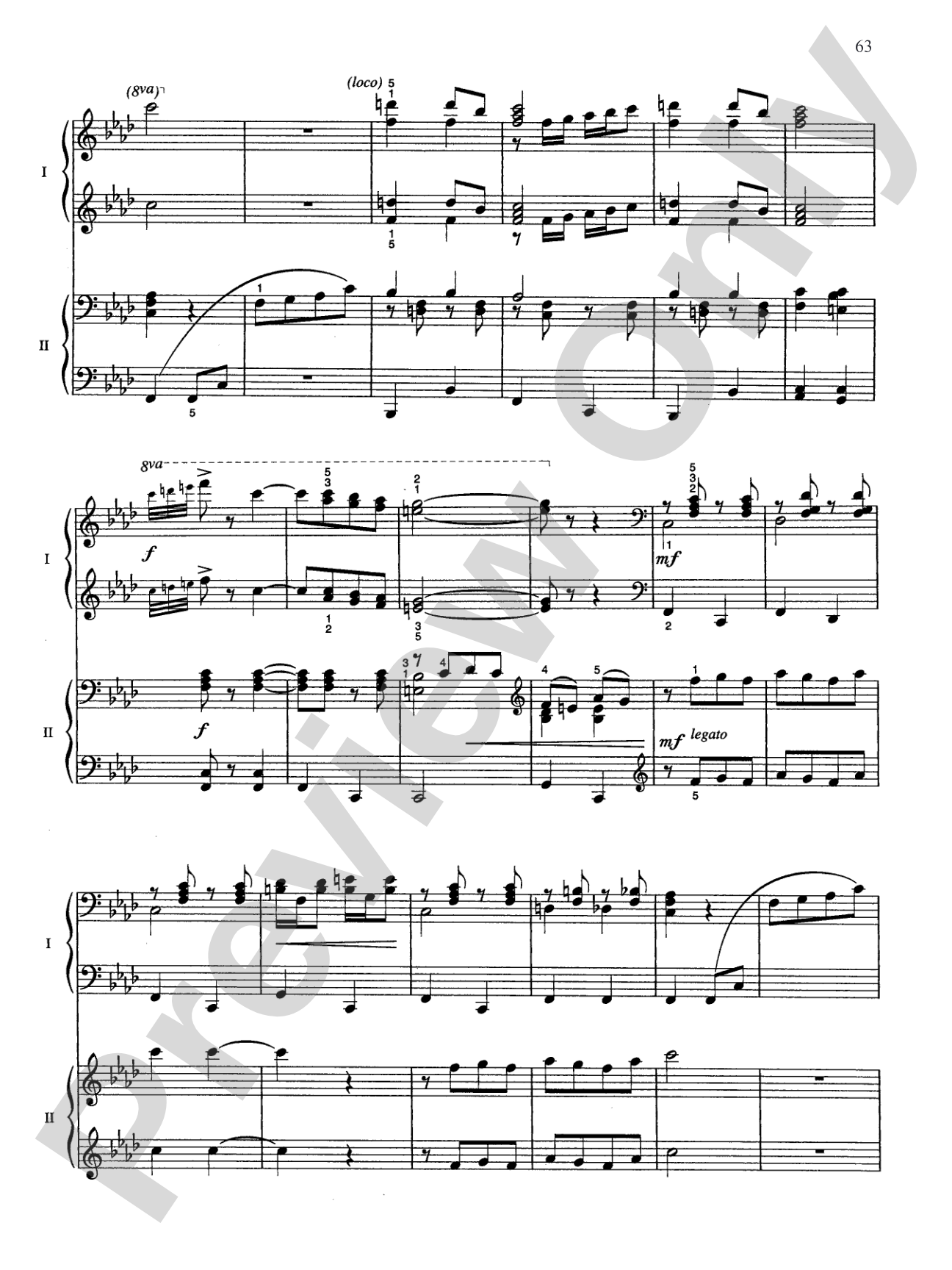

Swanee - Piano Duo (2 Pianos, 4 Hands): Piano Duo (2 Pianos, 4 Hands)
Selections by George and Ira Gershwin, Thomas "Fats" Waller, Scott Joplin, Irving Berlin, Jerome Kern and More
Arr. Jim Lyke, Geoff Haydon, Don Heitler, and John Arpin
Level: Intermediate / Late Intermediate
Item: 00-PS-0017304
$5.99
One moment…
Related Items
Ain't Misbehavin' (from "Ain't Misbehavin'") - Piano Duo (2 Pianos, 4 Hands): Piano Duo (2 Pianos, 4 Hands) |
$5.99
|
View | |
Alexander's Ragtime Band - Piano Duo (2 Pianos, 4 Hands): Piano Duo (2 Pianos, 4 Hands) |
$9.99
|
View | |
America, the Beautiful - Piano Duo (2 Pianos, 4 Hands): Piano Duo (2 Pianos, 4 Hands) |
$5.99
|
View | |
By Strauss (from "The Show Is On") - Piano Duo (2 Pianos, 4 Hands): Piano Duo (2 Pianos, 4 Hands) |
$5.99
|
View | |
Everybody's Doing It Now - Piano Duo (2 Pianos, 4 Hands): Piano Duo (2 Pianos, 4 Hands) |
$5.99
|
View | |
I Want to Be Happy (from "No, No, Nanette") - Piano Duo (2 Pianos, 4 Hands): Piano Duo (2 Pianos, 4 Hands) |
$5.99
|
View | |
Look for the Silver Lining - Piano Duo (2 Pianos, 4 Hands): Piano Duo (2 Pianos, 4 Hands) |
$5.99
|
View | |
Nobody but You (from "La La Lucille") - Piano Duo (2 Pianos, 4 Hands): Piano Duo (2 Pianos, 4 Hands) |
$4.99
|
View | |
Pineapple Rag - Piano Duo (2 Pianos, 4 Hands): Piano Duo (2 Pianos, 4 Hands) |
$9.99
|
View | |
Solace - A Mexican Serenade - Piano Duo (2 Pianos, 4 Hands): Piano Duo (2 Pianos, 4 Hands) |
$9.99
|
View | |
The Easy Winners - Piano Duo (2 Pianos, 4 Hands): Piano Duo (2 Pianos, 4 Hands) |
$9.99
|
View | |
When the Midnight Choo Choo Leaves for Alabam' - Piano Duo (2 Pianos, 4 Hands): Piano Duo (2 Pianos, 4 Hands) |
$5.99
|
View | |
15 Arrangements of American Classics for Two Pianos, Four Hands: Piano Duo (2 Pianos, 4 Hands) Book (2 copies required) |
$17.95
|
View |
Description
The 15 American classics in this collection have been masterfully arranged for two pianos, four hands. Titles: Ain't Misbehavin' (Fats Waller) * Alexander's Ragtime Band (Irving Berlin) * America, the Beautiful (Katherine Lee Bates and Samuel A. Ward) * By Strauss (George Gershwin and Ira Gershwin) * The Easy Winners (Scott Joplin) * Everybody's Doing It Now (Irving Berlin) * Gladiolus Rag (Scott Joplin) * I Want to be Happy (Vincent Youmans) * Look for the Silver Lining (Jerome Kern) * Medley: Yankee Doodle Boy; Over There; You're a Grand Old Flag (George M. Cohan) * Nobody But You (George Gershwin) * Pineapple Rag (Scott Joplin) * Solace (Scott Joplin) * Swanee (George Gershwin) * When the Midnight Choo-Choo Leaves for Alabam' (Irving Berlin). 128 pages. A Federation Festivals 2024-2028 selection.


Discover MakeMusic Cloud: thousands of interactive titles your students can play along with today.
Sample Audio
No sample audio found.
Sample Video
No sample videos found.
Additional Details
Series:
Alfred's Classic Editions
Publisher:
Alfred Music
Page Count:
128
SKU:
00-PS-0017304
More about this title
About the Composer: George Gershwin
George Gershwin (1898-1937) bridged concert music and popular song with uncommon fluency. His melodies became standards of American culture, and his harmonies revealed sophisticated training alongside his gifts as a songwriter and pianist.
For music educators, Gershwin represents a crucial repertoire crossroads. His works appear in concert halls, jazz ensembles, and popular music classes alike, making him essential to any rounded music education. Students who learn his pieces gain exposure to blues idiom, jazz inflection, and the craft of memorable melody, all rooted in authentic American vernacular.
Why we love this
This collection captures the joy of two-piano playing without demanding virtuosity. The arrangements by Haydon and Lyke balance both parts so neither pianist sits idle, and the selection spans Gershwin's wit alongside beloved ragtime and patriotic standards. Intermediate and late intermediate pianists get immediate musical gratification, full texture, and the genuine partnership that makes duo playing addictive.
What to expect
These arrangements shimmer with stride piano energy, ragtime swing, and the sophisticated charm of 1920s popular song. Playing them together creates the texture and harmonic color of a full ensemble, giving two pianists the thrill of sounding complete and cohesive.
Who it's for
Intermediate and late intermediate pianists seeking collaborative repertoire that combines American popular standards with genuine musical substance. Duet partners in studios, school music programs, and community settings will find 15 appealing pieces that invite repeated performance without becoming stale.
How to get the most out of it
- Establish clear communication about tempo and rubato before rehearsal. The syncopated rhythms in pieces like the Berlin and Joplin selections need matching interpretive choices between both pianists.
- Practice the hand-crossing sections (common in ragtime arrangements) separately at each piano, then together. Familiarity with your partner's physical setup prevents collisions during performance.
- Listen critically to the balance between pianos during your first run-throughs. One pianist may naturally play louder; adjust voicing and dynamic shaping so the melody registers regardless of which piano carries it.
- Experiment with slight tempo flexibility in the Gershwin numbers. These pieces thrive on rhythmic personality, not metronomic precision.
How to use it
Build a concert around American standards and ragtime by pairing this collection with other two-piano works or alternating with solo pieces. The patriotic medley and iconic Gershwin numbers work especially well as a program finale, and individual selections fit naturally into pops concerts, community events, or recitals celebrating American music.
Skills your students will build
- Rhythmic independence between hands and across two pianos, especially in syncopated and ragtime idioms
- Stylistic interpretation of stride bass, jazz harmonies, and blues inflection
- Collaborative listening and ensemble balance at the keyboard
- Quick memorization and confidence with period popular song forms
- Sight-reading fluid piano duet scores