
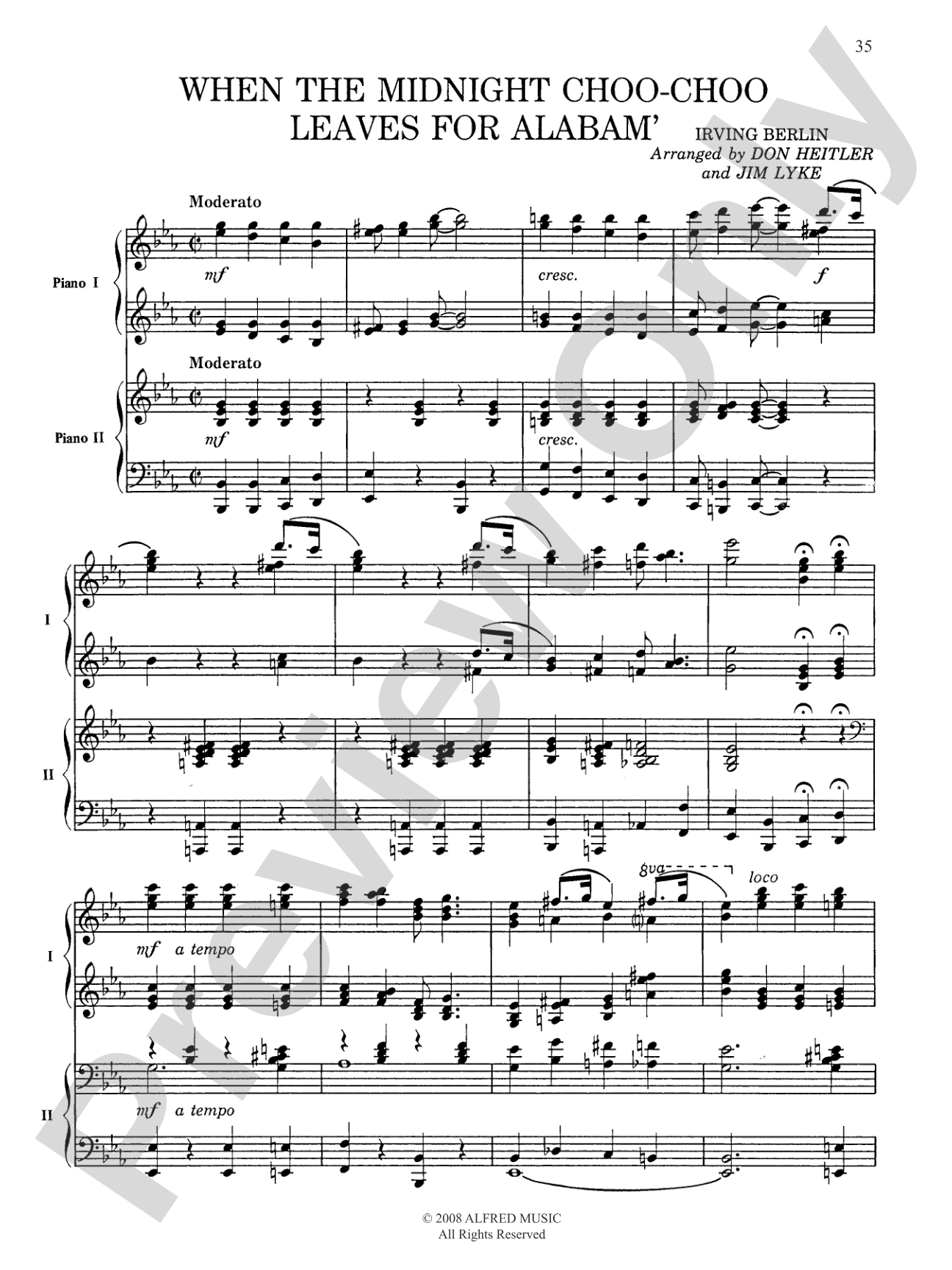
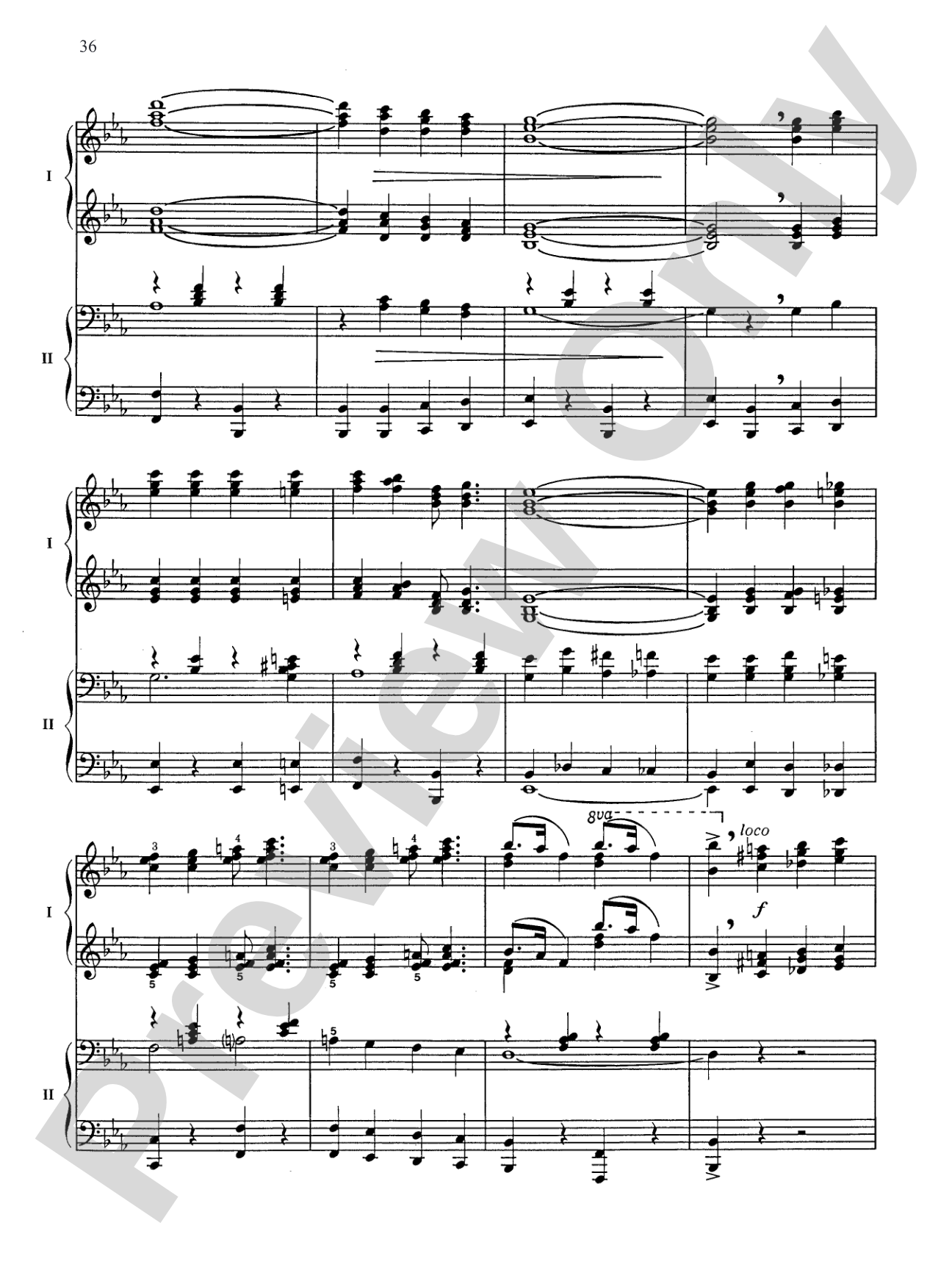

When the Midnight Choo Choo Leaves for Alabam' - Piano Duo (2 Pianos, 4 Hands): Piano Duo (2 Pianos, 4 Hands)
Selections by George and Ira Gershwin, Thomas "Fats" Waller, Scott Joplin, Irving Berlin, Jerome Kern and More
Arr. Jim Lyke, Geoff Haydon, Don Heitler, and John Arpin
Level: Intermediate / Late Intermediate
Item: 00-PS-0017306
$5.99
One moment…
Related Items
Ain't Misbehavin' (from "Ain't Misbehavin'") - Piano Duo (2 Pianos, 4 Hands): Piano Duo (2 Pianos, 4 Hands) |
$5.99
|
View | |
Alexander's Ragtime Band - Piano Duo (2 Pianos, 4 Hands): Piano Duo (2 Pianos, 4 Hands) |
$9.99
|
View | |
America, the Beautiful - Piano Duo (2 Pianos, 4 Hands): Piano Duo (2 Pianos, 4 Hands) |
$5.99
|
View | |
By Strauss (from "The Show Is On") - Piano Duo (2 Pianos, 4 Hands): Piano Duo (2 Pianos, 4 Hands) |
$5.99
|
View | |
Everybody's Doing It Now - Piano Duo (2 Pianos, 4 Hands): Piano Duo (2 Pianos, 4 Hands) |
$5.99
|
View | |
I Want to Be Happy (from "No, No, Nanette") - Piano Duo (2 Pianos, 4 Hands): Piano Duo (2 Pianos, 4 Hands) |
$5.99
|
View | |
Look for the Silver Lining - Piano Duo (2 Pianos, 4 Hands): Piano Duo (2 Pianos, 4 Hands) |
$5.99
|
View | |
Nobody but You (from "La La Lucille") - Piano Duo (2 Pianos, 4 Hands): Piano Duo (2 Pianos, 4 Hands) |
$4.99
|
View | |
Pineapple Rag - Piano Duo (2 Pianos, 4 Hands): Piano Duo (2 Pianos, 4 Hands) |
$9.99
|
View | |
Solace - A Mexican Serenade - Piano Duo (2 Pianos, 4 Hands): Piano Duo (2 Pianos, 4 Hands) |
$9.99
|
View | |
Swanee - Piano Duo (2 Pianos, 4 Hands): Piano Duo (2 Pianos, 4 Hands) |
$5.99
|
View | |
The Easy Winners - Piano Duo (2 Pianos, 4 Hands): Piano Duo (2 Pianos, 4 Hands) |
$9.99
|
View | |
15 Arrangements of American Classics for Two Pianos, Four Hands: Piano Duo (2 Pianos, 4 Hands) Book (2 copies required) |
$17.95
|
View |
Description
The 15 American classics in this collection have been masterfully arranged for two pianos, four hands. Titles: Ain't Misbehavin' (Fats Waller) * Alexander's Ragtime Band (Irving Berlin) * America, the Beautiful (Katherine Lee Bates and Samuel A. Ward) * By Strauss (George Gershwin and Ira Gershwin) * The Easy Winners (Scott Joplin) * Everybody's Doing It Now (Irving Berlin) * Gladiolus Rag (Scott Joplin) * I Want to be Happy (Vincent Youmans) * Look for the Silver Lining (Jerome Kern) * Medley: Yankee Doodle Boy; Over There; You're a Grand Old Flag (George M. Cohan) * Nobody But You (George Gershwin) * Pineapple Rag (Scott Joplin) * Solace (Scott Joplin) * Swanee (George Gershwin) * When the Midnight Choo-Choo Leaves for Alabam' (Irving Berlin). 128 pages. A Federation Festivals 2024-2028 selection.


Discover MakeMusic Cloud: thousands of interactive titles your students can play along with today.
Sample Audio
No sample audio found.
Sample Video
No sample videos found.
Additional Details
Series:
Alfred's Classic Editions
Publisher:
Alfred Music
Page Count:
128
SKU:
00-PS-0017306
More about this title
About the Composer: Irving Berlin
Irving Berlin (1888-1989) composed some of the most enduring popular songs in American music history. Born in Russia and immigrating to New York as a child, Berlin became the voice of early 20th-century American optimism and vernacular style, writing for Broadway stages, film, and popular entertainment with extraordinary melodic gift and cultural sensitivity.
Berlin's catalog spans decades and genres, from ragtime-influenced novelty songs to sophisticated show tunes and patriotic anthems. His melodies became the soundtrack to American life, performed by everyone from jazz musicians to concert pianists, and his influence on popular songwriting remains foundational to music education.
Why we love this
This collection captures the golden age of American songwriting at a level where two pianists can genuinely shine together. Heitler and Lyke's arrangements honor the original melodies and harmonic character while creating genuine dialogue between the pianos, making each piece feel like a conversation rather than a simplified reduction. Programming these works offers your students a chance to play repertoire they've likely heard, which builds confidence and connects concert performance to the wider musical world.
What to expect
These arrangements transport you into the vibrant, energetic world of early American popular music. Ragtime pieces sparkle with syncopation and witty orchestration; patriotic selections land with confidence and warmth; and the slower, more romantic songs reveal Berlin's gift for memorable melody. Playing through this collection feels like a joyride through a century of American musical culture.
Who it's for
This book serves two pianists working at the intermediate or late intermediate level who want to expand their collaborative repertoire beyond classical duets. Pairs with complementary skills will find rewarding material here, whether preparing for a duet recital, fulfilling a festival requirement, or simply exploring the joy of four-hand piano playing together.
How to get the most out of it
- Establish clear roles before rehearsal begins. One pianist may consistently carry the melody while the other provides rhythmic or harmonic support, or these roles may shift within a single piece. Marking these sections in the score prevents confusion and speeds up learning.
- Balance the two pianos by checking the acoustic properties of your rehearsal space and performance venue. What works in a practice room may require adjustment on stage; plan for a sound check beforehand.
- Listen to the original compositions or other recorded versions of these songs before rehearsing. The rhythmic swing and character of ragtime pieces like 'The Easy Winners' and 'Pineapple Rag' differ notably from straight classical interpretations.
- Pay attention to tempo relationships. Ragtime selections, patriotic medleys, and blues-influenced pieces each carry different stylistic expectations. Discuss how Berlin's compositional voice shifts across the collection and adjust your interpretations accordingly.
How to use it
Select individual pieces for recital programming that pairs well with classical or contemporary works, or program a full evening around this collection as a thematic celebration of American songwriting. Several pieces work equally well in more casual settings like community performances or festival showcases where accessible, crowd-familiar repertoire strengthens audience engagement.
Skills your students will build
- Collaborative listening and synchronization across two independent melodic lines
- Ragtime rhythmic interpretation and swing articulation
- Balancing melody with accompaniment patterns at the piano
- Reading and executing contrasting textures and roles within a single arrangement
- Stylistic flexibility across popular song, patriotic, and jazz-influenced idioms