
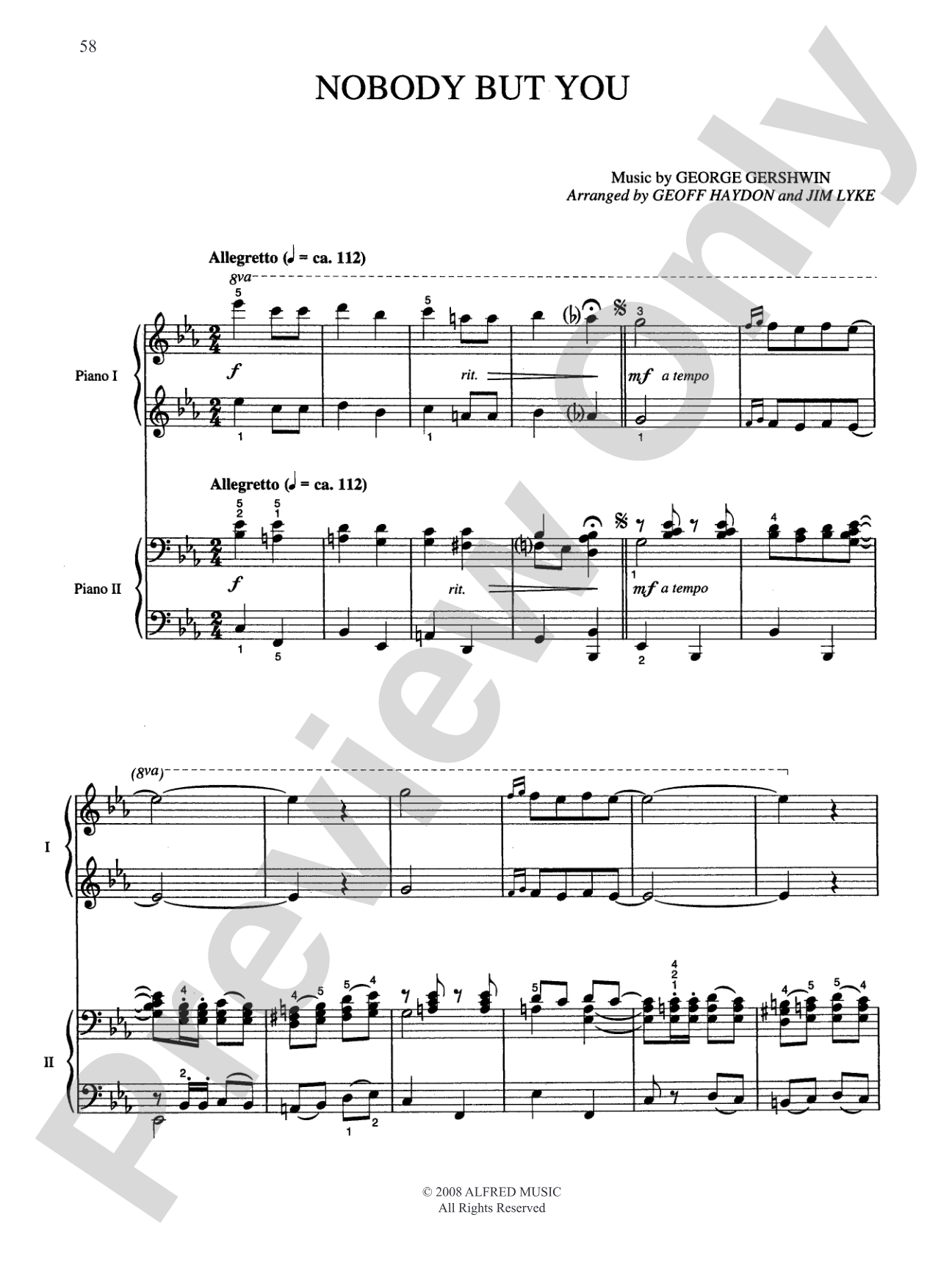

Nobody but You (from "La La Lucille") - Piano Duo (2 Pianos, 4 Hands): Piano Duo (2 Pianos, 4 Hands)
Selections by George and Ira Gershwin, Thomas "Fats" Waller, Scott Joplin, Irving Berlin, Jerome Kern and More
Arr. Jim Lyke, Geoff Haydon, Don Heitler, and John Arpin
Level: Intermediate / Late Intermediate
Item: 00-PS-0017301
$4.99
One moment…
Related Items
Ain't Misbehavin' (from "Ain't Misbehavin'") - Piano Duo (2 Pianos, 4 Hands): Piano Duo (2 Pianos, 4 Hands) |
$5.99
|
View | |
Alexander's Ragtime Band - Piano Duo (2 Pianos, 4 Hands): Piano Duo (2 Pianos, 4 Hands) |
$9.99
|
View | |
America, the Beautiful - Piano Duo (2 Pianos, 4 Hands): Piano Duo (2 Pianos, 4 Hands) |
$5.99
|
View | |
By Strauss (from "The Show Is On") - Piano Duo (2 Pianos, 4 Hands): Piano Duo (2 Pianos, 4 Hands) |
$5.99
|
View | |
Everybody's Doing It Now - Piano Duo (2 Pianos, 4 Hands): Piano Duo (2 Pianos, 4 Hands) |
$5.99
|
View | |
I Want to Be Happy (from "No, No, Nanette") - Piano Duo (2 Pianos, 4 Hands): Piano Duo (2 Pianos, 4 Hands) |
$5.99
|
View | |
Look for the Silver Lining - Piano Duo (2 Pianos, 4 Hands): Piano Duo (2 Pianos, 4 Hands) |
$5.99
|
View | |
Pineapple Rag - Piano Duo (2 Pianos, 4 Hands): Piano Duo (2 Pianos, 4 Hands) |
$9.99
|
View | |
Solace - A Mexican Serenade - Piano Duo (2 Pianos, 4 Hands): Piano Duo (2 Pianos, 4 Hands) |
$9.99
|
View | |
Swanee - Piano Duo (2 Pianos, 4 Hands): Piano Duo (2 Pianos, 4 Hands) |
$5.99
|
View | |
The Easy Winners - Piano Duo (2 Pianos, 4 Hands): Piano Duo (2 Pianos, 4 Hands) |
$9.99
|
View | |
When the Midnight Choo Choo Leaves for Alabam' - Piano Duo (2 Pianos, 4 Hands): Piano Duo (2 Pianos, 4 Hands) |
$5.99
|
View | |
15 Arrangements of American Classics for Two Pianos, Four Hands: Piano Duo (2 Pianos, 4 Hands) Book (2 copies required) |
$17.95
|
View |
Description
The 15 American classics in this collection have been masterfully arranged for two pianos, four hands. Titles: Ain't Misbehavin' (Fats Waller) * Alexander's Ragtime Band (Irving Berlin) * America, the Beautiful (Katherine Lee Bates and Samuel A. Ward) * By Strauss (George Gershwin and Ira Gershwin) * The Easy Winners (Scott Joplin) * Everybody's Doing It Now (Irving Berlin) * Gladiolus Rag (Scott Joplin) * I Want to be Happy (Vincent Youmans) * Look for the Silver Lining (Jerome Kern) * Medley: Yankee Doodle Boy; Over There; You're a Grand Old Flag (George M. Cohan) * Nobody But You (George Gershwin) * Pineapple Rag (Scott Joplin) * Solace (Scott Joplin) * Swanee (George Gershwin) * When the Midnight Choo-Choo Leaves for Alabam' (Irving Berlin). 128 pages. A Federation Festivals 2024-2028 selection.


Discover MakeMusic Cloud: thousands of interactive titles your students can play along with today.
Sample Audio
No sample audio found.
Sample Video
No sample videos found.
Additional Details
Series:
Alfred's Classic Editions
Publisher:
Alfred Music
Page Count:
128
SKU:
00-PS-0017301
More about this title
About the Composer: George Gershwin
George Gershwin (1898-1937) brought jazz vocabulary into concert music at a time when most classical composers dismissed it as lowbrow. His gift for melody was inseparable from his understanding of rhythm, harmony, and orchestration. He died at 38, yet his output shaped American music so completely that composers who came after him had to reckon with what he'd already done.
For music educators, Gershwin matters because his pieces reveal how popular and classical traditions can speak to each other. His melodies stick with students. His harmonies surprise them. Teaching his work means teaching American musical identity at a hinge moment in its history.
Why we love this
This collection pairs two talented arrangers with some of Gershwin's most infectious music, creating parts that feel genuinely collaborative rather than subsidiary. "Nobody But You" sits alongside ragtime masterworks by Scott Joplin and standards by Irving Berlin and others, giving two pianists a repertoire book that spans American vernacular music without ever sounding thin or academic.
What to expect
Toe-tapping and bright. These arrangements sparkle with the rhythmic vitality of early jazz and popular song, yet the writing respects both pianos and gives each player moments to lead and moments to support. The overall effect feels festive and accessible.
Who it's for
Intermediate and late intermediate pianists who want to experience duet playing without requiring advanced technique. This collection suits community music programs, preparatory studio partnerships, and piano students ready to explore American standards in a collaborative context.
How to get the most out of it
- Establish a steady pulse between the two pianos before rehearsal; these arrangements thrive when both players commit to the same tempo and refuse to rush the syncopation.
- Listen across the parts for countermelody and answering phrases. Often one piano carries the main line while the other provides rhythmic or harmonic color; balance them so both voices emerge.
- Negotiate the arrangement's character early. These pieces have swagger and snap. Agree on whether you're playing them as concert recital music or with the looser, more dance-inflected feel of their original settings.
- Work sections of this 128-page book in clusters rather than sequentially. Group pieces by arranger's voice or harmonic language to build stylistic continuity in rehearsal.
How to use it
Program individual pieces from this book in recitals showcasing collaborative piano work. A single arrangement like "Nobody But You" works well paired with orchestral transcriptions or other two-piano literature. The full collection is substantial enough to anchor a studio recital devoted entirely to American music.
Skills your students will build
- Ensemble listening and part awareness in a two-piano texture
- Reading and executing syncopated rhythms common to jazz and ragtime idioms
- Maintaining tempo independence while coordinating with another pianist
- Understanding how melody, countermelody, and accompaniment interweave
- Interpreting popular American song styles from the early 20th century