
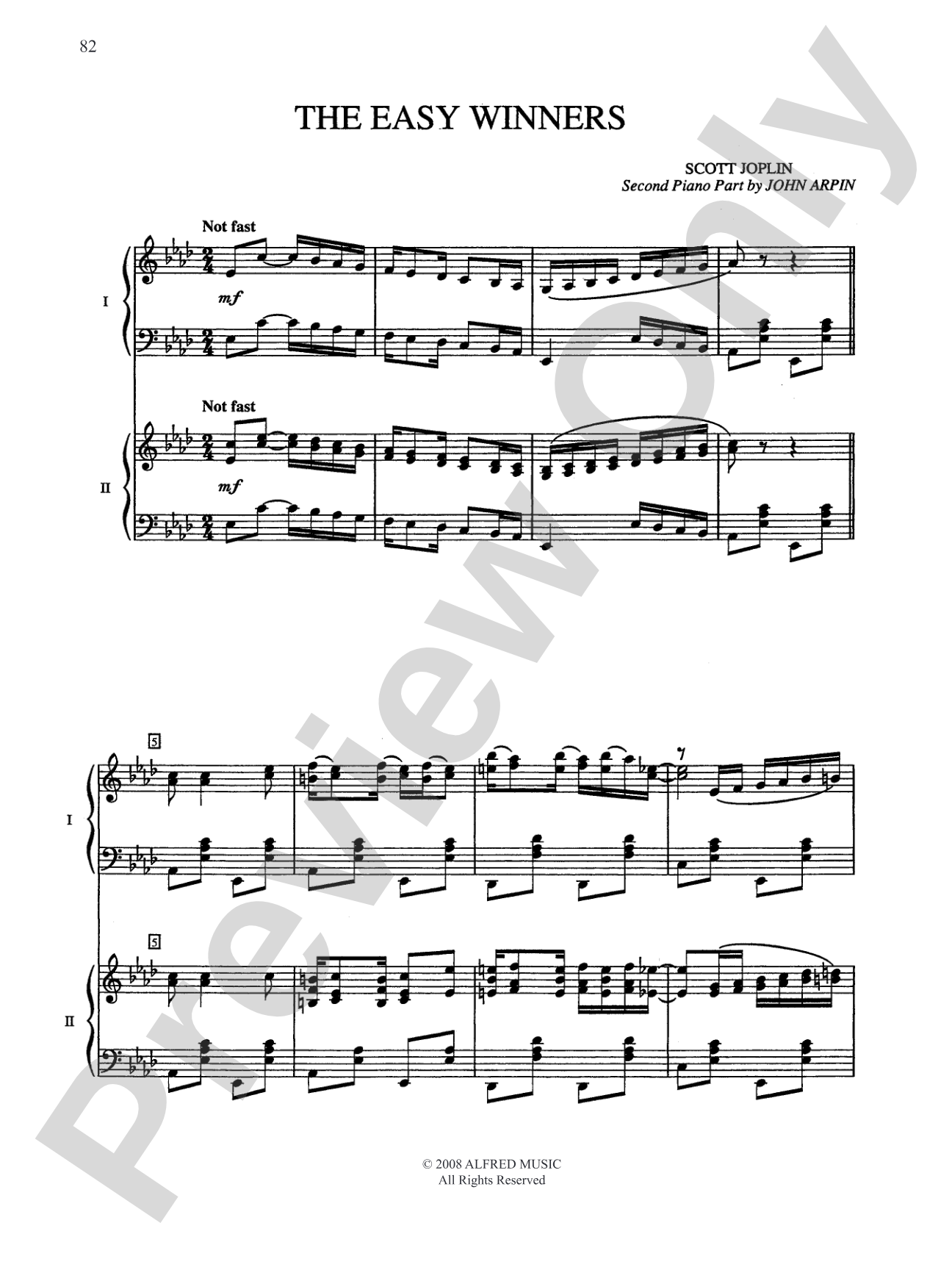
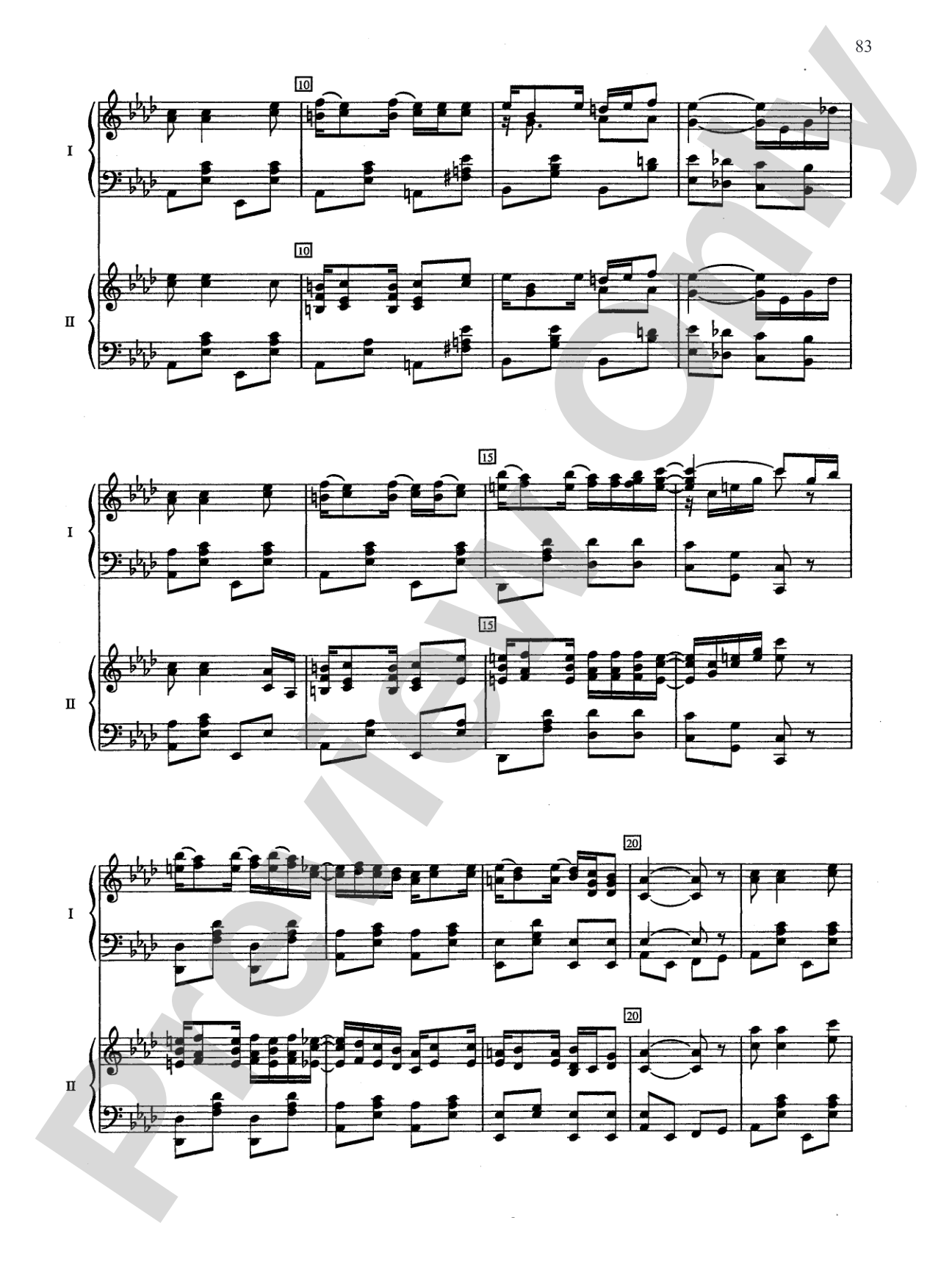
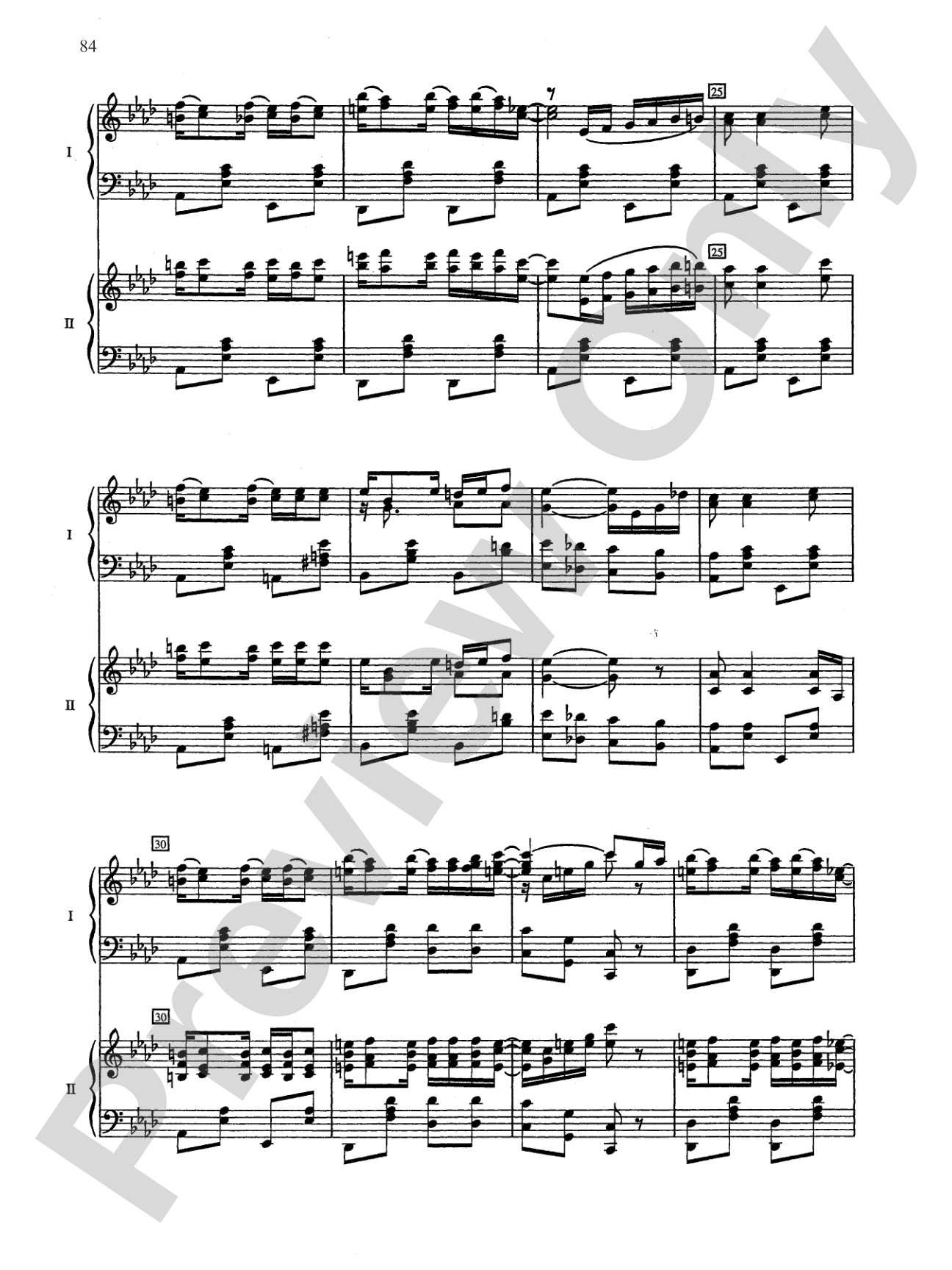

The Easy Winners - Piano Duo (2 Pianos, 4 Hands): Piano Duo (2 Pianos, 4 Hands)
Selections by George and Ira Gershwin, Thomas "Fats" Waller, Scott Joplin, Irving Berlin, Jerome Kern and More
Arr. Jim Lyke, Geoff Haydon, Don Heitler, and John Arpin
Level: Intermediate / Late Intermediate
Item: 00-PS-0017305
$9.99
Pickup currently not available
Related Items
Ain't Misbehavin' (from "Ain't Misbehavin'") - Piano Duo (2 Pianos, 4 Hands): Piano Duo (2 Pianos, 4 Hands) |
$5.99
|
View | |
Alexander's Ragtime Band - Piano Duo (2 Pianos, 4 Hands): Piano Duo (2 Pianos, 4 Hands) |
$9.99
|
View | |
America, the Beautiful - Piano Duo (2 Pianos, 4 Hands): Piano Duo (2 Pianos, 4 Hands) |
$5.99
|
View | |
By Strauss (from "The Show Is On") - Piano Duo (2 Pianos, 4 Hands): Piano Duo (2 Pianos, 4 Hands) |
$5.99
|
View | |
Everybody's Doing It Now - Piano Duo (2 Pianos, 4 Hands): Piano Duo (2 Pianos, 4 Hands) |
$5.99
|
View | |
I Want to Be Happy (from "No, No, Nanette") - Piano Duo (2 Pianos, 4 Hands): Piano Duo (2 Pianos, 4 Hands) |
$5.99
|
View | |
Look for the Silver Lining - Piano Duo (2 Pianos, 4 Hands): Piano Duo (2 Pianos, 4 Hands) |
$5.99
|
View | |
Nobody but You (from "La La Lucille") - Piano Duo (2 Pianos, 4 Hands): Piano Duo (2 Pianos, 4 Hands) |
$4.99
|
View | |
Pineapple Rag - Piano Duo (2 Pianos, 4 Hands): Piano Duo (2 Pianos, 4 Hands) |
$9.99
|
View | |
Solace - A Mexican Serenade - Piano Duo (2 Pianos, 4 Hands): Piano Duo (2 Pianos, 4 Hands) |
$9.99
|
View | |
Swanee - Piano Duo (2 Pianos, 4 Hands): Piano Duo (2 Pianos, 4 Hands) |
$5.99
|
View | |
When the Midnight Choo Choo Leaves for Alabam' - Piano Duo (2 Pianos, 4 Hands): Piano Duo (2 Pianos, 4 Hands) |
$5.99
|
View | |
15 Arrangements of American Classics for Two Pianos, Four Hands: Piano Duo (2 Pianos, 4 Hands) Book (2 copies required) |
$17.95
|
View |
Description
The 15 American classics in this collection have been masterfully arranged for two pianos, four hands. Titles: Ain't Misbehavin' (Fats Waller) * Alexander's Ragtime Band (Irving Berlin) * America, the Beautiful (Katherine Lee Bates and Samuel A. Ward) * By Strauss (George Gershwin and Ira Gershwin) * The Easy Winners (Scott Joplin) * Everybody's Doing It Now (Irving Berlin) * Gladiolus Rag (Scott Joplin) * I Want to be Happy (Vincent Youmans) * Look for the Silver Lining (Jerome Kern) * Medley: Yankee Doodle Boy; Over There; You're a Grand Old Flag (George M. Cohan) * Nobody But You (George Gershwin) * Pineapple Rag (Scott Joplin) * Solace (Scott Joplin) * Swanee (George Gershwin) * When the Midnight Choo-Choo Leaves for Alabam' (Irving Berlin). 128 pages. A Federation Festivals 2024-2028 selection.


Discover MakeMusic Cloud: thousands of interactive titles your students can play along with today.
Sample Audio
No sample audio found.
Sample Video
No sample videos found.
Additional Details
Series:
Alfred's Classic Editions
Publisher:
Alfred Music
Page Count:
128
SKU:
00-PS-0017305
More about this title
About the Composer: Scott Joplin
Scott Joplin (1868-1917) stands as the defining figure of ragtime, a genre that reshaped American music at the turn of the twentieth century. Born in Texas, Joplin rose to prominence as a pianist and composer whose syncopated melodies and sophisticated harmonies elevated ragtime from a regional entertainment style to a nationally recognized art form. His works, including "The Maple Leaf Rag" and "The Easy Winners," remain cornerstones of American musical repertoire.
Joplin's influence on music education extends beyond performance; his compositions have become essential tools for teaching rhythmic complexity, jazz-influenced harmony, and the history of American popular music. His ability to balance technical challenge with infectious melody makes his ragtime works particularly valuable for intermediate pianists seeking to expand their stylistic range.
Why we love this
John Arpin's arrangements transform these 15 American standards into genuinely engaging two-piano literature without sacrificing the infectious energy of the originals. The collection balances ragtime masterpieces (three Joplin rags) with Irving Berlin and George Gershwin standards, giving duo partnerships substantial material that spans genres while maintaining accessibility at the intermediate level. Intermediate pianists rarely find four-hand repertoire that feels this musically rewarding to perform.
What to expect
Vibrant, rhythmically alive, and thoroughly American. These arrangements shimmer with syncopation and stride-influenced accompaniment, capturing the exuberance of Tin Pan Alley and the sophisticated syncopation of ragtime's golden age. Playing through the collection feels like a tour through the most charismatic moments of early twentieth-century American music.
Who it's for
Intermediate to late intermediate piano partnerships seeking substantial duet literature with strong historical and stylistic substance. This collection works well for pianists building confidence with two-piano performance, ensemble awareness, and the rhythmic complexities of early American jazz and ragtime idioms.
How to get the most out of it
- Establish a steady, conversational pulse between the two pianos before focusing on character details. Ragtime's syncopation requires both players to lock into a shared sense of time.
- Differentiate the textural roles: one piano often carries melody while the other maintains rhythmic momentum. Bring clarity to this hierarchy through dynamic balance rather than strict volume control.
- Lean into the stylistic diversity across the collection. The Joplin rags demand crisp articulation and lifted rhythms, while the Berlin and Gershwin selections benefit from smoother phrasing and richer harmonies.
- Rehearse the syncopated figures in isolation, particularly where both pianos share rhythmic material simultaneously. Slight rushes are easy to develop here; marking subdivisions helps maintain precision.
How to use it
Program selections from this collection in recitals dedicated to American music or early jazz history; the variety of styles and familiar melodies engage audiences while challenging performers. The 15 pieces also work well as opening or closing concert material, where their energy and accessibility create strong audience connection.
Skills your students will build
- Syncopated rhythm reading and execution, particularly dotted figures and tied notes across beat divisions
- Two-piano balance and independent voice management within a shared harmonic texture
- Stylistic range spanning ragtime, Tin Pan Alley, and early American jazz idioms
- Stride piano patterns and left-hand accompaniment figures typical of early twentieth-century piano writing
- Collaborating with a partner to shape phrasing and dynamics across non-aligned keyboard parts