
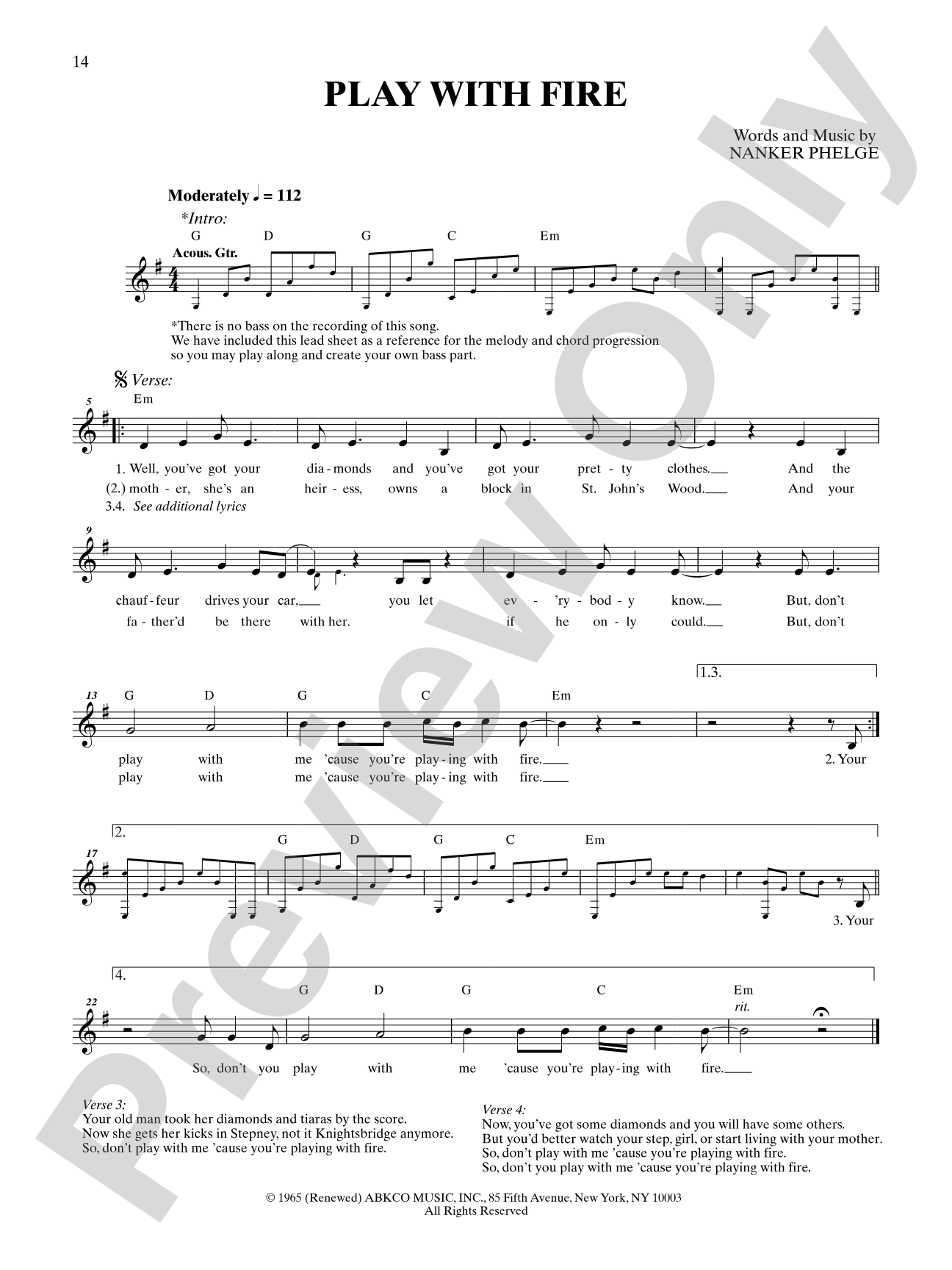

Play With Fire: Bass TAB
The Rolling Stones
Item: 00-PS-0010208
$4.99
One moment…
Related Items
Heart of Stone: Authentic Guitar TAB |
$4.99
|
View | |
Paint It, Black: Bass TAB |
$4.99
|
View | |
(I Can't Get No) Satisfaction: Bass TAB |
$4.99
|
View | |
(I Can't Get No) Satisfaction: Authentic Guitar TAB |
$4.99
|
View | |
Street Fighting Man: Bass TAB |
$4.99
|
View | |
Get Off of My Cloud: Bass TAB |
$4.99
|
View | |
Get Off of My Cloud: Authentic Guitar TAB |
$4.99
|
View | |
Heart of Stone: Bass TAB |
$4.99
|
View | |
19th Nervous Breakdown: Bass TAB |
$4.99
|
View | |
19th Nervous Breakdown: Authentic Guitar TAB |
$5.99
|
View | |
Wild Horses: Bass TAB |
$4.99
|
View | |
Wild Horses: Authentic Guitar TAB |
$5.99
|
View | |
Time is on My Side: Bass TAB |
$4.99
|
View | |
Play With Fire: Authentic Guitar TAB |
$4.99
|
View | |
Mother's Little Helper: Authentic Guitar TAB |
$4.99
|
View | |
Mother's Little Helper: Bass TAB |
$4.99
|
View | |
Honky Tonk Women: Bass TAB |
$4.99
|
View | |
Honky Tonk Women: Authentic Guitar TAB |
$5.99
|
View | |
You Can't Always Get What You Want: Bass TAB |
$5.99
|
View | |
You Can't Always Get What You Want: Authentic Guitar TAB |
$9.99
|
View | |
As Tears Go By: Authentic Guitar TAB |
$4.99
|
View | |
As Tears Go By: Bass TAB |
$4.99
|
View | |
Ruby Tuesday: Bass TAB |
$4.99
|
View | |
Ruby Tuesday: Authentic Guitar TAB |
$4.99
|
View | |
Sympathy for the Devil: Bass TAB |
$4.99
|
View | |
Brown Sugar: Bass TAB |
$4.99
|
View | |
Brown Sugar: Authentic Guitar TAB |
$5.99
|
View | |
Let's Spend the Night Together: Authentic Guitar TAB |
$4.99
|
View | |
Let's Spend the Night Together: Bass TAB |
$4.99
|
View | |
Midnight Rambler: Bass TAB |
$9.99
|
View | |
Midnight Rambler: Authentic Guitar TAB |
$9.99
|
View | |
Under My Thumb: Bass TAB |
$4.99
|
View | |
Gimme Shelter: Bass TAB |
$4.99
|
View | |
Gimme Shelter: Authentic Guitar TAB |
$5.99
|
View | |
Jumpin' Jack Flash: Authentic Guitar TAB |
$5.99
|
View | |
Jumpin' Jack Flash: Bass TAB |
$4.99
|
View | |
Street Fighting Man: Authentic Guitar TAB |
$4.99
|
View | |
Sympathy for the Devil: Authentic Guitar TAB |
$5.99
|
View | |
Paint It, Black: Authentic Guitar TAB |
$4.99
|
View | |
Under My Thumb: Authentic Guitar TAB |
$4.99
|
View | |
Time Is On My Side: Authentic Guitar TAB |
$4.99
|
View | |
The Rolling Stones: Hot Rocks 1964-1971: Authentic Bass TAB Book |
$19.95
|
View | |
The Rolling Stones: Hot Rocks 1964-1971: Authentic Guitar TAB Book |
$24.99
|
View |
Description
Hot Rocks was the first, and, four decades later, remains the most significant Rolling Stones compilation ever released. It is The Rolling Stones' biggest-selling album---more than 12 million copies! This book features all 21 tracks from this landmark recording--fully transcribed for bass! Hot Rocks' traces the development of the songwriting team of Jagger and Richards. The album begins with the early cover recording of "Time Is on My Side" and then proceeds chronologically through most of the band's biggest hits from its first decade. Titles: 19th Nervous Breakdown * As Tears Go By * Brown Sugar * Get Off of My Cloud * Gimme Shelter * Heart of Stone * Honky Tonk Women * (I Can't Get No) Satisfaction * Jumpin' Jack Flash * Let's Spend the Night Together * Midnight Rambler * Mother's Little Helper * Paint It, Black * Play With Fire * Ruby Tuesday * Street Fighting Man * Sympathy For The Devil * Time Is On My Side * Under My Thumb * Wild Horses * You Can't Always Get What You Want.


Play With Fire: Bass TAB isn't in MakeMusic Cloud just yet...but it could be. Let us know you'd like to see it, and you'll help shape what comes next. In the meantime, start a free trial and dive into thousands of interactive titles your students can play along with today.
Request This Title
Tell us you want it.
Start Your Free Trial
Explore everything that's ready to play right now.
Sample Audio
No sample audio found.
Sample Video
No sample videos found.
Additional Details
Series:
Alfred's Classic Album Editions
Publisher:
Alfred Music
Page Count:
88
SKU:
00-PS-0010208
More about this title
About the Composer: Nanker Phelge
Nanker Phelge is the pseudonymous writing credit used by The Rolling Stones during their early years, representing the collective songwriting of Mick Jagger and Keith Richards alongside other band members. This nom de plume appears on many of the Stones' foundational tracks from the 1960s, capturing a pivotal moment when the band was absorbing American blues and rock influences and synthesizing them into their own distinctive sound.
The songs credited to Nanker Phelge showcase the songwriting partnership at its most inventive and prolific. From blues-based originals to sophisticated pop arrangements, these compositions established the template for rock writing that would define the band's career and influence countless musicians across generations.
Why we love this
This collection gives bass players direct access to one of rock's most influential catalogs, with all 21 tracks from the best-selling Stones compilation fully transcribed. The songs span a remarkable range of styles and bass approaches, from the driving lines of 'Jumpin' Jack Football' to the nuanced playing required for 'Paint It Black,' making it an education in itself.
What to expect
Playing through Hot Rocks is a masterclass in restraint and pocket. These songs move between bluesy simplicity and intricate rhythmic interplay, grounded in the fundamental understanding that the bass holds the song's foundation. The arc across 21 tracks feels like watching a band find and refine its voice.
Who it's for
Bass players who want to deepen their knowledge of rock fundamentals through studying one of the genre's most significant catalogs. This collection works equally well for students building repertoire and experienced players exploring how the Stones' bass parts evolved across their first decade.
How to get the most out of it
- Study the rhythmic pocket of each song before focusing on the exact pitches. The Stones' bass parts rely heavily on feel and groove; locking into the drum part will make the transcriptions sit correctly.
- Pay attention to dynamics across the album. Early tracks like 'Time Is on My Side' sit lighter in the mix, while later songs like 'Sympathy for the Devil' demand more presence and aggression.
- Reference the original recordings while learning from the TAB. Hearing how these lines sit in context with the guitar and drums will deepen your understanding of the arrangement choices.
- Notice how the bass interacts with the songwriting over the chronological progression. The early covers show restraint, while the later originals feature more inventive countermelody and syncopation.
How to use it
Use individual tracks as performance vehicles in recitals or band settings where the bass can step into the spotlight. The range of moods and tempos makes the collection useful for study sequences, or tackle the entire album as a semester-long exploration of rock bass fundamentals and the evolution of a single band's approach.
Skills your students will build
- Playing to a groove without losing musical intention
- Transcribing and interpreting bass parts from recordings
- Understanding the relationship between bass lines and drum patterns in rock contexts
- Navigating different bass approaches across blues, rock, and pop styles
- Maintaining rhythmic integrity while serving the song's emotional arc