
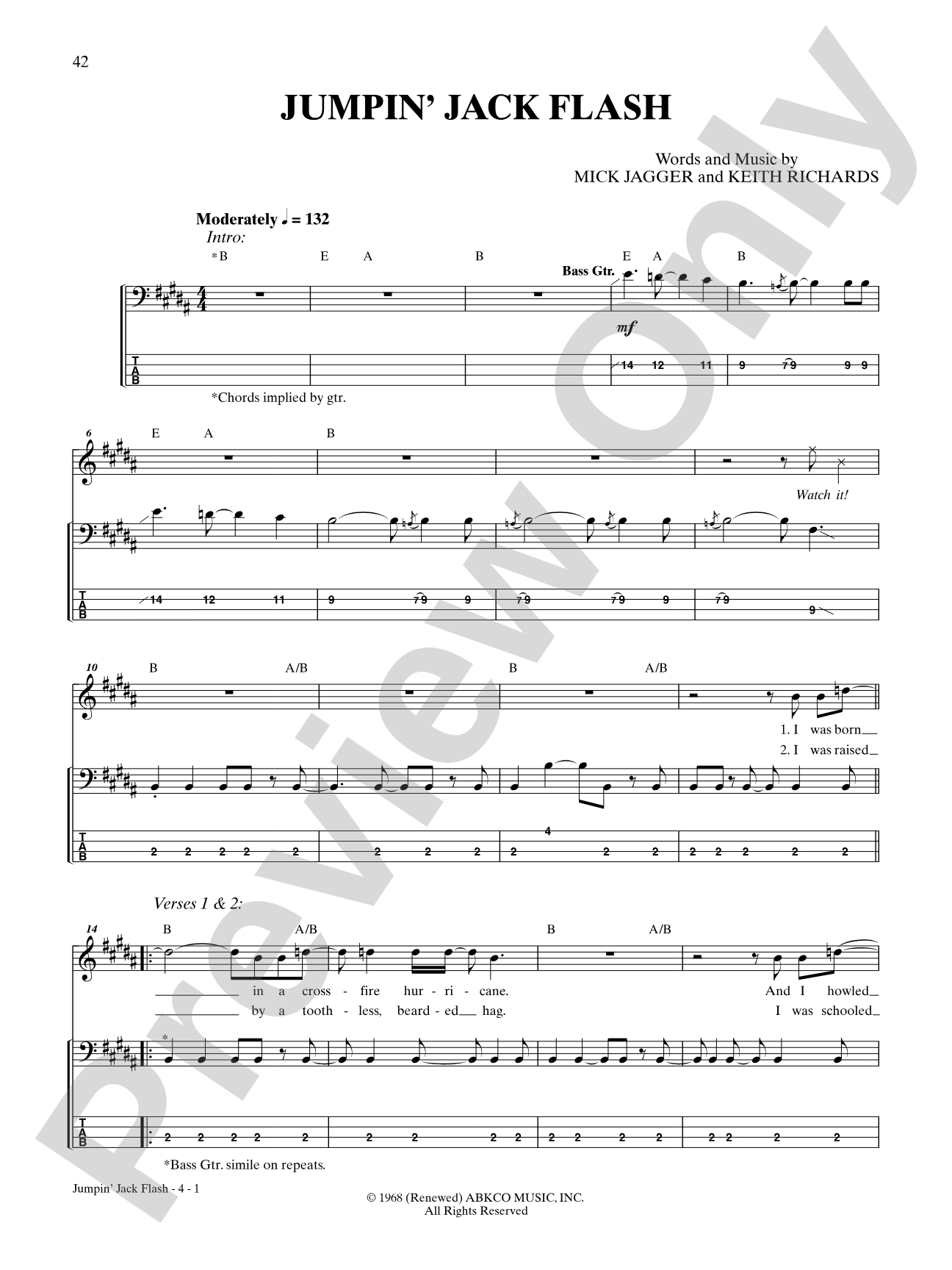

Jumpin' Jack Flash: Bass TAB
The Rolling Stones
Item: 00-PS-0010231
$4.99
Pickup currently not available
Related Items
Heart of Stone: Authentic Guitar TAB |
$4.99
|
View | |
Paint It, Black: Bass TAB |
$4.99
|
View | |
(I Can't Get No) Satisfaction: Bass TAB |
$4.99
|
View | |
(I Can't Get No) Satisfaction: Authentic Guitar TAB |
$4.99
|
View | |
Street Fighting Man: Bass TAB |
$4.99
|
View | |
Get Off of My Cloud: Bass TAB |
$4.99
|
View | |
Get Off of My Cloud: Authentic Guitar TAB |
$4.99
|
View | |
Heart of Stone: Bass TAB |
$4.99
|
View | |
19th Nervous Breakdown: Bass TAB |
$4.99
|
View | |
19th Nervous Breakdown: Authentic Guitar TAB |
$5.99
|
View | |
Wild Horses: Bass TAB |
$4.99
|
View | |
Wild Horses: Authentic Guitar TAB |
$5.99
|
View | |
Time is on My Side: Bass TAB |
$4.99
|
View | |
Play With Fire: Bass TAB |
$4.99
|
View | |
Play With Fire: Authentic Guitar TAB |
$4.99
|
View | |
Mother's Little Helper: Authentic Guitar TAB |
$4.99
|
View | |
Mother's Little Helper: Bass TAB |
$4.99
|
View | |
Honky Tonk Women: Bass TAB |
$4.99
|
View | |
Honky Tonk Women: Authentic Guitar TAB |
$5.99
|
View | |
You Can't Always Get What You Want: Bass TAB |
$5.99
|
View | |
You Can't Always Get What You Want: Authentic Guitar TAB |
$9.99
|
View | |
As Tears Go By: Authentic Guitar TAB |
$4.99
|
View | |
As Tears Go By: Bass TAB |
$4.99
|
View | |
Ruby Tuesday: Bass TAB |
$4.99
|
View | |
Ruby Tuesday: Authentic Guitar TAB |
$4.99
|
View | |
Sympathy for the Devil: Bass TAB |
$4.99
|
View | |
Brown Sugar: Bass TAB |
$4.99
|
View | |
Brown Sugar: Authentic Guitar TAB |
$5.99
|
View | |
Let's Spend the Night Together: Authentic Guitar TAB |
$4.99
|
View | |
Let's Spend the Night Together: Bass TAB |
$4.99
|
View | |
Midnight Rambler: Bass TAB |
$9.99
|
View | |
Midnight Rambler: Authentic Guitar TAB |
$9.99
|
View | |
Under My Thumb: Bass TAB |
$4.99
|
View | |
Gimme Shelter: Bass TAB |
$4.99
|
View | |
Gimme Shelter: Authentic Guitar TAB |
$5.99
|
View | |
Jumpin' Jack Flash: Authentic Guitar TAB |
$5.99
|
View | |
Street Fighting Man: Authentic Guitar TAB |
$4.99
|
View | |
Sympathy for the Devil: Authentic Guitar TAB |
$5.99
|
View | |
Paint It, Black: Authentic Guitar TAB |
$4.99
|
View | |
Under My Thumb: Authentic Guitar TAB |
$4.99
|
View | |
Time Is On My Side: Authentic Guitar TAB |
$4.99
|
View | |
The Rolling Stones: Hot Rocks 1964-1971: Authentic Bass TAB Book |
$19.95
|
View | |
The Rolling Stones: Hot Rocks 1964-1971: Authentic Guitar TAB Book |
$24.99
|
View |
Description
Hot Rocks was the first, and, four decades later, remains the most significant Rolling Stones compilation ever released. It is The Rolling Stones' biggest-selling album---more than 12 million copies! This book features all 21 tracks from this landmark recording--fully transcribed for bass! Hot Rocks' traces the development of the songwriting team of Jagger and Richards. The album begins with the early cover recording of "Time Is on My Side" and then proceeds chronologically through most of the band's biggest hits from its first decade. Titles: 19th Nervous Breakdown * As Tears Go By * Brown Sugar * Get Off of My Cloud * Gimme Shelter * Heart of Stone * Honky Tonk Women * (I Can't Get No) Satisfaction * Jumpin' Jack Flash * Let's Spend the Night Together * Midnight Rambler * Mother's Little Helper * Paint It, Black * Play With Fire * Ruby Tuesday * Street Fighting Man * Sympathy For The Devil * Time Is On My Side * Under My Thumb * Wild Horses * You Can't Always Get What You Want.


Jumpin' Jack Flash: Bass TAB isn't in MakeMusic Cloud just yet...but it could be. Let us know you'd like to see it, and you'll help shape what comes next. In the meantime, start a free trial and dive into thousands of interactive titles your students can play along with today.
Request This Title
Tell us you want it.
Start Your Free Trial
Explore everything that's ready to play right now.
Sample Audio
No sample audio found.
Sample Video
No sample videos found.
Additional Details
Series:
Alfred's Classic Album Editions
Publisher:
Alfred Music
Page Count:
88
SKU:
00-PS-0010231
More about this title
About the Composer: Mick Jagger
Mick Jagger co-wrote the majority of The Rolling Stones' catalog alongside Keith Richards, establishing one of rock music's most prolific and influential songwriting partnerships. Beginning in the early 1960s, Jagger's compositions ranged from blues covers to original material that defined the band's sound across decades, combining lyrical storytelling with memorable hooks that made complex songs accessible to global audiences.
As both composer and frontman, Jagger shaped songs that remain central to rock education and bass study. His work with Richards demonstrates how strong melodic ideas and rhythmic clarity serve as the foundation for arrangements that endure across generations of musicians learning to interpret classic rock repertoire.
Why we love this
This collection captures the full arc of The Rolling Stones' first decade through their biggest hits, giving bass players the chance to learn the actual lines from records that defined rock music. Every track is a staple of classic rock radio, meaning students will recognize and be excited to play these songs immediately. The 88-page TAB transcription makes these iconic bass parts accessible without requiring intensive staff notation reading, so players can focus on feel, groove, and the specific techniques that make each line distinctive.
What to expect
Raw, energetic, and groove-centered. These are songs built on rhythm and swagger, where the bass line serves the song's momentum rather than showcasing technical virtuosity. You'll feel the swagger of "Satisfaction," the creeping menace of "Paint It, Black," the straight-ahead power of "Jumpin' Jack Flash," and the funky subtlety of "Honky Tonk Women." This music demands feel and pocket as much as precision.
Who it's for
Bass players who want to dig into classic rock's most essential repertoire without the barrier of staff notation. Whether you're a student building your rock vocabulary, a player preparing for auditions or gigs, or someone simply eager to master the lines you've heard a thousand times, this collection offers 21 tracks that span beginner-friendly grooves and intermediate-level sophistication.
How to get the most out of it
- Study the original recording while reading the TAB. Hearing Bill Wyman's tone, attack, and phrasing will show you where to dig in and where to lay back, details that TAB alone cannot convey.
- Lock into the kick drum pattern first on each track. The Stones' rhythmic pocket is tight and intentional; your bass line will sit best when you're locked with the drums rather than trying to lead.
- Pay attention to the subtle variations between verse, chorus, and bridge sections. Many of these lines shift their feel or emphasis depending on the song section, and those details are what separate competent playing from great playing.
- Work through the songs in chronological order as presented in the book. Doing so lets you hear how the band's approach to bass lines evolved, from simpler early work to more intricate playing in their later '60s material.
How to use it
Use this book to build a rock and roll unit in your curriculum, or assign individual tracks as supplementary repertoire that students choose based on their interests. Many of these songs are short, memorable, and compelling enough to learn quickly, making them ideal for motivating less engaged players. You might also program an entire Stones-focused concert or collaborate with guitarists who can work from the same series.
Skills your students will build
- Reading and interpreting TAB notation accurately
- Locking into kick drum patterns and groove-based playing
- Recognizing and executing the difference between verse, chorus, and bridge bass lines
- Understanding blues-based rock harmony through bass line movement
- Playing with consistent tone and feel across styles ranging from ballads to up-tempo rockers
- Translating recorded performances into playable bass lines