
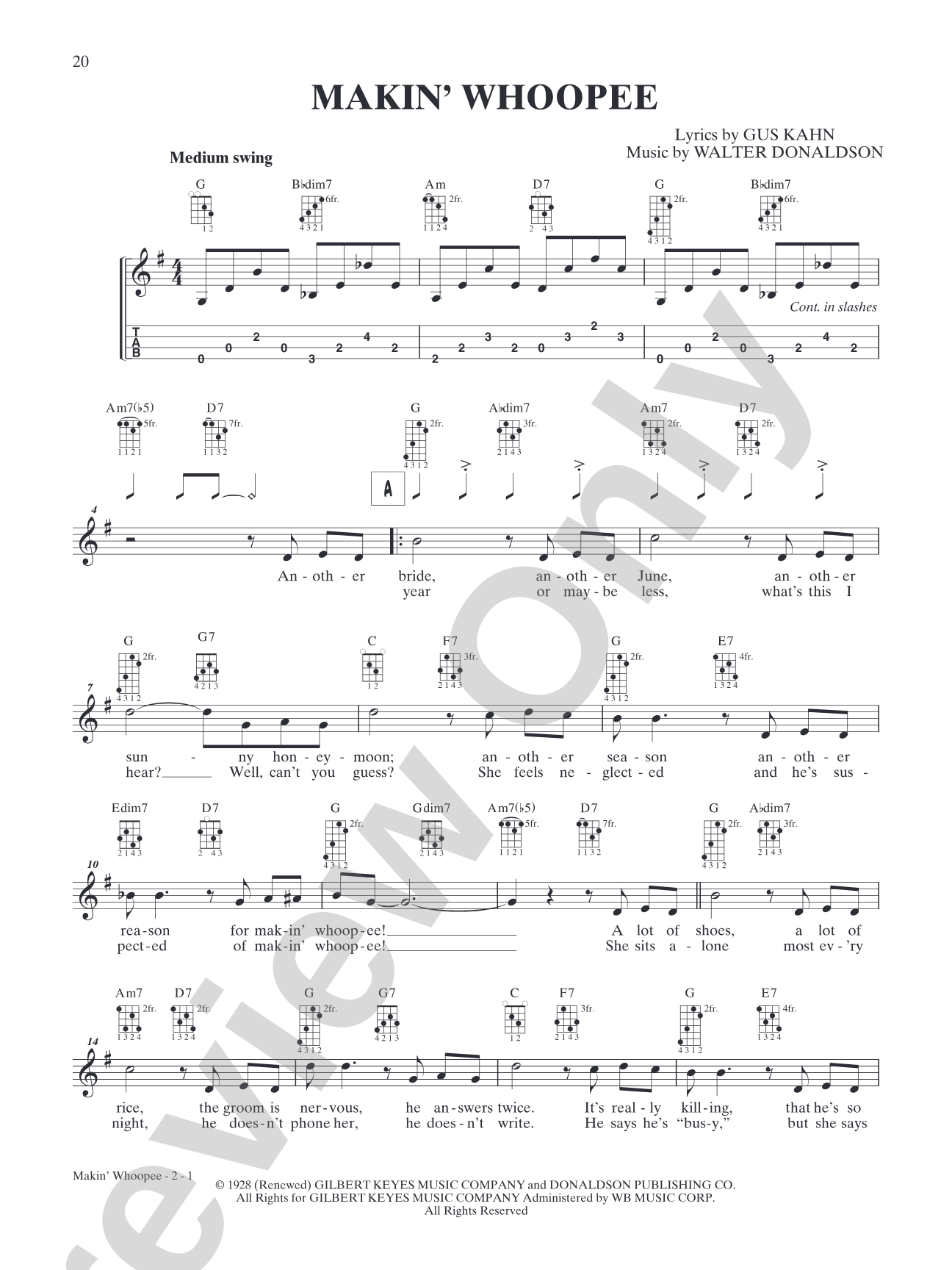

Makin' Whoopee: Mandolin TAB
12 Great Songs of the '20s & '30s
Item: 00-PS-0011776
$4.99
One moment…
Related Items
Five Foot Two, Eyes of Blue: Mandolin TAB |
$4.99
|
View | |
Ain't Misbehavin': Mandolin TAB |
$4.99
|
View | |
It Don't Mean a Thing: Mandolin TAB |
$4.99
|
View | |
Tonight You Belong to Me: Mandolin TAB |
$4.99
|
View | |
As Time Goes By: Mandolin TAB |
$4.99
|
View | |
It Had to Be You: Mandolin TAB |
$4.99
|
View | |
Sweet Georgia Brown: Mandolin TAB |
$4.99
|
View | |
Ain't She Sweet: Mandolin TAB |
$4.99
|
View | |
I'll See You in My Dreams: Mandolin TAB |
$4.99
|
View | |
Dream a Little Dream of Me: Mandolin TAB |
$4.99
|
View |
Description
Swingin' Jazz Mandolin is designed for your total enjoyment. Each song is arranged in a fun and lively way with a strum-and-sing approach. The chords are simple, yet entirely appropriate to the jazz-age style of the '20s and '30s---the era of the great mandolin orchestras before the popularity of the guitar. We've also included classic intros, endings, and turnarounds that will make you sound like an authentic early jazzer. Titles: Ain't Misbehavin' * Ain't She Sweet * As Time Goes By * Bye Bye Blackbird * Dream a Little Dream of Me * Five Foot Two, Eyes of Blue * I'll See You in My Dreams * It Don't Mean a Thing (If It Ain't Got That Swing) * It Had to Be You * Makin' Whoopee * Sweet Georgia Brown * Tonight You Belong to Me.


Makin' Whoopee: Mandolin TAB isn't in MakeMusic Cloud just yet...but it could be. Let us know you'd like to see it, and you'll help shape what comes next. In the meantime, start a free trial and dive into thousands of interactive titles your students can play along with today.
Request This Title
Tell us you want it.
Start Your Free Trial
Explore everything that's ready to play right now.
Sample Audio
No sample audio found.
Sample Video
No sample videos found.
Additional Details
Series:
Just for Fun
Publisher:
Alfred Music
Page Count:
40
SKU:
00-PS-0011776
More about this title
About the Composer: Gus Kahn
Gus Kahn (1886-1941) was one of the most prolific lyricists of the jazz age, crafting witty, conversational lyrics that captured the spirit and humor of 1920s and '30s America. His collaborations with composers like Walter Donaldson produced standards that defined the era, from the playful sass of "Makin' Whoopee" to the romantic yearning of "It Had to Be You." Kahn's gift for singable, memorable lines made his work ideal for the mandolin orchestras that dominated popular music before the guitar took over.
While primarily known as a lyricist, Kahn's contributions to "Makin' Whoopee" (with Donaldson) showcase his deep understanding of melody and phrasing. His songs remain teaching staples because they balance accessibility with genuine sophistication, giving students real jazz vocabulary to work with.
Why we love this
These 12 standards capture mandolin's moment as a serious jazz voice, and the TAB format makes them immediately playable without years of reading chops. The arrangements respect authentic jazz-age voicings while keeping chord progressions straightforward, so players can focus on the swing feel, turnarounds, and the strum-and-sing approach that makes early jazz mandolin sound so alive and conversational.
What to expect
Playful, sophisticated, and deeply swinging. These songs carry the wit and optimism of the jazz age, with harmonies that feel both familiar and distinctly vintage. The mandolin's bright, percussive voice cuts through like the sound of a crowded speakeasy, full of energy and charm without a trace of kitsch.
Who it's for
Mandolin players drawn to jazz history and the pre-swing era sound, from intermediate sight readers exploring TAB-based learning to experienced players looking to round out their repertoire with authentic '20s and '30s material. This collection works equally well for solo recital preparation or ensemble reading sessions where period authenticity matters.
How to get the most out of it
- Lean into the swing eighth-note feel rather than playing evenly; these songs live in the space between the beat, not on top of it.
- Study the classic intros and endings provided; they teach you period-authentic phrasing that separates casual playing from convincing interpretation.
- Let the chords breathe during the melody sections; resist the urge to fill every moment with strumming, especially on ballads like "As Time Goes By."
- Practice the turnarounds slowly to lock them in your muscle memory; they're the connective tissue that makes transitions sound effortless.
How to use it
String ensemble directors can extract these as solo features over a rhythm section to introduce students to jazz idiom and period style. Solo recitalists use them to anchor a program theme around American songbook repertoire or early jazz history, and they work beautifully in casual performance settings where the strum-and-sing approach invites audience familiarity.
Skills your students will build
- Reading TAB notation alongside chord symbols
- Interpreting swing articulation and eighth-note feel
- Executing jazz-style turnarounds and transition passages
- Voicing jazz chords on the mandolin fretboard
- Balancing melody line with rhythmic accompaniment in a strum-and-sing format