
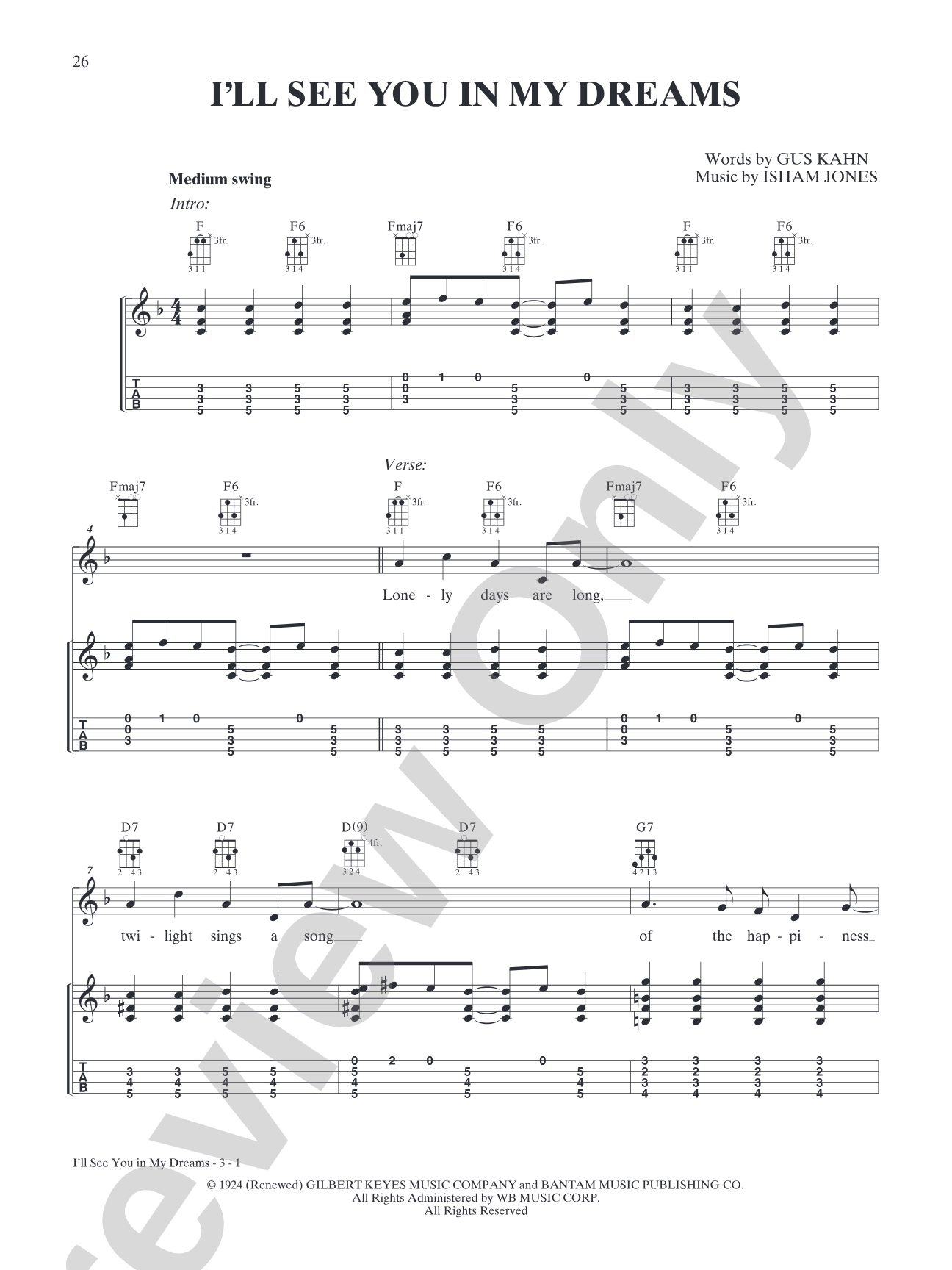

I'll See You in My Dreams: Mandolin TAB
12 Great Songs of the '20s & '30s
Item: 00-PS-0011936
$4.99
Pickup currently not available
Related Items
Makin' Whoopee: Mandolin TAB |
$4.99
|
View | |
Five Foot Two, Eyes of Blue: Mandolin TAB |
$4.99
|
View | |
Ain't Misbehavin': Mandolin TAB |
$4.99
|
View | |
It Don't Mean a Thing: Mandolin TAB |
$4.99
|
View | |
Tonight You Belong to Me: Mandolin TAB |
$4.99
|
View | |
As Time Goes By: Mandolin TAB |
$4.99
|
View | |
It Had to Be You: Mandolin TAB |
$4.99
|
View | |
Sweet Georgia Brown: Mandolin TAB |
$4.99
|
View | |
Ain't She Sweet: Mandolin TAB |
$4.99
|
View | |
Dream a Little Dream of Me: Mandolin TAB |
$4.99
|
View |
Description
Swingin' Jazz Mandolin is designed for your total enjoyment. Each song is arranged in a fun and lively way with a strum-and-sing approach. The chords are simple, yet entirely appropriate to the jazz-age style of the '20s and '30s---the era of the great mandolin orchestras before the popularity of the guitar. We've also included classic intros, endings, and turnarounds that will make you sound like an authentic early jazzer. Titles: Ain't Misbehavin' * Ain't She Sweet * As Time Goes By * Bye Bye Blackbird * Dream a Little Dream of Me * Five Foot Two, Eyes of Blue * I'll See You in My Dreams * It Don't Mean a Thing (If It Ain't Got That Swing) * It Had to Be You * Makin' Whoopee * Sweet Georgia Brown * Tonight You Belong to Me.


I'll See You in My Dreams: Mandolin TAB isn't in MakeMusic Cloud just yet...but it could be. Let us know you'd like to see it, and you'll help shape what comes next. In the meantime, start a free trial and dive into thousands of interactive titles your students can play along with today.
Request This Title
Tell us you want it.
Start Your Free Trial
Explore everything that's ready to play right now.
Sample Audio
No sample audio found.
Sample Video
No sample videos found.
Additional Details
Series:
Just for Fun
Publisher:
Alfred Music
Page Count:
40
SKU:
00-PS-0011936
More about this title
About the Composer: Gus Kahn
Gus Kahn (1886-1941) was one of the most prolific lyricists of the jazz age, collaborating with composers like Isham Jones to create standards that defined the 1920s and 1930s. His gift for memorable melodies paired with accessible, singable lyrics made his work ideal for both professional ensembles and amateur musicians. Kahn understood what made a song stick with audiences, and his catalog remains a cornerstone of jazz and popular music education.
Why we love this
This collection captures the mandolin's glory days with carefully chosen standards that sit perfectly in the instrument's natural register and strumming style. The arrangements honor authentic '20s and '30s sensibilities without overcomplicating the playing experience, making these songs immediately satisfying for mandolinists who want to sound accomplished without wrestling through complex voicings.
What to expect
These arrangements breathe with the energy and style of the jazz age, offering you the chance to inhabit a specific time and place in music history through your playing. The familiar melodies pair with the mandolin's natural brightness and resonance to create something warm, playful, and genuinely fun to perform.
Who it's for
Mandolinists at early-intermediate level who want to play authentic jazz standards in a fun, accessible format will find exactly what they need here. Whether you're building a recital program, exploring jazz repertoire for the first time, or simply rediscovering the mandolin's place in American music history, this collection speaks directly to players who love melody and swing.
How to get the most out of it
- Pay attention to the classic intros and endings included here; these phrase shapes are what distinguish early jazz-era mandolin playing from casual strumming.
- Keep the rhythm driving but relaxed. The 'strum-and-sing' approach works best when you commit to steady pulse without rushing through the changes.
- Use the suggested chord voicings as written first, then experiment with substitutions once the melody feels natural in your hands.
- Listen to recordings of mandolin orchestras from the 1920s to absorb the articulation and warmth these arrangements are designed to evoke.
How to use it
Build an entire recital or concert set around these standards, or integrate individual selections into a program that explores different eras and genres on mandolin. This collection also works beautifully for informal performances, social gatherings, and community events where audiences respond well to recognizable jazz-age repertoire.
Skills your students will build
- Jazz chord reading and interpretation on fretted instruments
- Strum patterns and rhythmic articulation in swing style
- Melodic phrasing and lyrical singing while playing
- Recognition and performance of classic jazz turnarounds and intros
- Ornamentation and stylistic flourishes in early jazz idiom