
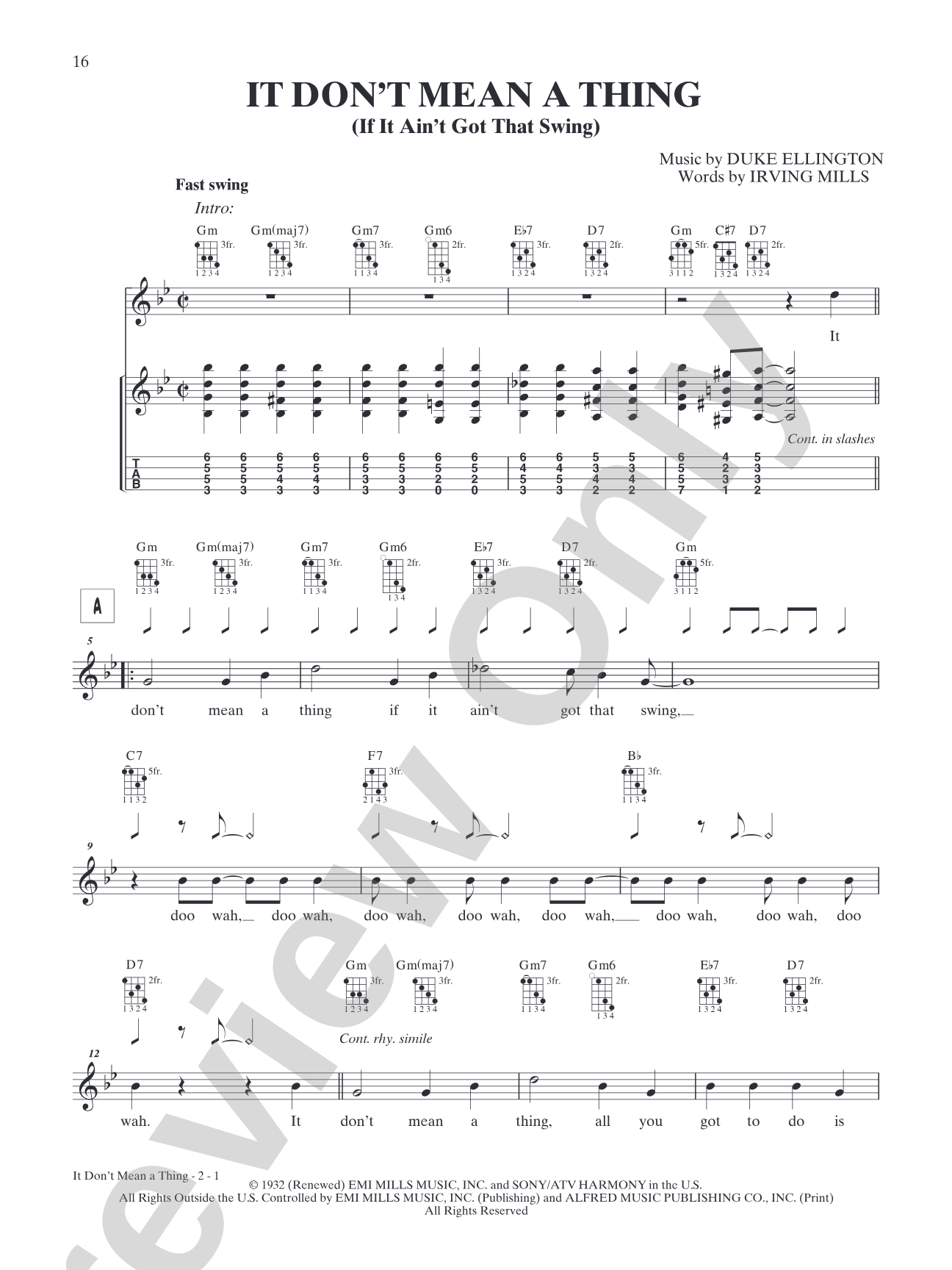

It Don't Mean a Thing: Mandolin TAB
12 Great Songs of the '20s & '30s
Item: 00-PS-0011799
$4.99
One moment…
Related Items
Makin' Whoopee: Mandolin TAB |
$4.99
|
View | |
Five Foot Two, Eyes of Blue: Mandolin TAB |
$4.99
|
View | |
Ain't Misbehavin': Mandolin TAB |
$4.99
|
View | |
Tonight You Belong to Me: Mandolin TAB |
$4.99
|
View | |
As Time Goes By: Mandolin TAB |
$4.99
|
View | |
It Had to Be You: Mandolin TAB |
$4.99
|
View | |
Sweet Georgia Brown: Mandolin TAB |
$4.99
|
View | |
Ain't She Sweet: Mandolin TAB |
$4.99
|
View | |
I'll See You in My Dreams: Mandolin TAB |
$4.99
|
View | |
Dream a Little Dream of Me: Mandolin TAB |
$4.99
|
View |
Description
Swingin' Jazz Mandolin is designed for your total enjoyment. Each song is arranged in a fun and lively way with a strum-and-sing approach. The chords are simple, yet entirely appropriate to the jazz-age style of the '20s and '30s---the era of the great mandolin orchestras before the popularity of the guitar. We've also included classic intros, endings, and turnarounds that will make you sound like an authentic early jazzer. Titles: Ain't Misbehavin' * Ain't She Sweet * As Time Goes By * Bye Bye Blackbird * Dream a Little Dream of Me * Five Foot Two, Eyes of Blue * I'll See You in My Dreams * It Don't Mean a Thing (If It Ain't Got That Swing) * It Had to Be You * Makin' Whoopee * Sweet Georgia Brown * Tonight You Belong to Me.


Discover MakeMusic Cloud: thousands of interactive titles your students can play along with today.
Sample Audio
No sample audio found.
Sample Video
No sample videos found.
Additional Details
Series:
Just for Fun
Publisher:
Alfred Music
Page Count:
40
SKU:
00-PS-0011799
More about this title
About the Composer: Duke Ellington
Duke Ellington (1899-1974) stands as one of the most important composers in American music history. His work transformed jazz from improvised entertainment into a sophisticated art form worthy of concert halls, while his prolific output across seven decades produced thousands of compositions ranging from three-minute songs to extended orchestral works. Ellington's harmonic innovations and orchestral color became foundational to jazz vocabulary, and his influence extends far beyond jazz into classical, popular, and educational music.
As a bandleader, composer, and pianist, Ellington created music that was simultaneously intellectually complex and immediately engaging. His collaborations with lyricist Irving Mills produced many of the standards that defined the Jazz Age, songs that continue to delight musicians and audiences because they balance melodic accessibility with genuine sophistication.
Why we love this
This collection captures the mandolin's authentic role in early jazz history, when it was a lead voice rather than a rhythm instrument. The arrangements honor the orchestral clarity and harmonic sophistication Ellington was famous for while remaining playable by mandolinists at intermediate levels. Programming standards from the Jazz Age on mandolin creates an unexpected and genuinely swinging concert moment that most audiences have never heard before.
What to expect
These tunes sparkle with the sophisticated joy of the Jazz Age, when the mandolin's bright, cutting tone made it a natural fit for dance bands and orchestral ensembles. The swing feel invites you to relax into a groove while the classic chord progressions and melodic shapes keep your fingers engaged. Playing through this collection feels like stepping into a speakeasy where the music is clever, the energy is playful, and everyone in the room understands the language of swing.
Who it's for
Mandolinists who want to move beyond fingerstyle classical repertoire and explore the instrument's jazz heritage will find genuine material here. Whether you're an intermediate player building performance confidence or an experienced mandolinist curious about early jazz idioms, these standard tunes paired with TAB notation make them immediately accessible. This is ideal for musicians who enjoy swinging rhythm and want their mandolin to do more than one musical thing.
How to get the most out of it
- Treat the strum patterns as flexible guides, not rigid metronomes. Jazz phrasing lives in the space around the beat, so let your sense of swing feel slightly behind the pulse where natural.
- Study the classic intros and endings provided before the tune starts. These turnarounds establish the early jazz idiom and give your performance immediate authenticity.
- Balance the chords and melody line carefully. Simple chords don't mean accompaniment only; mandolin's brightness means your harmonic work will be heard, so shape those chord voicings with intention.
- Listen to recordings of 1920s-30s mandolin orchestras to hear how tempo and articulation created the swing feel. These tunes were written for ensembles, so consider how your solo mandolin interpretation can suggest that fuller sound.
How to use it
Feature a single arrangement in a pops or jazz-themed concert to introduce audiences to mandolin's pre-guitar jazz history. A recital performer could build a short mandolin jazz set using three or four tunes from this book, paired perhaps with classical pieces to show the instrument's range. For a community or school concert, these standards work well in a mixed-instrumentation jazz setting where mandolin serves as a featured soloist voice alongside piano, bass, and drums.
Skills your students will build
- Swing phrasing and rhythmic interpretation in a jazz context
- Jazz chord voicings and harmonic sophistication appropriate to the era
- Strum-pattern flexibility and timing within a jazz ensemble feel
- Reading TAB notation fluently while connecting it to melody and harmony
- Understanding the mandolin's authentic role in early 20th-century jazz