
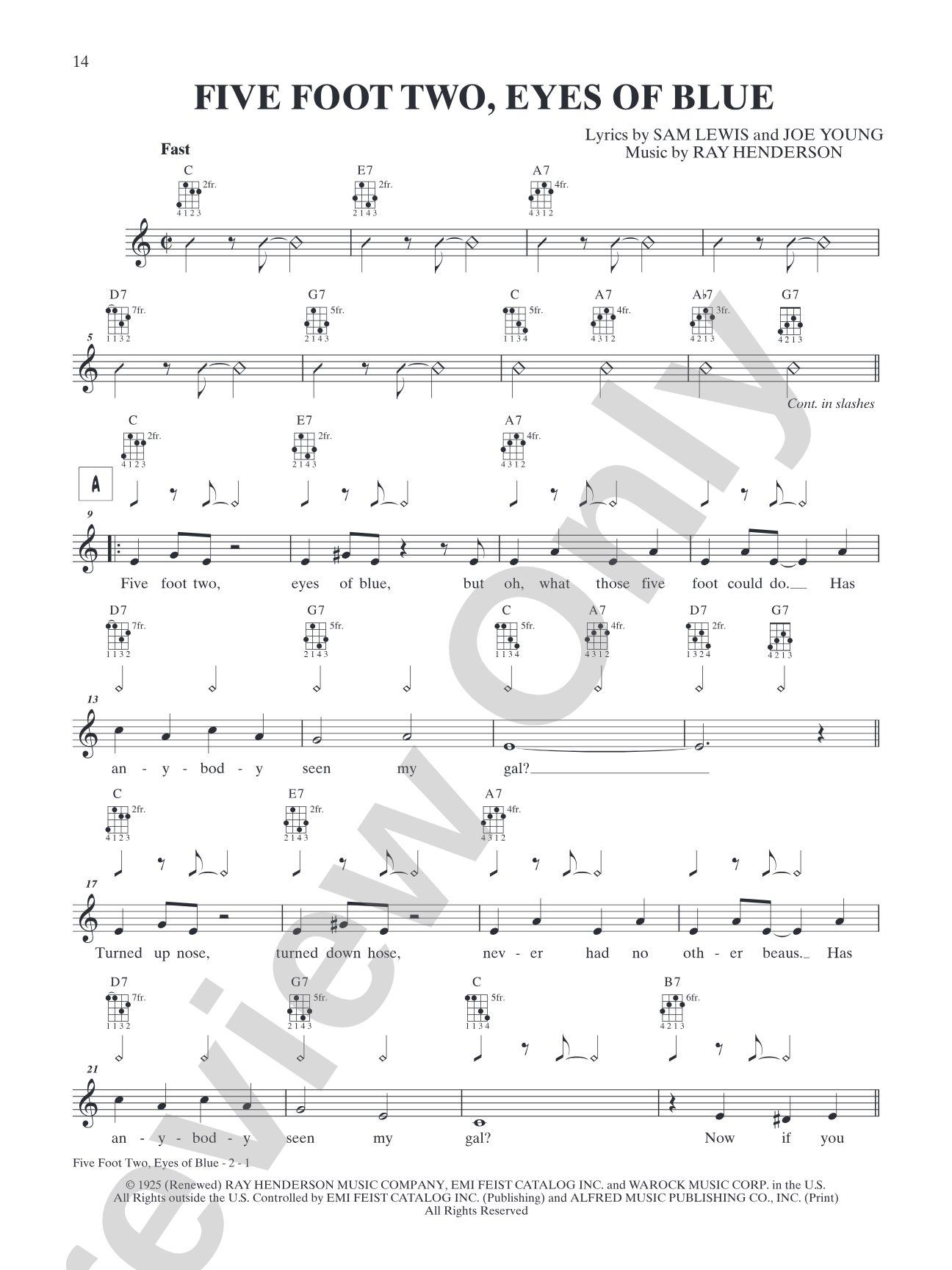

Five Foot Two, Eyes of Blue: Mandolin TAB
12 Great Songs of the '20s & '30s
Item: 00-PS-0011781
$4.99
One moment…
Related Items
Makin' Whoopee: Mandolin TAB |
$4.99
|
View | |
Ain't Misbehavin': Mandolin TAB |
$4.99
|
View | |
It Don't Mean a Thing: Mandolin TAB |
$4.99
|
View | |
Tonight You Belong to Me: Mandolin TAB |
$4.99
|
View | |
As Time Goes By: Mandolin TAB |
$4.99
|
View | |
It Had to Be You: Mandolin TAB |
$4.99
|
View | |
Sweet Georgia Brown: Mandolin TAB |
$4.99
|
View | |
Ain't She Sweet: Mandolin TAB |
$4.99
|
View | |
I'll See You in My Dreams: Mandolin TAB |
$4.99
|
View | |
Dream a Little Dream of Me: Mandolin TAB |
$4.99
|
View |
Description
Swingin' Jazz Mandolin is designed for your total enjoyment. Each song is arranged in a fun and lively way with a strum-and-sing approach. The chords are simple, yet entirely appropriate to the jazz-age style of the '20s and '30s---the era of the great mandolin orchestras before the popularity of the guitar. We've also included classic intros, endings, and turnarounds that will make you sound like an authentic early jazzer. Titles: Ain't Misbehavin' * Ain't She Sweet * As Time Goes By * Bye Bye Blackbird * Dream a Little Dream of Me * Five Foot Two, Eyes of Blue * I'll See You in My Dreams * It Don't Mean a Thing (If It Ain't Got That Swing) * It Had to Be You * Makin' Whoopee * Sweet Georgia Brown * Tonight You Belong to Me.


Discover MakeMusic Cloud: thousands of interactive titles your students can play along with today.
Sample Audio
No sample audio found.
Sample Video
No sample videos found.
Additional Details
Series:
Just for Fun
Publisher:
Alfred Music
Page Count:
40
SKU:
00-PS-0011781
More about this title
About the Composer: Ray Henderson
Ray Henderson (1896-1970) was one of the most prolific songwriters of the Jazz Age, composing dozens of standards that defined the sound of 1920s Broadway and popular music. His melodies were crafted to be memorable and singable, whether for theatrical productions or the dance orchestras that dominated the era. Henderson's collaborations with lyricists Joe Young and Sam M. Lewis produced some of the decade's most enduring tunes, many of which remain central to jazz and popular music pedagogy today.
Henderson's gift was for writing songs that felt both sophisticated and accessible. His work with mandolin orchestras reflected a moment when the mandolin was still a serious jazz instrument, before the guitar's dominance reshaped popular music. His compositions remain ideal vehicles for introducing musicians to the rhythmic language and harmonic vocabulary of the jazz era.
Why we love this
This folio captures the mandolin's place in jazz history at a moment when it was a lead voice in ensemble playing, not an afterthought. The chord voicings and strum patterns are rooted in authentic 1920s-30s style without requiring advanced jazz vocabulary. Mandolinists get to explore swing-era classics while learning genuine period technique through the intros, endings, and turnarounds that make these arrangements sound like they belong in an early jazz context.
What to expect
Playful and buoyant. These are songs built for enjoyment, not struggle, with the kind of rhythmic lift and melodic clarity that made them popular a century ago. The mandolin's brightness pairs perfectly with the optimism and energy of jazz-age standards, creating a sound that feels both nostalgic and vital.
Who it's for
Mandolinists who want to venture beyond folk and classical traditions into jazz repertoire without needing advanced jazz theory. Players at the intermediate level who read TAB comfortably and have chord knowledge will find these arrangements accessible and rewarding. This is especially valuable for musicians interested in early jazz history or those looking to expand what a mandolin can do musically.
How to get the most out of it
- Anchor your rhythm with steady downstrokes on the beat; the mandolin's natural brightness shines when the pulse is clear and unwavering.
- Study the suggested intros and endings on the page as fully as you'd study the melody. These are teaching moments disguised as ornamentation.
- Let the chords breathe rather than rushing them. The jazz standards of this era were written with space in mind, and your accompaniment should reflect that pacing.
- Experiment with dampening the strings after chords to match the percussive, rhythmic quality of period mandolin orchestras. Clean stops shape the swing feel.
How to use it
Feature one of these arrangements in a coffeehouse recital or informal concert where the mandolin's acoustic presence works naturally. Pair it with other fretted instruments if possible, echoing the ensemble tradition these songs come from. This folio also works well as supplemental repertoire for players who want to explore jazz without committing to a full jazz curriculum.
Skills your students will build
- Reading mandolin TAB fluently
- Understanding jazz-era chord progressions and harmony
- Executing swing rhythm and understanding the pulse behind jazz phrasing
- Playing classic intros, endings, and turnarounds as compositional and stylistic devices
- Developing accompaniment sensitivity through strum-and-sing technique