
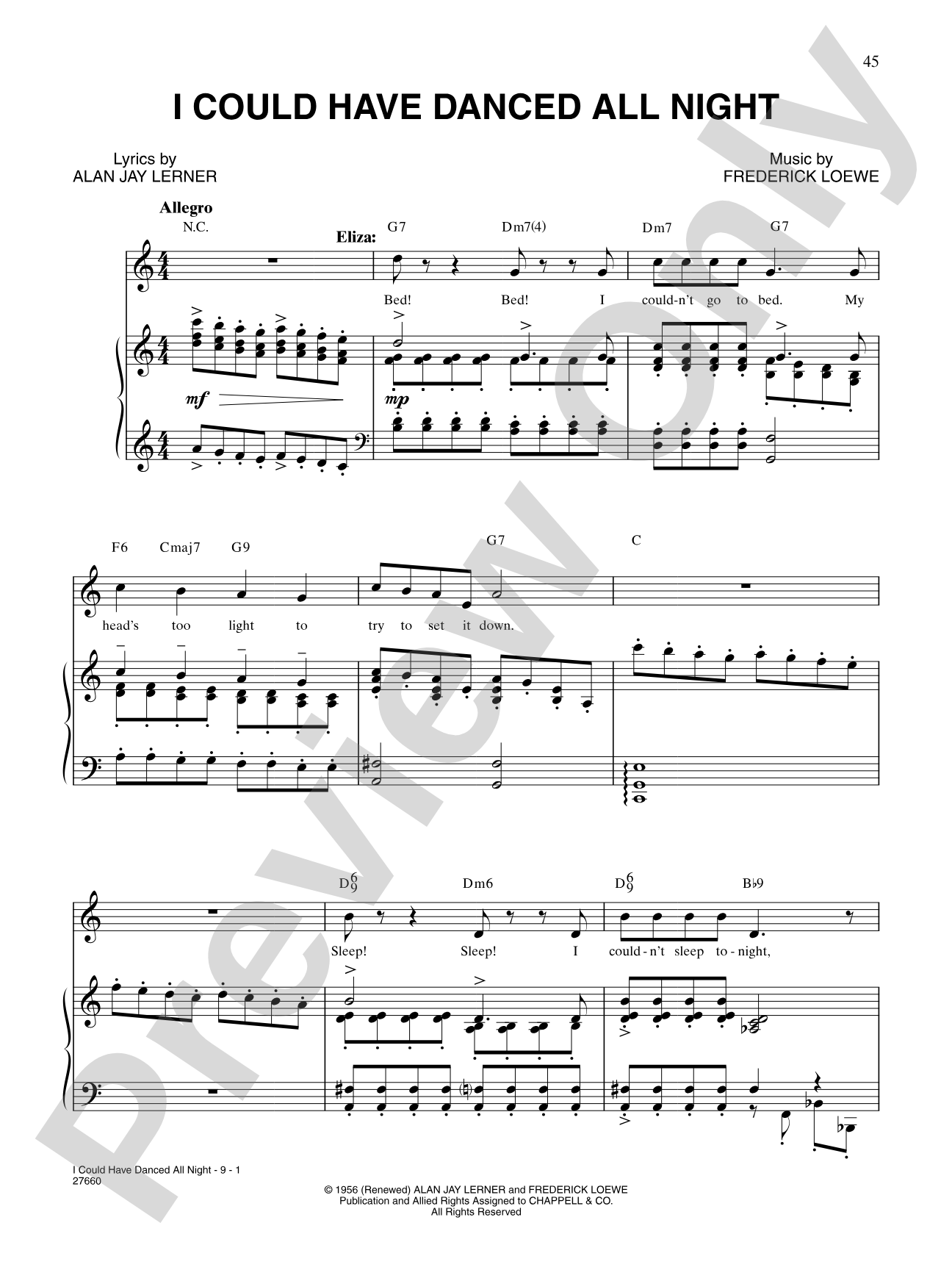
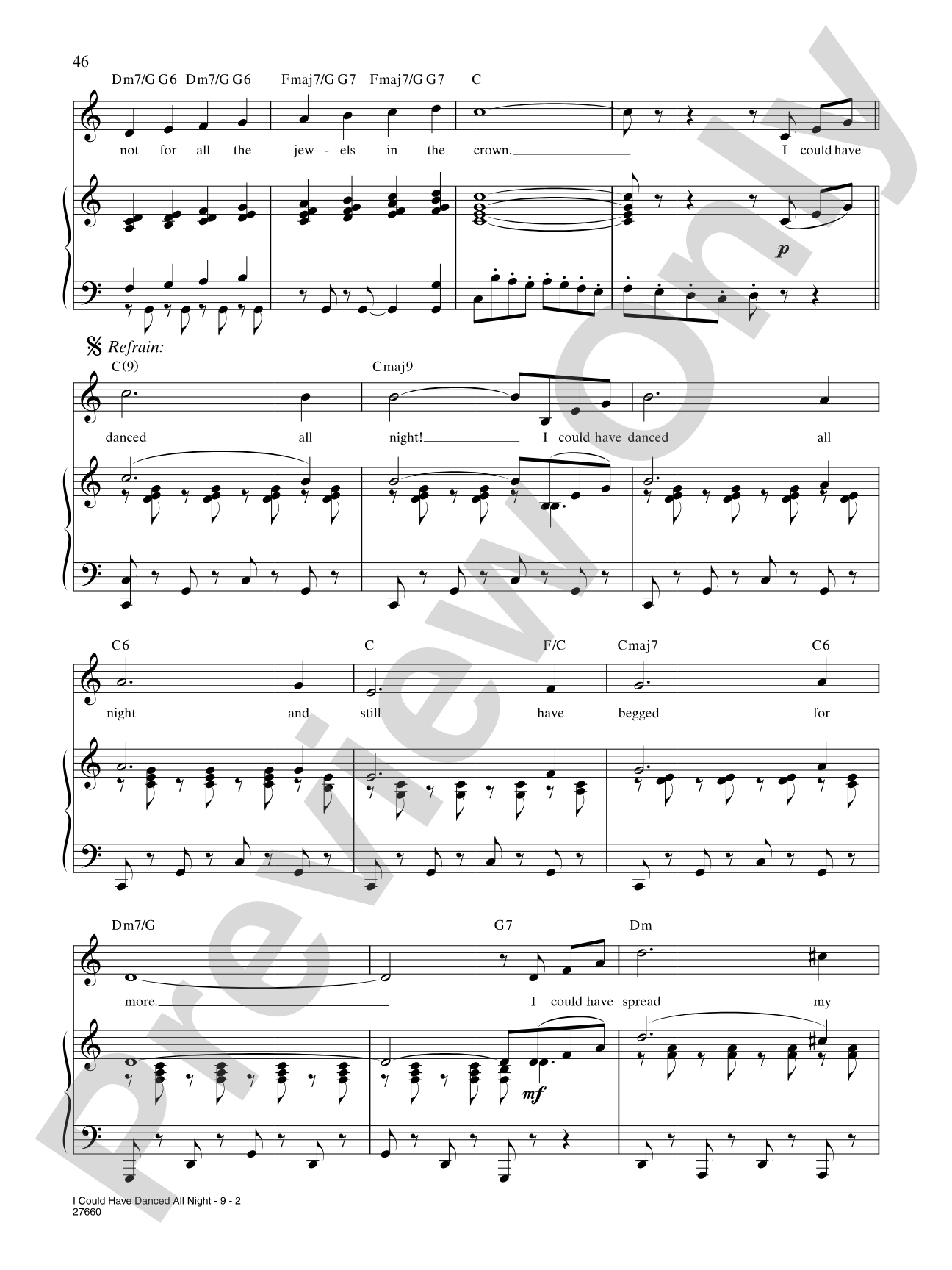

I Could Have Danced All Night
(from "My Fair Lady"): Piano/Vocal/Chords
Lyrics by Alan Jay Lerner, music by Frederick Loewe
Item: 00-PSP-000196
$5.99
One moment…
Related Items
Get Me To The Church On Time (from "My Fair Lady"): Piano/Vocal/Chords |
$4.99
|
View | |
I'm An Ordinary Man (from "My Fair Lady"): Piano/Vocal/Chords |
$9.99
|
View | |
I've Grown Accustomed To Her Face (from "My Fair Lady"): Piano/Vocal/Chords |
$9.99
|
View | |
Just You Wait (from "My Fair Lady"): Piano/Vocal/Chords |
$5.99
|
View | |
On The Street Where You Live (from "My Fair Lady"): Piano/Vocal/Chords |
$4.99
|
View | |
Show Me (from "My Fair Lady"): Piano/Vocal/Chords |
$5.99
|
View | |
The Rain In Spain (from "My Fair Lady"): Piano/Vocal/Chords |
$4.99
|
View | |
Why Can't The English? (from "My Fair Lady"): Piano/Vocal/Chords |
$5.99
|
View | |
With A Little Bit Of Luck (from "My Fair Lady"): Piano/Vocal/Chords |
$5.99
|
View | |
Without You (from "My Fair Lady"): Piano/Vocal/Chords |
$5.99
|
View | |
Wouldn't It Be Loverly (from "My Fair Lady"): Piano/Vocal/Chords |
$4.99
|
View |
Description
My Fair Lady is the classic stage musical based on George Bernard Shaw's book Pygmalion. The musical was later adapted for film, and the movie, starring Rex Harrison and Audrey Hepburn, was released in 1964. This book features selections from the musical, providing the lyrics along with piano and chord arrangements for all the songs included.
Titles: Get Me to the Church on Time * I Could Have Danced All Night * I'm an Ordinary Man * I've Grown Accustomed to Her Face * Just You Wait * On the Street Where You Live * The Rain in Spain * Show Me * Why Can't the English? * With a Little Bit of Luck * Without You * Wouldn't It Be Loverly.


Titles: Get Me to the Church on Time * I Could Have Danced All Night * I'm an Ordinary Man * I've Grown Accustomed to Her Face * Just You Wait * On the Street Where You Live * The Rain in Spain * Show Me * Why Can't the English? * With a Little Bit of Luck * Without You * Wouldn't It Be Loverly.
I Could Have Danced All Night
(from "My Fair Lady"): Piano/Vocal/Chords isn't in MakeMusic Cloud just yet...but it could be. Let us know you'd like to see it, and you'll help shape what comes next. In the meantime, start a free trial and dive into thousands of interactive titles your students can play along with today.
Request This Title
Tell us you want it.
Start Your Free Trial
Explore everything that's ready to play right now.
Sample Audio
No sample audio found.
Sample Video
No sample videos found.
Additional Details
Series:
Alfred's Classic Musical Editions
Publisher:
Alfred Music
Page Count:
104
SKU:
00-PSP-000196
More about this title
About the Composer: Frederick Loewe
Frederick Loewe (1901-1988) composed the melodies that made My Fair Lady a cornerstone of American musical theater. Born in Vienna and trained in classical composition, Loewe brought European sophistication to Broadway while crafting songs that feel inevitable and singable. His collaborations with lyricist Alan Jay Lerner created some of the most enduring music in the American songbook, and his influence on musical composition extends far beyond the stage.
Why we love this
This collection gives singers and pianists direct access to some of the most beloved material in musical theater without requiring a full production setup. The chord symbols make it genuinely playable for accompanists at varying levels, while the complete lyrics keep the storytelling intact. Programming a medley or individual songs from this score signals sophistication and works equally well in concert, recital, or cabaret-style settings.
What to expect
Opening this score feels like stepping into a London parlor where wit, romance, and social comedy dance across every page. The music carries the lightness and charm of its source material while maintaining the elegance that made My Fair Lady a timeless story. Each song captures a distinct emotional moment, from the exuberance of a character discovering joy to the quiet vulnerability of reluctant affection.
Who it's for
Singers preparing audition material or recital repertoire will find polished, singable arrangements alongside the original lyrics and context. Pianists accompanying vocalists, whether in studio or performance, gain both the melodic line and harmonic framework needed to support a singer's interpretation. Community theater performers, amateur singers, and voice students benefit from having a complete score that balances accessibility with theatrical authenticity.
How to get the most out of it
- Pay attention to the lyrical phrasing in the vocal line; these melodies were written to serve the text, so let the words guide your breath and phrase shapes rather than treating them as pure music.
- Use the chord symbols to find flexibility in your accompaniment. You can simplify dense voicings or add movement between changes depending on your technique level and the character you're building.
- Listen to the original cast recording or film versions to absorb the rhythmic energy and style conventions of the era; Lerner and Loewe's wit lives in the tempo and articulation choices.
How to use it
Solo numbers from this score work beautifully in American songbook recitals or themed concerts exploring musical theater classics. A carefully chosen medley of 2-3 contrasting selections showcases the range Loewe wrote into this score and demonstrates a singer's ability to shift character and mood. For voice studio instructors, these songs offer repertoire that combines technical musicality with the dramatic storytelling that builds performing maturity.
Skills your students will build
- Singing through rhythmic complexity without losing legibility of text
- Interpreting chord symbols and realizing simple to moderately voiced accompaniments
- Sustaining theatrical character and emotional truth within a song's narrative arc
- Balancing vocal line independence with harmonic support in piano/vocal partnerships
- Understanding the relationship between lyrical content and melodic shape