
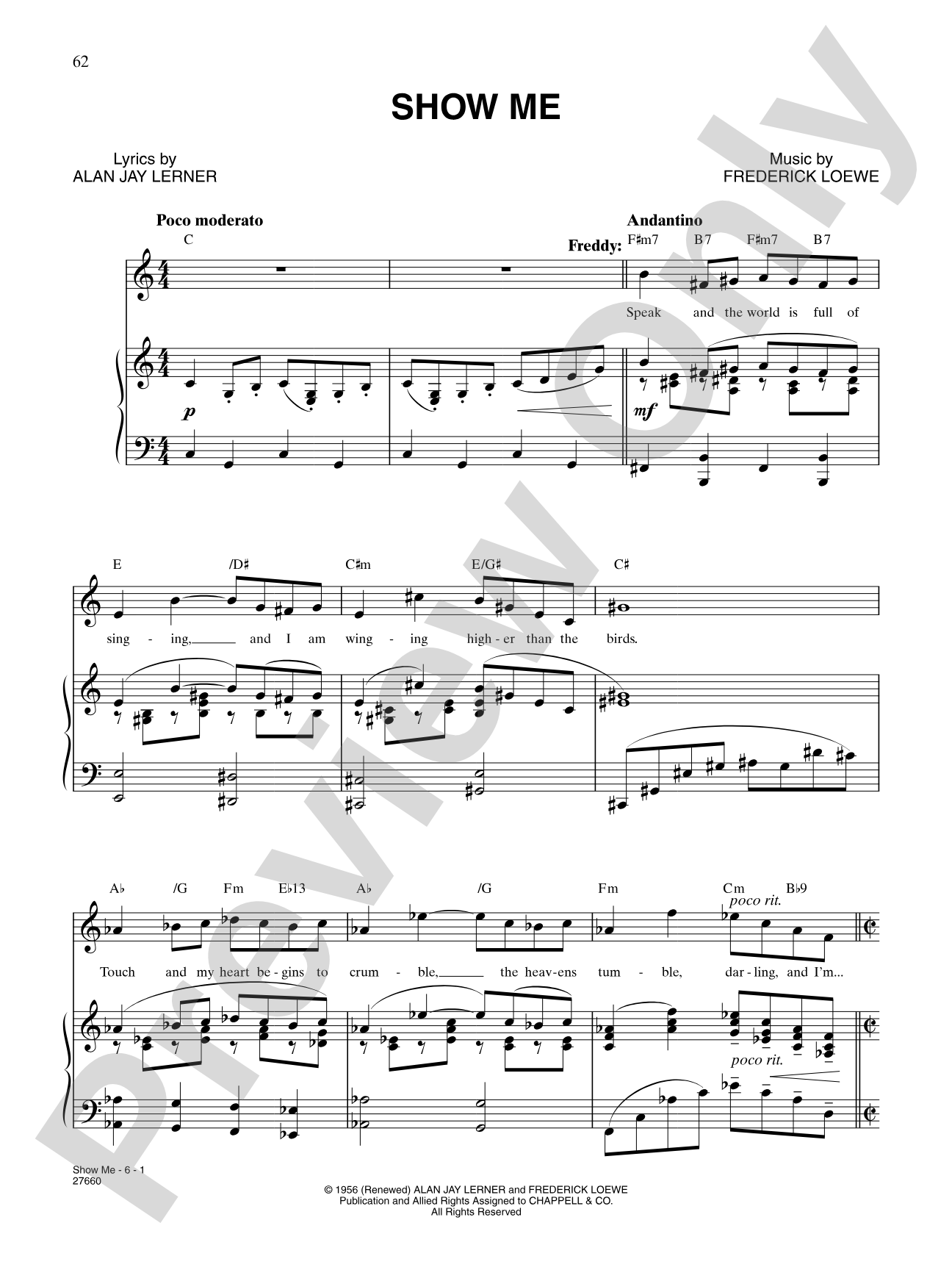
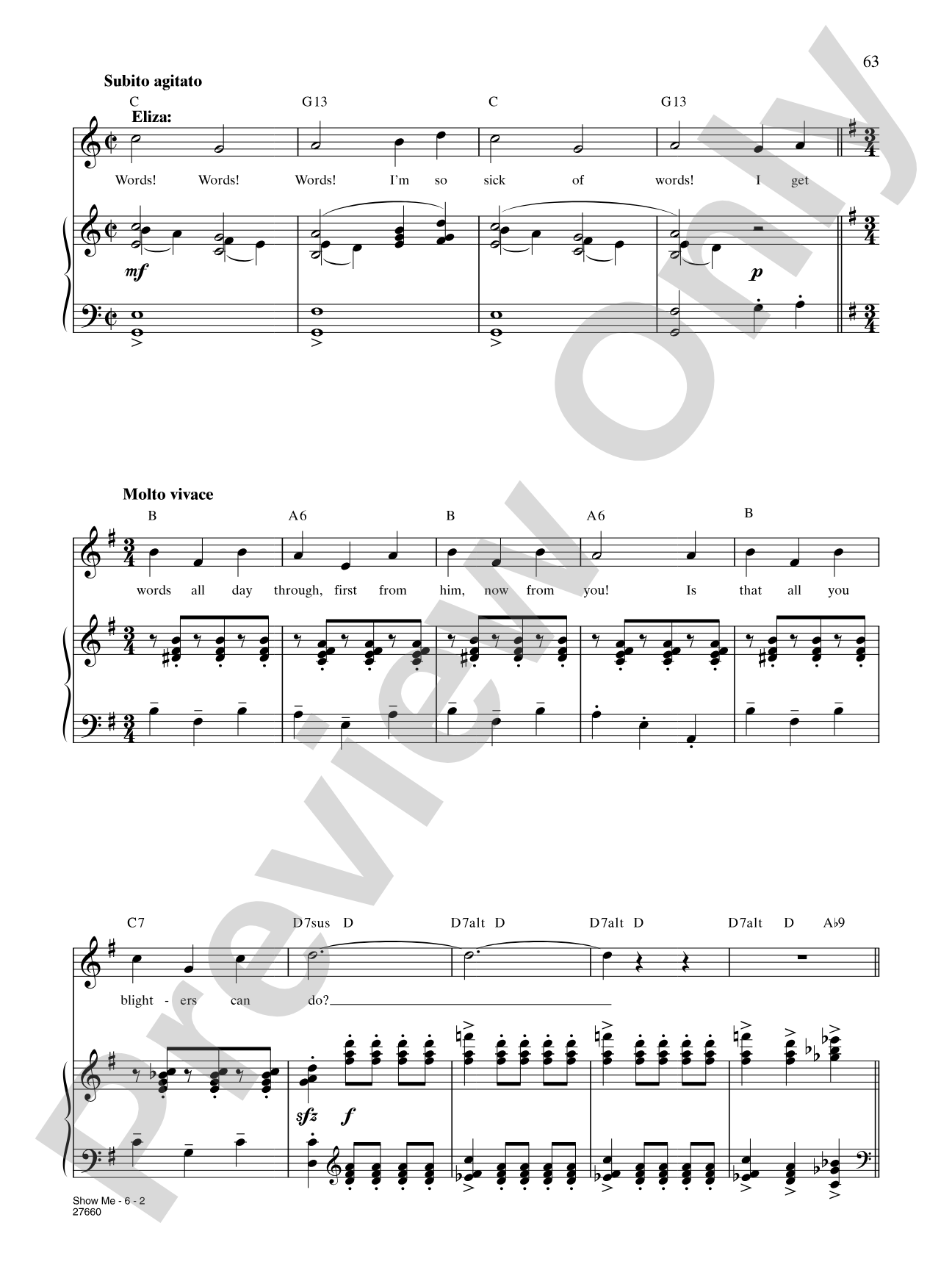

Show Me (from "My Fair Lady"): Piano/Vocal/Chords
Lyrics by Alan Jay Lerner, music by Frederick Loewe
Item: 00-PSP-000201
$5.99
One moment…
Related Items
Get Me To The Church On Time (from "My Fair Lady"): Piano/Vocal/Chords |
$4.99
|
View | |
I Could Have Danced All Night
|
$5.99
|
View | |
I'm An Ordinary Man (from "My Fair Lady"): Piano/Vocal/Chords |
$9.99
|
View | |
I've Grown Accustomed To Her Face (from "My Fair Lady"): Piano/Vocal/Chords |
$9.99
|
View | |
Just You Wait (from "My Fair Lady"): Piano/Vocal/Chords |
$5.99
|
View | |
On The Street Where You Live (from "My Fair Lady"): Piano/Vocal/Chords |
$4.99
|
View | |
The Rain In Spain (from "My Fair Lady"): Piano/Vocal/Chords |
$4.99
|
View | |
Why Can't The English? (from "My Fair Lady"): Piano/Vocal/Chords |
$5.99
|
View | |
With A Little Bit Of Luck (from "My Fair Lady"): Piano/Vocal/Chords |
$5.99
|
View | |
Without You (from "My Fair Lady"): Piano/Vocal/Chords |
$5.99
|
View | |
Wouldn't It Be Loverly (from "My Fair Lady"): Piano/Vocal/Chords |
$4.99
|
View |
Description
My Fair Lady is the classic stage musical based on George Bernard Shaw's book Pygmalion. The musical was later adapted for film, and the movie, starring Rex Harrison and Audrey Hepburn, was released in 1964. This book features selections from the musical, providing the lyrics along with piano and chord arrangements for all the songs included.
Titles: Get Me to the Church on Time * I Could Have Danced All Night * I'm an Ordinary Man * I've Grown Accustomed to Her Face * Just You Wait * On the Street Where You Live * The Rain in Spain * Show Me * Why Can't the English? * With a Little Bit of Luck * Without You * Wouldn't It Be Loverly.


Titles: Get Me to the Church on Time * I Could Have Danced All Night * I'm an Ordinary Man * I've Grown Accustomed to Her Face * Just You Wait * On the Street Where You Live * The Rain in Spain * Show Me * Why Can't the English? * With a Little Bit of Luck * Without You * Wouldn't It Be Loverly.
Show Me (from "My Fair Lady"): Piano/Vocal/Chords isn't in MakeMusic Cloud just yet...but it could be. Let us know you'd like to see it, and you'll help shape what comes next. In the meantime, start a free trial and dive into thousands of interactive titles your students can play along with today.
Request This Title
Tell us you want it.
Start Your Free Trial
Explore everything that's ready to play right now.
Sample Audio
No sample audio found.
Sample Video
No sample videos found.
Additional Details
Series:
Alfred's Classic Musical Editions
Publisher:
Alfred Music
Page Count:
104
SKU:
00-PSP-000201
More about this title
About the Composer: Frederick Loewe
Frederick Loewe (1901-1988) was an Austrian-American composer whose gift for melody transformed musical theater in the mid-20th century. Alongside lyricist Alan Jay Lerner, he created some of Broadway's most enduring scores, including My Fair Lady, which opened in 1956 and became a cultural phenomenon both on stage and screen.
Loewe's music is characterized by sophisticated harmonic language, memorable vocal lines, and orchestrations that serve the drama rather than overshadow it. For music educators, his work remains a cornerstone of musical theater repertoire because it demands genuine musicianship from performers while remaining accessible to serious students.
Why we love this
Show Me stands out as a moment of vulnerability within the musical, requiring singers to balance legit vocal technique with intimate storytelling. The piano/vocal/chords format gives you flexibility to accompany students at various levels while teaching them how contemporary harmonic language (for 1956) still sounds sophisticated and entirely singable.
What to expect
Show Me captures a pivotal character moment: Eliza challenging Freddy to prove his feelings through action rather than romance. The music mirrors her directness with clear, elegant lines and understated orchestration that makes every word land without melodrama.
Who it's for
This arrangement suits singers preparing audition material, voice students exploring musical theater repertoire, and pianists developing collaborative skills in the show music genre. It also works well for students who benefit from seeing chord symbols alongside traditional notation.
How to get the most out of it
- Establish the conversational tone from the opening bars; this is Eliza testing whether Freddy's words match his actions, not a traditional love song declaration.
- Shape the melody across the longer phrases rather than treating each measure as a unit; let the accompaniment support rather than drive the phrasing.
- Balance the chromatic movement in the harmony against a clean, unforced vocal line; the sophistication lies in the writing, not the delivery.
- Pay attention to the lyrical subtext when approaching the repeated sections; small variations in dynamic or articulation deepen the emotional arc.
How to use it
This single song works as a solo audition piece, a master class example of character-driven musical theater writing, or part of a curated evening of Lerner and Loewe selections. It pairs naturally with other moments from My Fair Lady for performers studying the full show, or stands alone for recital programming that includes theatrical repertoire.
Skills your students will build
- Singing through longer melodic phrases without breaking for breath
- Interpreting chord symbols and understanding voice-leading beneath a melody
- Capturing character subtext and emotional restraint in musical theater
- Collaborating with an accompanist using lead sheet notation