
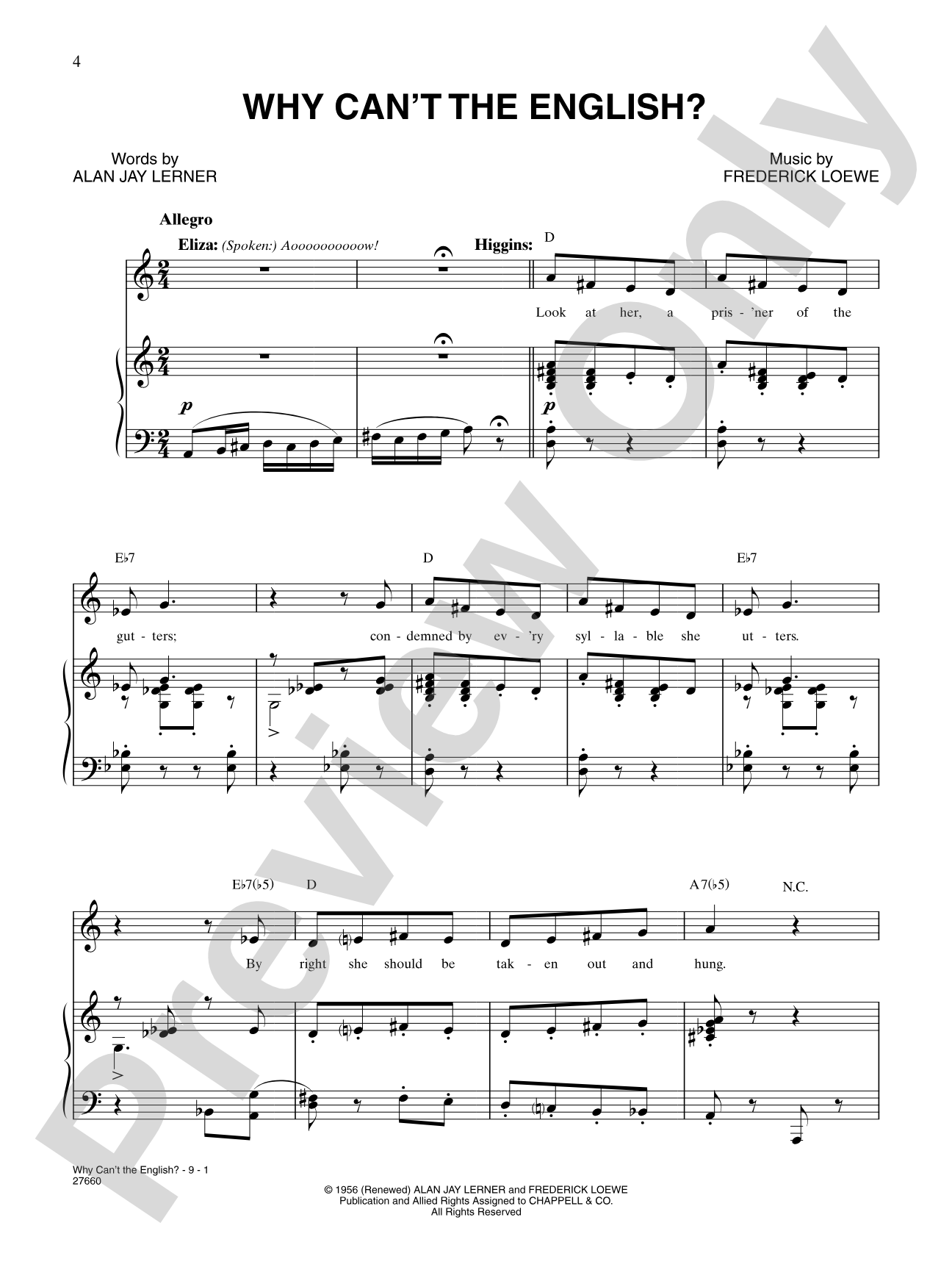
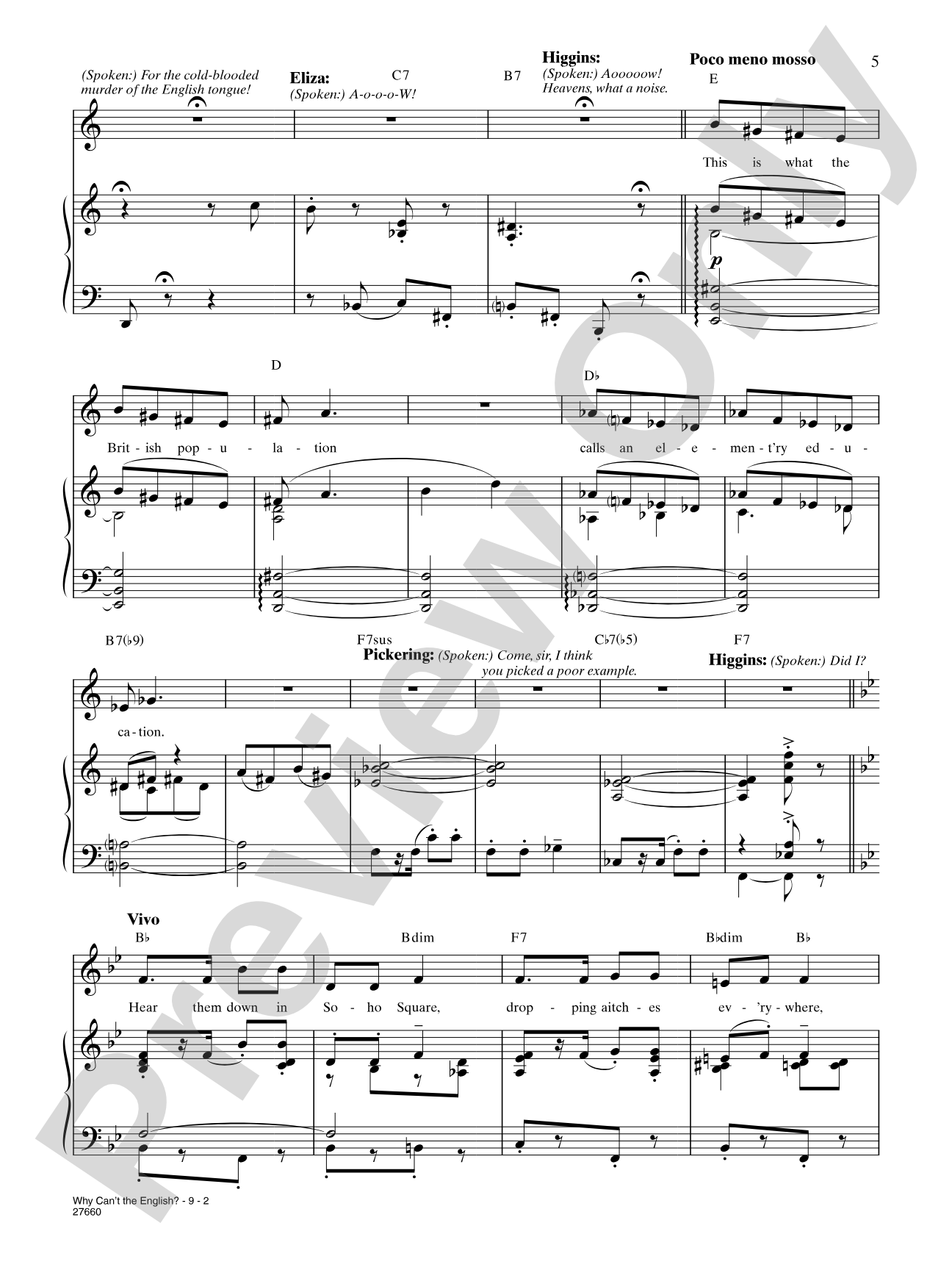

Why Can't The English? (from "My Fair Lady"): Piano/Vocal/Chords
Lyrics by Alan Jay Lerner, music by Frederick Loewe
Item: 00-PSP-000203
$5.99
One moment…
Related Items
Get Me To The Church On Time (from "My Fair Lady"): Piano/Vocal/Chords |
$4.99
|
View | |
I Could Have Danced All Night
|
$5.99
|
View | |
I'm An Ordinary Man (from "My Fair Lady"): Piano/Vocal/Chords |
$9.99
|
View | |
I've Grown Accustomed To Her Face (from "My Fair Lady"): Piano/Vocal/Chords |
$9.99
|
View | |
Just You Wait (from "My Fair Lady"): Piano/Vocal/Chords |
$5.99
|
View | |
On The Street Where You Live (from "My Fair Lady"): Piano/Vocal/Chords |
$4.99
|
View | |
Show Me (from "My Fair Lady"): Piano/Vocal/Chords |
$5.99
|
View | |
The Rain In Spain (from "My Fair Lady"): Piano/Vocal/Chords |
$4.99
|
View | |
With A Little Bit Of Luck (from "My Fair Lady"): Piano/Vocal/Chords |
$5.99
|
View | |
Without You (from "My Fair Lady"): Piano/Vocal/Chords |
$5.99
|
View | |
Wouldn't It Be Loverly (from "My Fair Lady"): Piano/Vocal/Chords |
$4.99
|
View |
Description
My Fair Lady is the classic stage musical based on George Bernard Shaw's book Pygmalion. The musical was later adapted for film, and the movie, starring Rex Harrison and Audrey Hepburn, was released in 1964. This book features selections from the musical, providing the lyrics along with piano and chord arrangements for all the songs included.
Titles: Get Me to the Church on Time * I Could Have Danced All Night * I'm an Ordinary Man * I've Grown Accustomed to Her Face * Just You Wait * On the Street Where You Live * The Rain in Spain * Show Me * Why Can't the English? * With a Little Bit of Luck * Without You * Wouldn't It Be Loverly.


Titles: Get Me to the Church on Time * I Could Have Danced All Night * I'm an Ordinary Man * I've Grown Accustomed to Her Face * Just You Wait * On the Street Where You Live * The Rain in Spain * Show Me * Why Can't the English? * With a Little Bit of Luck * Without You * Wouldn't It Be Loverly.
Why Can't The English? (from "My Fair Lady"): Piano/Vocal/Chords isn't in MakeMusic Cloud just yet...but it could be. Let us know you'd like to see it, and you'll help shape what comes next. In the meantime, start a free trial and dive into thousands of interactive titles your students can play along with today.
Request This Title
Tell us you want it.
Start Your Free Trial
Explore everything that's ready to play right now.
Sample Audio
No sample audio found.
Sample Video
No sample videos found.
Additional Details
Series:
Alfred's Classic Musical Editions
Publisher:
Alfred Music
Page Count:
104
SKU:
00-PSP-000203
More about this title
About the Composer: Frederick Loewe
Frederick Loewe (1901-1988) was an Austrian-American composer who created some of the most enduring melodies in musical theater. Trained in classical composition in Berlin and Paris, Loewe brought sophisticated harmonic language and elegant melodic writing to Broadway, reshaping what audiences expected from the musical theater score. His collaboration with lyricist Alan Jay Lerner produced four major musicals, of which My Fair Lady stands as perhaps the most performed and recorded musical of the 20th century.
Why we love this
This collection captures the wit and musicality of Loewe's score in a singable, pianistically accessible format. The material rewards singers who understand character and diction as much as technique, and the chord charts make it ideal for both solo recital work and collaborative arrangements in the studio or classroom.
What to expect
These songs inhabit a world of London charm, social aspiration, and affectionate satire. The musical language moves fluidly between comic patter and genuine lyricism, with moments of tender vulnerability alongside sharp, witty character numbers. Loewe's melodies are immediately singable yet sophisticated enough to reward careful musical attention.
Who it's for
Singer-pianists and vocal students preparing audition material, recital selections, or solo arrangements for voice and piano. Music directors and accompanists looking for classic musical theater repertoire that works well in intimate settings as well as larger presentations. Pianists interested in exploring the harmonic language and accompaniment textures of one of the great composers of American musical theater.
How to get the most out of it
- Approach the lyrics with the precision and clarity that the English language music requires; Loewe's setting of text demands crisp consonants and deliberate phrasing to land the comedy and sentiment.
- Use the chord symbols to explore different harmonic voicings on the piano that support the character of each song rather than defaulting to simple chord block accompaniments.
- Balance the theatrical expression with musical restraint; these songs work best when the emotion emerges from the text and melody rather than from excessive dramatic overlay.
- Listen closely to how the vocal line sits against the accompaniment in each song, as Loewe frequently places the melody in unexpected rhythmic relationship to the piano's harmonic movement.
How to use it
Program selections from this collection in a vocal recital exploring the American musical theater canon, or pair individual songs with classical or contemporary pieces to create varied concert programs. The full collection also works well as a teaching resource for intermediate to advanced student singers learning to interpret character-driven repertoire with harmonic sophistication.
Skills your students will build
- Diction and lyrical clarity in English text
- Interpreting character through melody and harmonic context
- Sight-reading chord charts and realizing figured bass notation
- Balancing vocal expression with musical precision
- Understanding theatrical song structure and form