
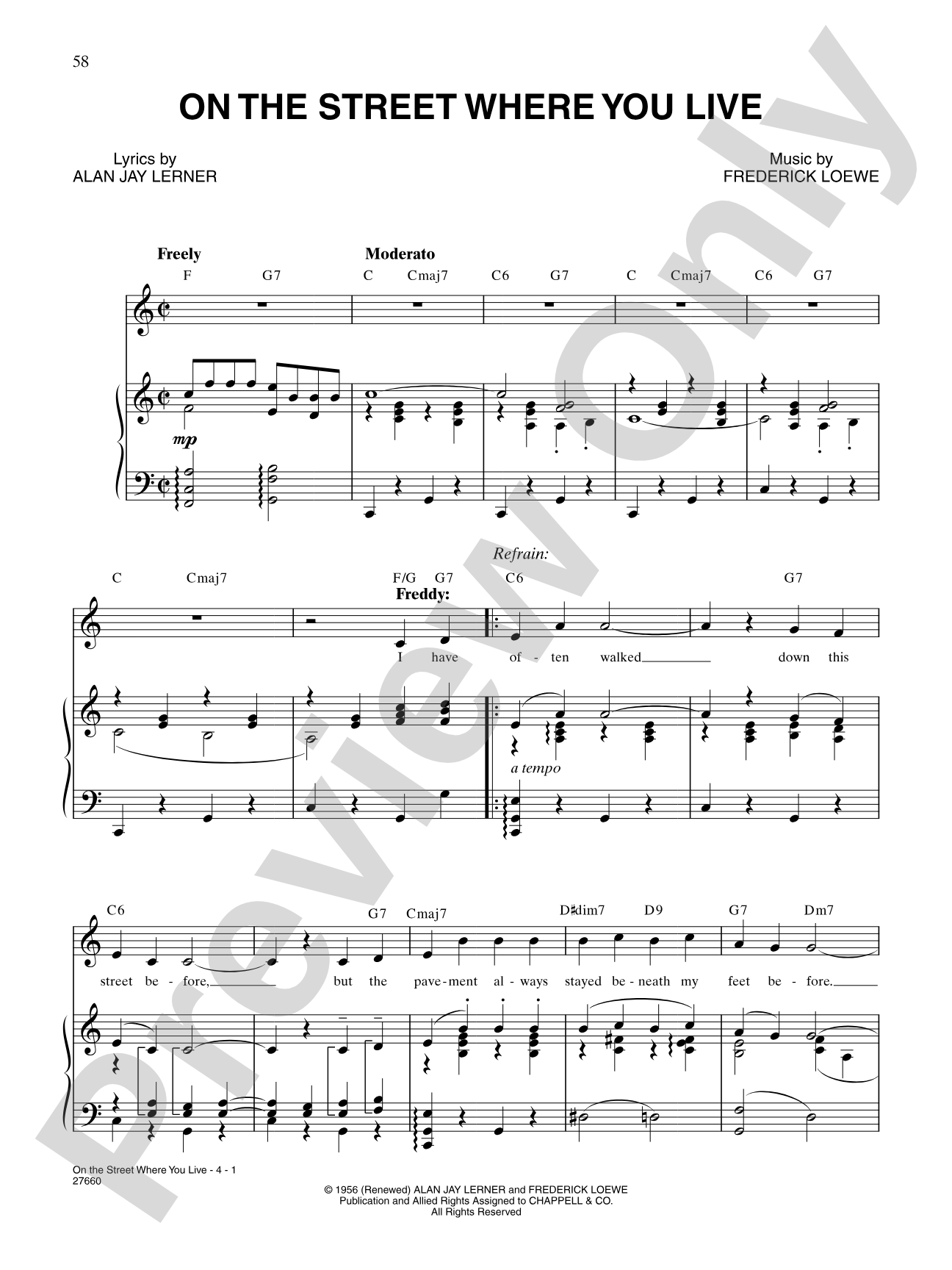

On The Street Where You Live (from "My Fair Lady"): Piano/Vocal/Chords
Lyrics by Alan Jay Lerner, music by Frederick Loewe
Item: 00-PSP-000200
$4.99
One moment…
Related Items
Get Me To The Church On Time (from "My Fair Lady"): Piano/Vocal/Chords |
$4.99
|
View | |
I Could Have Danced All Night
|
$5.99
|
View | |
I'm An Ordinary Man (from "My Fair Lady"): Piano/Vocal/Chords |
$9.99
|
View | |
I've Grown Accustomed To Her Face (from "My Fair Lady"): Piano/Vocal/Chords |
$9.99
|
View | |
Just You Wait (from "My Fair Lady"): Piano/Vocal/Chords |
$5.99
|
View | |
Show Me (from "My Fair Lady"): Piano/Vocal/Chords |
$5.99
|
View | |
The Rain In Spain (from "My Fair Lady"): Piano/Vocal/Chords |
$4.99
|
View | |
Why Can't The English? (from "My Fair Lady"): Piano/Vocal/Chords |
$5.99
|
View | |
With A Little Bit Of Luck (from "My Fair Lady"): Piano/Vocal/Chords |
$5.99
|
View | |
Without You (from "My Fair Lady"): Piano/Vocal/Chords |
$5.99
|
View | |
Wouldn't It Be Loverly (from "My Fair Lady"): Piano/Vocal/Chords |
$4.99
|
View |
Description
My Fair Lady is the classic stage musical based on George Bernard Shaw's book Pygmalion. The musical was later adapted for film, and the movie, starring Rex Harrison and Audrey Hepburn, was released in 1964. This book features selections from the musical, providing the lyrics along with piano and chord arrangements for all the songs included.
Titles: Get Me to the Church on Time * I Could Have Danced All Night * I'm an Ordinary Man * I've Grown Accustomed to Her Face * Just You Wait * On the Street Where You Live * The Rain in Spain * Show Me * Why Can't the English? * With a Little Bit of Luck * Without You * Wouldn't It Be Loverly.


Titles: Get Me to the Church on Time * I Could Have Danced All Night * I'm an Ordinary Man * I've Grown Accustomed to Her Face * Just You Wait * On the Street Where You Live * The Rain in Spain * Show Me * Why Can't the English? * With a Little Bit of Luck * Without You * Wouldn't It Be Loverly.
On The Street Where You Live (from "My Fair Lady"): Piano/Vocal/Chords isn't in MakeMusic Cloud just yet...but it could be. Let us know you'd like to see it, and you'll help shape what comes next. In the meantime, start a free trial and dive into thousands of interactive titles your students can play along with today.
Request This Title
Tell us you want it.
Start Your Free Trial
Explore everything that's ready to play right now.
Sample Audio
No sample audio found.
Sample Video
No sample videos found.
Additional Details
Series:
Alfred's Classic Musical Editions
Publisher:
Alfred Music
Page Count:
104
SKU:
00-PSP-000200
More about this title
About the Composer: Frederick Loewe
Frederick Loewe (1901-1988) composed the melodies that defined the golden age of American musical theater. A classically trained musician born in Vienna, Loewe brought European sophistication to Broadway, crafting scores of remarkable harmonic depth and singability. His partnership with lyricist Alan Jay Lerner produced four major musicals, with My Fair Lady standing as their masterpiece and one of the most frequently performed stage musicals worldwide.
Loewe's gift was his ability to write music that serves the story without overshadowing the text. His melodies sit naturally in the voice, his accompaniments support rather than dominate, and his harmonic language feels both accessible and refined. For music educators, his scores represent the gold standard of how melody, harmony, and lyric can work together.
Why we love this
Every selection in this edition stands alone beautifully while belonging to a coherent dramatic whole. The vocal ranges and accompaniment styles vary enough to suit different voices and pianists, yet the songwriting maintains a consistent elegance that makes the entire collection rewarding to perform. This is Broadway writing at its most teachable: every phrase has clarity, every harmonic choice makes musical sense, and the dramatic context enriches the music itself.
What to expect
These songs capture the wit, romance, and emotional vulnerability of the show. Some sparkle with comedy and rhythmic drive; others settle into tenderness and reflection. The music shifts from the brisk, articulate energy of "Get Me to the Church on Time" to the achingly sincere simplicity of "On the Street Where You Live" to the playful impudence of "Just You Wait." Singing or accompanying these selections means inhabiting a world of refined charm, where elegance and sincerity go hand in hand.
Who it's for
Vocalists preparing audition material or recital repertoire, voice students exploring the Broadway canon, and pianists building their ability to accompany singing in a variety of styles. This collection works equally well for someone learning a single song and for a pianist or vocalist wanting to dive into multiple selections from one of theater's greatest scores.
How to get the most out of it
- Balance the vocal line with an accompaniment that breathes rather than dominates. The chord notations give flexibility; use them to shape the harmonic support around the singer's phrasing.
- Pay attention to the text as the guide for musical choices. Loewe's melodies follow the natural rhythm and emphasis of the lyrics, so singing through the words clearly will reveal the intended shape of each phrase.
- Tempo flexibility enhances emotional impact. Several of these songs benefit from slight rubato in the verse sections, with more rhythmic precision in the choruses, which mirrors how they function dramatically in the show.
- Use the chord chart to understand the harmonic progression so you can anticipate and support the singer's emotional arc within each song.
How to use it
Pull individual selections for voice recitals, audition packages, or repertoire classes where students encounter the Broadway musical repertoire. A pianist might use this edition to develop accompanying skills across contrasting vocal styles and emotional contexts. Alternatively, vocal ensembles can program several selections as a medley or concert set that tells the story of the show's key moments.
Skills your students will build
- Interpreting chord symbols and using them to shape harmonic support
- Singing in the Broadway idiom with proper text clarity and emotional specificity
- Accompanying a vocalist with appropriate balance between melody and harmony
- Understanding how musical form and phrasing support lyrical content
- Navigating varied tempos and meters across contrasting song styles
- Building flexibility in sight-reading across both vocal and piano parts