
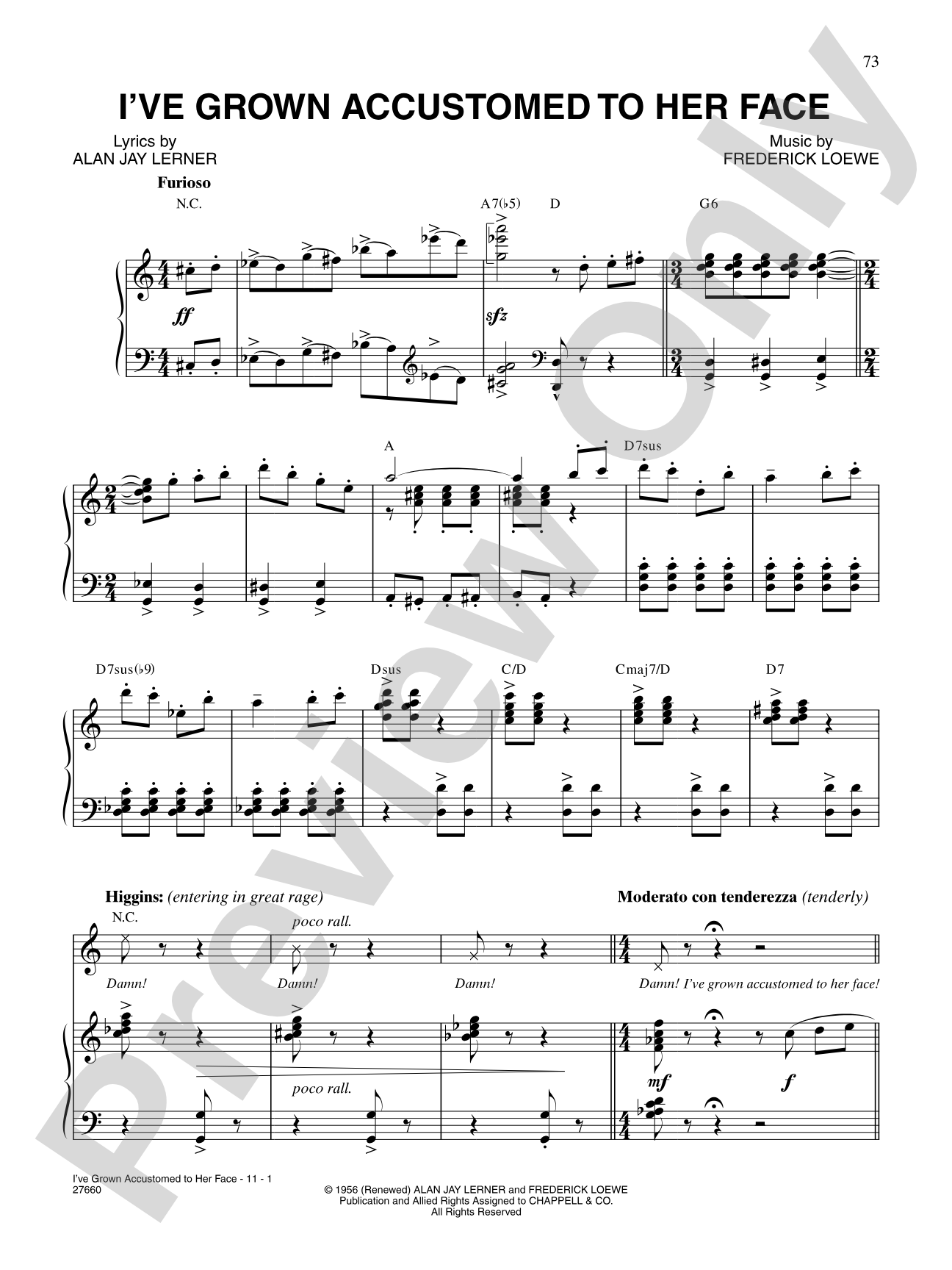
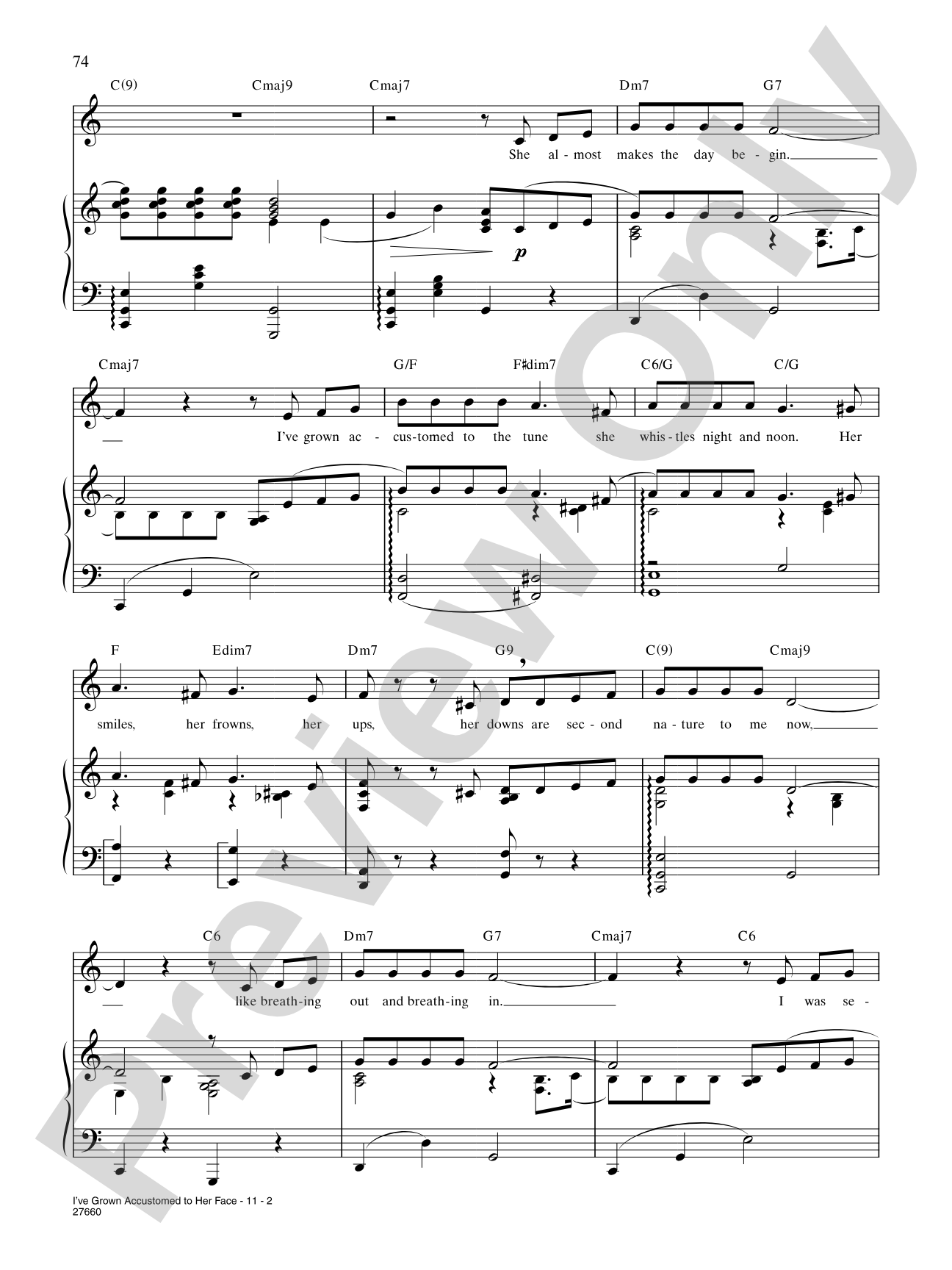
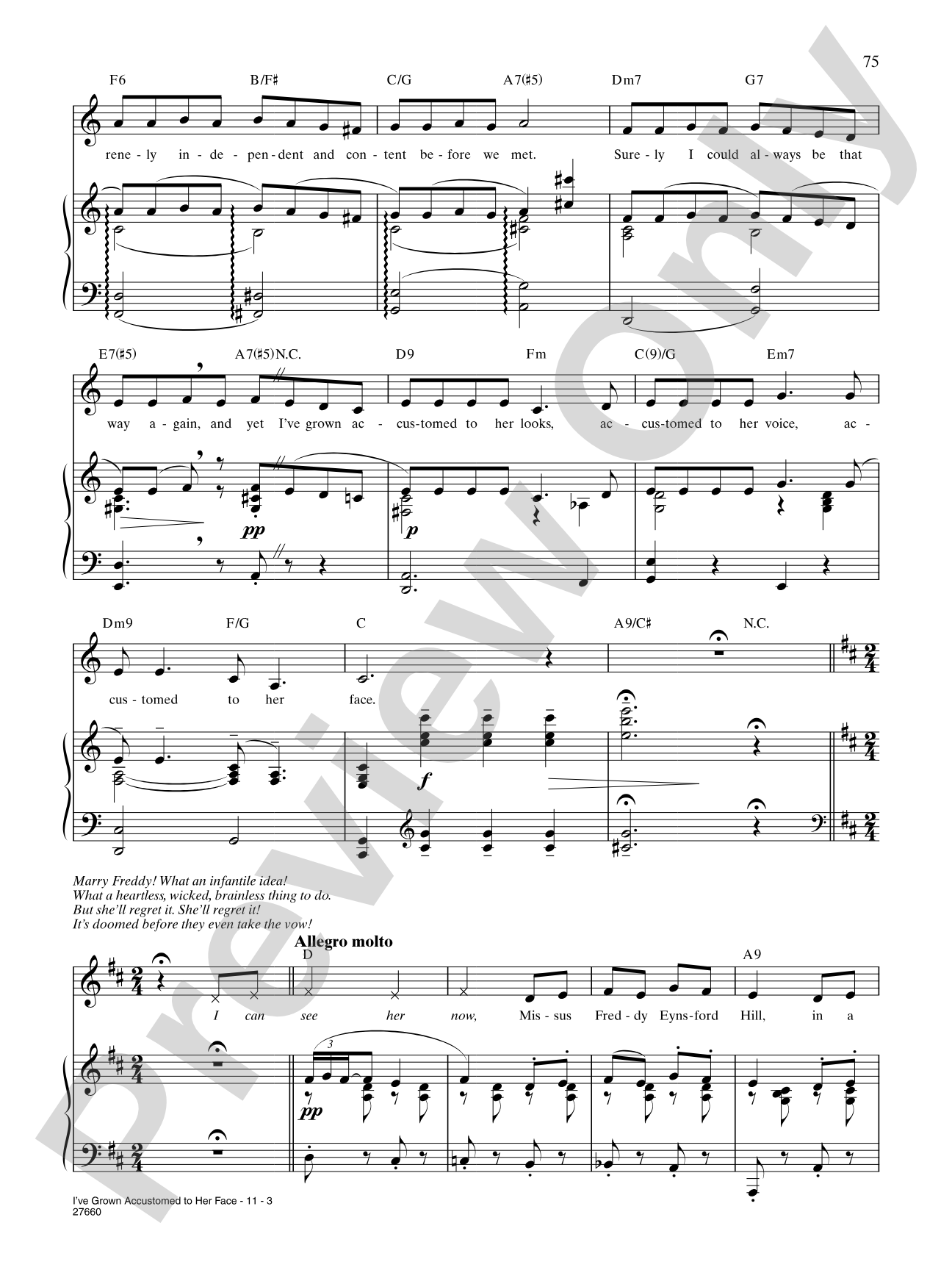

I've Grown Accustomed To Her Face (from "My Fair Lady"): Piano/Vocal/Chords
Lyrics by Alan Jay Lerner, music by Frederick Loewe
Item: 00-PSP-000198
$9.99
One moment…
Related Items
Get Me To The Church On Time (from "My Fair Lady"): Piano/Vocal/Chords |
$4.99
|
View | |
I Could Have Danced All Night
|
$5.99
|
View | |
I'm An Ordinary Man (from "My Fair Lady"): Piano/Vocal/Chords |
$9.99
|
View | |
Just You Wait (from "My Fair Lady"): Piano/Vocal/Chords |
$5.99
|
View | |
On The Street Where You Live (from "My Fair Lady"): Piano/Vocal/Chords |
$4.99
|
View | |
Show Me (from "My Fair Lady"): Piano/Vocal/Chords |
$5.99
|
View | |
The Rain In Spain (from "My Fair Lady"): Piano/Vocal/Chords |
$4.99
|
View | |
Why Can't The English? (from "My Fair Lady"): Piano/Vocal/Chords |
$5.99
|
View | |
With A Little Bit Of Luck (from "My Fair Lady"): Piano/Vocal/Chords |
$5.99
|
View | |
Without You (from "My Fair Lady"): Piano/Vocal/Chords |
$5.99
|
View | |
Wouldn't It Be Loverly (from "My Fair Lady"): Piano/Vocal/Chords |
$4.99
|
View |
Description
My Fair Lady is the classic stage musical based on George Bernard Shaw's book Pygmalion. The musical was later adapted for film, and the movie, starring Rex Harrison and Audrey Hepburn, was released in 1964. This book features selections from the musical, providing the lyrics along with piano and chord arrangements for all the songs included.
Titles: Get Me to the Church on Time * I Could Have Danced All Night * I'm an Ordinary Man * I've Grown Accustomed to Her Face * Just You Wait * On the Street Where You Live * The Rain in Spain * Show Me * Why Can't the English? * With a Little Bit of Luck * Without You * Wouldn't It Be Loverly.


Titles: Get Me to the Church on Time * I Could Have Danced All Night * I'm an Ordinary Man * I've Grown Accustomed to Her Face * Just You Wait * On the Street Where You Live * The Rain in Spain * Show Me * Why Can't the English? * With a Little Bit of Luck * Without You * Wouldn't It Be Loverly.
I've Grown Accustomed To Her Face (from "My Fair Lady"): Piano/Vocal/Chords isn't in MakeMusic Cloud just yet...but it could be. Let us know you'd like to see it, and you'll help shape what comes next. In the meantime, start a free trial and dive into thousands of interactive titles your students can play along with today.
Request This Title
Tell us you want it.
Start Your Free Trial
Explore everything that's ready to play right now.
Sample Audio
No sample audio found.
Sample Video
No sample videos found.
Additional Details
Series:
Alfred's Classic Musical Editions
Publisher:
Alfred Music
Page Count:
104
SKU:
00-PSP-000198
More about this title
About the Composer: Frederick Loewe
Frederick Loewe (1901-1988) was an Austrian-American composer whose gift for melody and theatrical storytelling made him one of the most celebrated figures in American musical theater. Working in partnership with lyricist Alan Jay Lerner, Loewe created some of the most enduring scores in Broadway history, including Brigadoon, Paint Your Wagon, and My Fair Lady. His music combines the sophistication of European operetta with the accessibility of popular song, a balance that has kept his work vital in both professional and educational settings for decades.
Loewe's approach to composition prioritized singability and emotional clarity. Whether writing a comedic number or a moment of genuine vulnerability, his melodies sit naturally in the voice and his harmonic language supports rather than obscures the lyric. For music educators, his catalog represents a masterclass in how theatrical music can serve both entertainment and serious artistic purpose.
Why we love this
This collection captures some of the most versatile and teachable songs in the musical theater repertoire. Each piece serves multiple purposes: they work beautifully as performance vehicles, they offer genuine harmonic and melodic substance for serious musicians, and they engage audiences of all ages. The piano arrangements strike an ideal balance between supporting the vocalist and providing interesting accompanying material for pianists beyond mere chord-playing.
What to expect
These songs embody the elegance and emotional intelligence of mid-century musical theater. There's wit and charm in the comedic numbers, genuine tenderness in the romantic ballads, and a theatrical sophistication that never feels pretentious. Performing this music means inhabiting characters and moments that audiences recognize and cherish.
Who it's for
This collection works for pianist-vocalist pairs preparing audition material, recital numbers, or special concert moments. It also serves church musicians, community theater musicians, and anyone seeking accessible yet musically substantial Broadway selections for performance or study.
How to get the most out of it
- Shape the piano introduction and interludes with the same dramatic intention as the vocal line. These moments establish mood and shouldn't feel like filler between verses.
- Read the lyrics even if you're not singing them. Understanding the emotional arc and narrative context of each song will inform your tempo, dynamic choices, and overall phrasing.
- Pay attention to the chord symbols for harmonic color. Loewe often uses seventh chords and chromatic movement that add sophistication; lean into those sonorities rather than playing them matter-of-factly.
- Balance the accompaniment dynamically so the vocalist remains the focal point. The piano should frame and support, not compete.
How to use it
Feature a single song as a concert opener or closer, or program several selections as a curated My Fair Lady medley for a Broadway-themed concert. The range of moods and tempos makes it easy to build variety; pair an uptempo character song with a lyrical ballad for contrast. These selections also work well in mixed recital programs where classical and musical theater repertoire share the stage.
Skills your students will build
- Coordinate piano accompaniment with vocal phrasing and breath points
- Interpret lyrical content to shape musical interpretation
- Read and execute chord symbols fluently while maintaining rhythmic accuracy
- Balance accompaniment texture to support rather than overshadow the melody
- Navigate the harmonic language of mid-century Broadway composition, including extended sevenths and chromatic voice-leading