
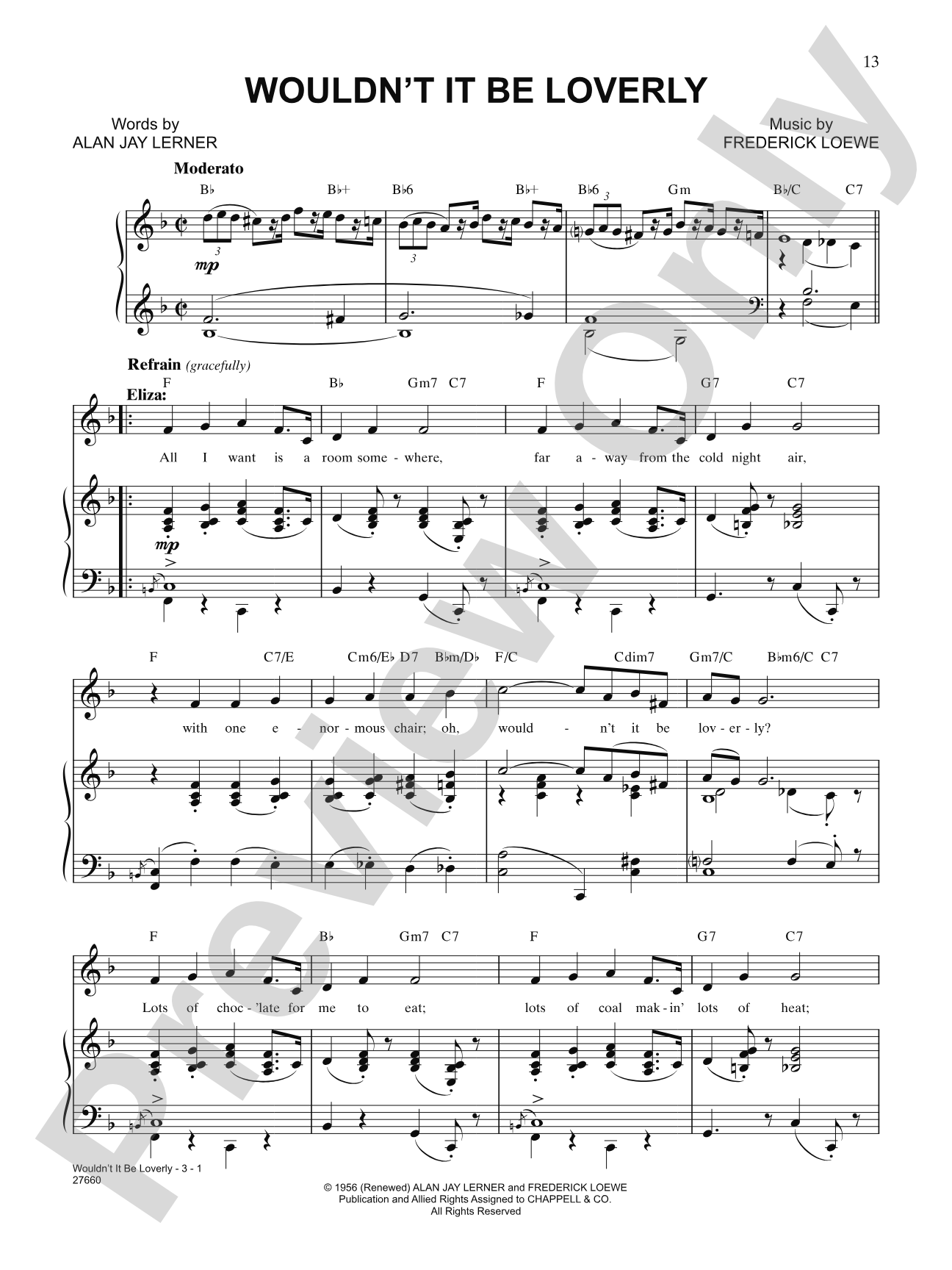

Wouldn't It Be Loverly (from "My Fair Lady"): Piano/Vocal/Chords
Lyrics by Alan Jay Lerner, music by Frederick Loewe
Item: 00-PSP-000206
$4.99
One moment…
Related Items
Get Me To The Church On Time (from "My Fair Lady"): Piano/Vocal/Chords |
$4.99
|
View | |
I Could Have Danced All Night
|
$5.99
|
View | |
I'm An Ordinary Man (from "My Fair Lady"): Piano/Vocal/Chords |
$9.99
|
View | |
I've Grown Accustomed To Her Face (from "My Fair Lady"): Piano/Vocal/Chords |
$9.99
|
View | |
Just You Wait (from "My Fair Lady"): Piano/Vocal/Chords |
$5.99
|
View | |
On The Street Where You Live (from "My Fair Lady"): Piano/Vocal/Chords |
$4.99
|
View | |
Show Me (from "My Fair Lady"): Piano/Vocal/Chords |
$5.99
|
View | |
The Rain In Spain (from "My Fair Lady"): Piano/Vocal/Chords |
$4.99
|
View | |
Why Can't The English? (from "My Fair Lady"): Piano/Vocal/Chords |
$5.99
|
View | |
With A Little Bit Of Luck (from "My Fair Lady"): Piano/Vocal/Chords |
$5.99
|
View | |
Without You (from "My Fair Lady"): Piano/Vocal/Chords |
$5.99
|
View |
Description
My Fair Lady is the classic stage musical based on George Bernard Shaw's book Pygmalion. The musical was later adapted for film, and the movie, starring Rex Harrison and Audrey Hepburn, was released in 1964. This book features selections from the musical, providing the lyrics along with piano and chord arrangements for all the songs included.
Titles: Get Me to the Church on Time * I Could Have Danced All Night * I'm an Ordinary Man * I've Grown Accustomed to Her Face * Just You Wait * On the Street Where You Live * The Rain in Spain * Show Me * Why Can't the English? * With a Little Bit of Luck * Without You * Wouldn't It Be Loverly.


Titles: Get Me to the Church on Time * I Could Have Danced All Night * I'm an Ordinary Man * I've Grown Accustomed to Her Face * Just You Wait * On the Street Where You Live * The Rain in Spain * Show Me * Why Can't the English? * With a Little Bit of Luck * Without You * Wouldn't It Be Loverly.
Wouldn't It Be Loverly (from "My Fair Lady"): Piano/Vocal/Chords isn't in MakeMusic Cloud just yet...but it could be. Let us know you'd like to see it, and you'll help shape what comes next. In the meantime, start a free trial and dive into thousands of interactive titles your students can play along with today.
Request This Title
Tell us you want it.
Start Your Free Trial
Explore everything that's ready to play right now.
Sample Audio
No sample audio found.
Sample Video
No sample videos found.
Additional Details
Series:
Alfred's Classic Musical Editions
Publisher:
Alfred Music
Page Count:
104
SKU:
00-PSP-000206
More about this title
About the Composer: Frederick Loewe
Frederick Loewe (1901-1988) was an Austrian-American composer whose gift for melody and harmonic sophistication shaped the sound of mid-century musical theatre. Born in Vienna, he immigrated to the United States and eventually partnered with lyricist Alan Jay Lerner, creating some of Broadway's most enduring scores: Brigadoon, Paint Your Wagon, My Fair Lady, and Camelot. His music balances classical training with theatrical warmth, making his work both musically substantial and immediately accessible to audiences.
Loewe's approach to songwriting prioritized singability without sacrificing harmonic interest. His orchestrations and piano arrangements serve the singers while maintaining enough musical complexity to reward trained musicians. For music educators, his work represents a standard of craft that demonstrates how popular music and serious musicianship need not be in conflict.
Why we love this
This collection gives singers and pianists direct access to Loewe's melodic genius without overcomplicating the arrangement. The chord symbols make it accessible for jazz pianists and guitar players while preserving the harmonic richness that makes these songs feel sophisticated rather than simple. Each song works beautifully as a standalone audition piece or recital selection.
What to expect
These songs carry the specificity of character and situation that distinguishes great musical theatre writing. Whether it's Eliza's longing for simple comfort in "Wouldn't It Be Loverly" or Freddy's romantic earnestness in "On the Street Where You Live," each number has emotional weight beneath its melody. The piano arrangements support intimate storytelling rather than grand spectacle, inviting singers into genuine connection with the material.
Who it's for
This book serves singers preparing audition material, voice students building recital repertoire, and pianists accompanying lessons or studio work. It's equally useful for conductors sketching arrangements or for adult amateur musicians returning to musical theatre after years away.
How to get the most out of it
- Observe the character of each song before diving into tempo. "Wouldn't It Be Loverly" unfolds at a conversational pace; rushing it sacrifices Eliza's vulnerability for surface charm.
- Use the chord symbols as a guide to voice leading in the piano part. These aren't decorative; they show Loewe's harmonic movement and inform how you shape phrase direction.
- Let the lyrics breathe in slower songs like "I've Grown Accustomed to Her Face." The piano part should support emotional clarity, not compete with it.
- In uptempo numbers like "With a Little Bit of Luck" or "Get Me to the Church on Time," maintain rhythmic precision; Loewe's comedy depends on crisp articulation.
How to use it
Select individual songs for a musical theatre recital, pairing contrasting numbers to showcase vocal range and dramatic range. The collection also works as a teaching resource for understanding song structure and character development across a full score. Use it as reference material when rehearsing a full production or preparing singers for auditions at professional or educational levels.
Skills your students will build
- Sight-reading piano/vocal scores with chord symbols
- Interpreting character through lyrical phrasing and tempo flexibility
- Understanding harmonic function through Loewe's chord progressions
- Balancing melody-driven singing with responsive piano accompaniment
- Building stylistic awareness of mid-century Broadway vocal writing