
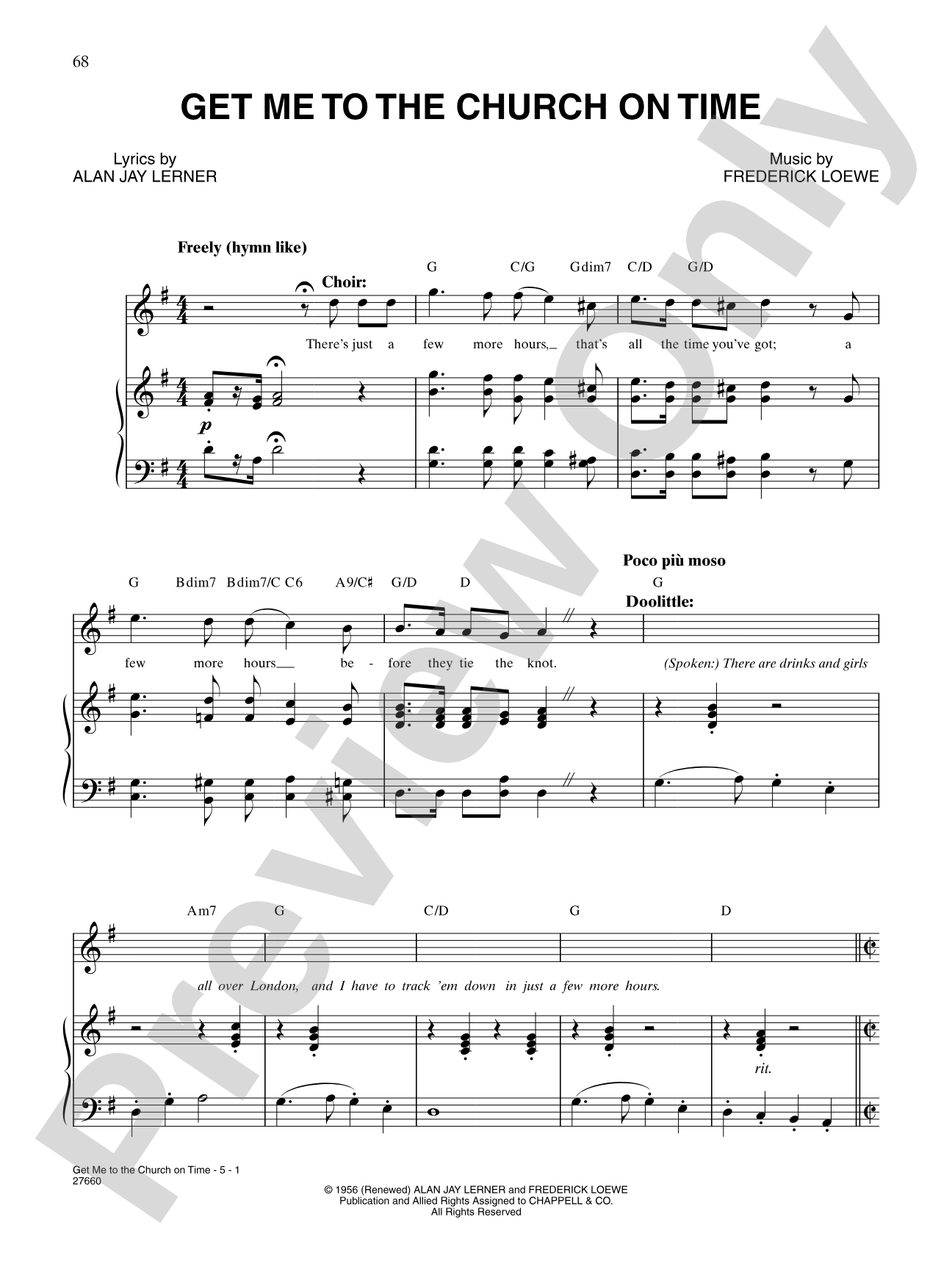

Get Me To The Church On Time (from "My Fair Lady"): Piano/Vocal/Chords
Lyrics by Alan Jay Lerner, music by Frederick Loewe
Item: 00-PSP-000195
$4.99
One moment…
Related Items
I Could Have Danced All Night
|
$5.99
|
View | |
I'm An Ordinary Man (from "My Fair Lady"): Piano/Vocal/Chords |
$9.99
|
View | |
I've Grown Accustomed To Her Face (from "My Fair Lady"): Piano/Vocal/Chords |
$9.99
|
View | |
Just You Wait (from "My Fair Lady"): Piano/Vocal/Chords |
$5.99
|
View | |
On The Street Where You Live (from "My Fair Lady"): Piano/Vocal/Chords |
$4.99
|
View | |
Show Me (from "My Fair Lady"): Piano/Vocal/Chords |
$5.99
|
View | |
The Rain In Spain (from "My Fair Lady"): Piano/Vocal/Chords |
$4.99
|
View | |
Why Can't The English? (from "My Fair Lady"): Piano/Vocal/Chords |
$5.99
|
View | |
With A Little Bit Of Luck (from "My Fair Lady"): Piano/Vocal/Chords |
$5.99
|
View | |
Without You (from "My Fair Lady"): Piano/Vocal/Chords |
$5.99
|
View | |
Wouldn't It Be Loverly (from "My Fair Lady"): Piano/Vocal/Chords |
$4.99
|
View |
Description
My Fair Lady is the classic stage musical based on George Bernard Shaw's book Pygmalion. The musical was later adapted for film, and the movie, starring Rex Harrison and Audrey Hepburn, was released in 1964. This book features selections from the musical, providing the lyrics along with piano and chord arrangements for all the songs included.
Titles: Get Me to the Church on Time * I Could Have Danced All Night * I'm an Ordinary Man * I've Grown Accustomed to Her Face * Just You Wait * On the Street Where You Live * The Rain in Spain * Show Me * Why Can't the English? * With a Little Bit of Luck * Without You * Wouldn't It Be Loverly.


Titles: Get Me to the Church on Time * I Could Have Danced All Night * I'm an Ordinary Man * I've Grown Accustomed to Her Face * Just You Wait * On the Street Where You Live * The Rain in Spain * Show Me * Why Can't the English? * With a Little Bit of Luck * Without You * Wouldn't It Be Loverly.
Get Me To The Church On Time (from "My Fair Lady"): Piano/Vocal/Chords isn't in MakeMusic Cloud just yet...but it could be. Let us know you'd like to see it, and you'll help shape what comes next. In the meantime, start a free trial and dive into thousands of interactive titles your students can play along with today.
Request This Title
Tell us you want it.
Start Your Free Trial
Explore everything that's ready to play right now.
Sample Audio
No sample audio found.
Sample Video
No sample videos found.
Additional Details
Series:
Alfred's Classic Musical Editions
Publisher:
Alfred Music
Page Count:
104
SKU:
00-PSP-000195
More about this title
About the Composer: Frederick Loewe
Frederick Loewe (1901-1988) was an Austrian-American composer whose gift for melody and harmonic sophistication shaped the sound of the American musical theater. Trained in Berlin and Paris, Loewe brought European classical sensibilities to Broadway, collaborating with lyricist Alan Jay Lerner to create some of the most enduring scores in musical history. My Fair Lady, which premiered in 1956, stands as his masterwork: a score that balances wit, romance, and theatrical storytelling with music that ranges from comic patter to soaring ballads.
Loewe's influence on music education extends beyond his famous melodies. His orchestrations and harmonic language demonstrate how to write for voices with intelligence and care, giving singers memorable lines while maintaining musical sophistication. Teachers and performers continue to study his work to understand how theatrical music can be both popular and musically substantial.
Why we love this
This collection captures twelve essential songs from one of theater's most perfect scores, and the piano/vocal arrangement format makes it genuinely useful for singers preparing auditions, recitals, or casual performances. Loewe's melodic gifts shine throughout these arrangements, and accompanying singers at the piano gives you immediate insight into his harmonic choices and how deliberately he composed for the human voice. The variety across these twelve selections means you'll find material suited to different voice types and styles, from the rollicking title song to intimate ballads.
What to expect
These songs capture the wit and charm of mid-century musical theater, moving from the comic bluster of 'Why Can't the English?' to the tenderness of 'On the Street Where You Live,' and the sophisticated, bittersweet reflection of 'I've Grown Accustomed to Her Face.' You'll find yourself drawn into Eliza's journey and the world of London society, where every song feels essential to the story rather than pausing the action.
Who it's for
This book serves singers preparing for auditions, students building a diverse solo recital repertoire, and pianists accompanying lessons or rehearsals. It also works well for singers exploring musical theater alongside classical or contemporary repertoire, and for classroom use when studying the development of the American musical.
How to get the most out of it
- Balance the vocal line so it sits naturally above the keyboard part rather than fighting for space; Loewe's accompaniments are busy but designed to support, not overshadow, the singer.
- Pay attention to the chord symbols when you're learning the arrangement, as they often suggest idiomatic voicings that sit better under the voice than literal transcriptions would.
- Mark phrase endings and breathing places before you begin, especially in longer songs like 'I've Grown Accustomed to Her Face,' where sustaining musicality across multiple verses matters greatly.
- Use the tempo markings as guides, but listen to how the text naturally wants to move; Loewe often builds flexibility into his phrasing that a rigid metronome can work against.
How to use it
Build a solo recital around these pieces, pairing them with art song or contemporary vocal music to show range across different musical idioms. You might also teach this score in a musical theater history unit, using individual songs to discuss how Loewe's compositional approach differs from operetta, comic song, or contemporary musical styles. The variety makes it easy to select two or three songs for a concert program rather than committing to the entire musical.
Skills your students will build
- Reading piano/vocal score format with chord symbols
- Interpreting theatrical text to shape musical phrasing and character
- Balancing vocal production in mid-range tessiture across different song styles
- Understanding harmonic language and voice-leading in popular music of the 1950s
- Building sustained vocal lines across multiple verses without repetitive monotony