
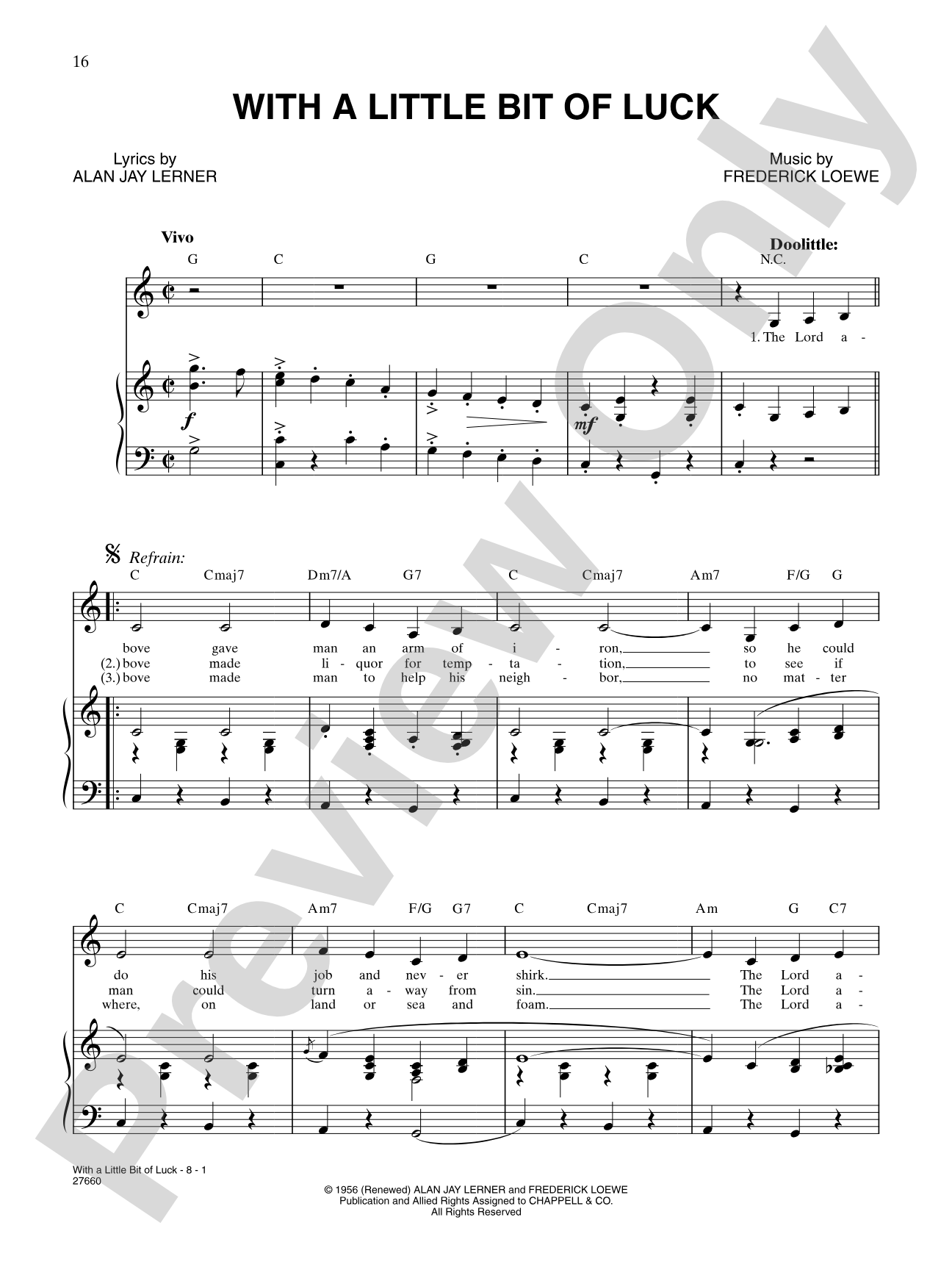
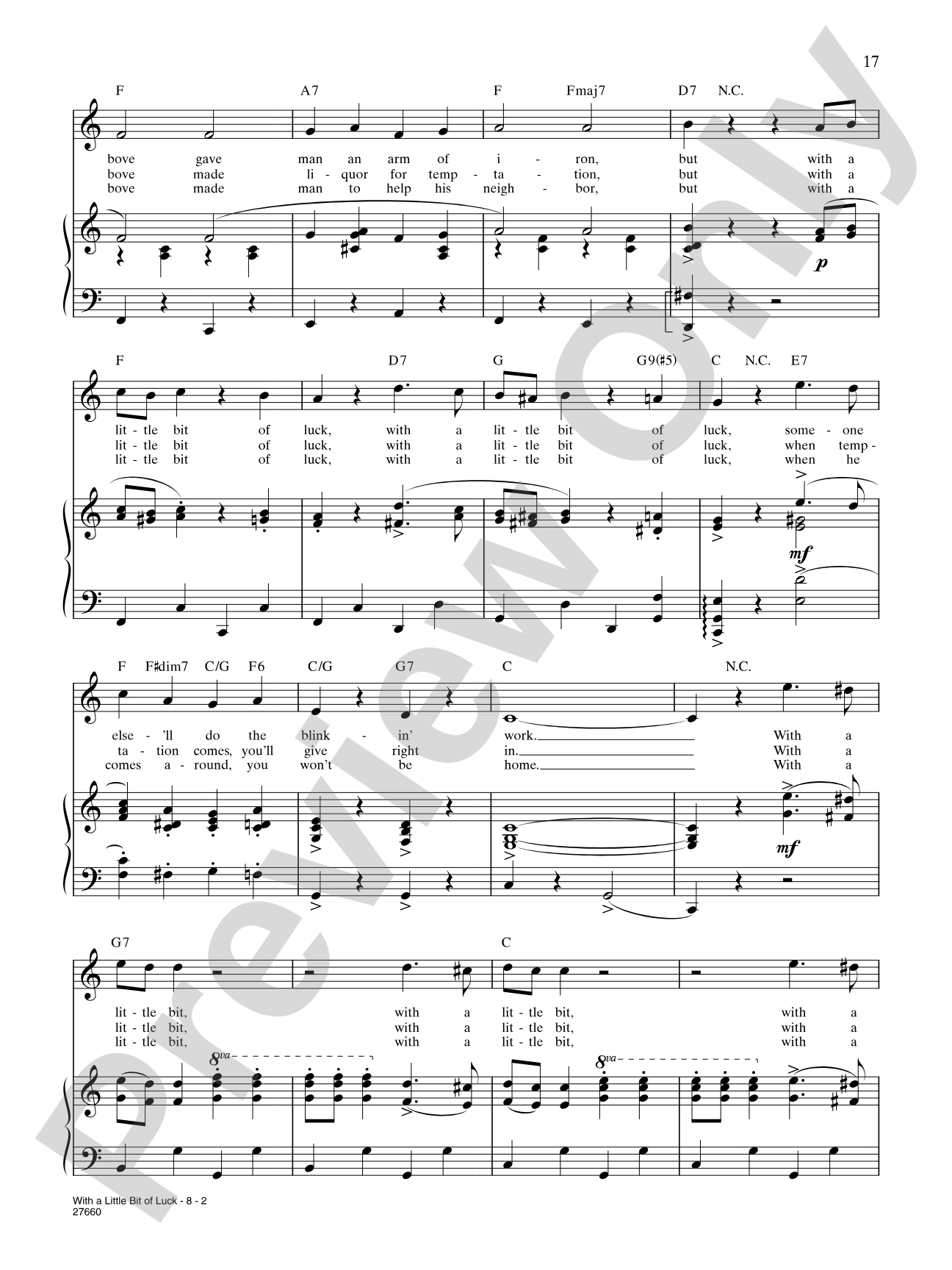

With A Little Bit Of Luck (from "My Fair Lady"): Piano/Vocal/Chords
Lyrics by Alan Jay Lerner, music by Frederick Loewe
Item: 00-PSP-000204
$5.99
One moment…
Related Items
Get Me To The Church On Time (from "My Fair Lady"): Piano/Vocal/Chords |
$4.99
|
View | |
I Could Have Danced All Night
|
$5.99
|
View | |
I'm An Ordinary Man (from "My Fair Lady"): Piano/Vocal/Chords |
$9.99
|
View | |
I've Grown Accustomed To Her Face (from "My Fair Lady"): Piano/Vocal/Chords |
$9.99
|
View | |
Just You Wait (from "My Fair Lady"): Piano/Vocal/Chords |
$5.99
|
View | |
On The Street Where You Live (from "My Fair Lady"): Piano/Vocal/Chords |
$4.99
|
View | |
Show Me (from "My Fair Lady"): Piano/Vocal/Chords |
$5.99
|
View | |
The Rain In Spain (from "My Fair Lady"): Piano/Vocal/Chords |
$4.99
|
View | |
Why Can't The English? (from "My Fair Lady"): Piano/Vocal/Chords |
$5.99
|
View | |
Without You (from "My Fair Lady"): Piano/Vocal/Chords |
$5.99
|
View | |
Wouldn't It Be Loverly (from "My Fair Lady"): Piano/Vocal/Chords |
$4.99
|
View |
Description
My Fair Lady is the classic stage musical based on George Bernard Shaw's book Pygmalion. The musical was later adapted for film, and the movie, starring Rex Harrison and Audrey Hepburn, was released in 1964. This book features selections from the musical, providing the lyrics along with piano and chord arrangements for all the songs included.
Titles: Get Me to the Church on Time * I Could Have Danced All Night * I'm an Ordinary Man * I've Grown Accustomed to Her Face * Just You Wait * On the Street Where You Live * The Rain in Spain * Show Me * Why Can't the English? * With a Little Bit of Luck * Without You * Wouldn't It Be Loverly.


Titles: Get Me to the Church on Time * I Could Have Danced All Night * I'm an Ordinary Man * I've Grown Accustomed to Her Face * Just You Wait * On the Street Where You Live * The Rain in Spain * Show Me * Why Can't the English? * With a Little Bit of Luck * Without You * Wouldn't It Be Loverly.
With A Little Bit Of Luck (from "My Fair Lady"): Piano/Vocal/Chords isn't in MakeMusic Cloud just yet...but it could be. Let us know you'd like to see it, and you'll help shape what comes next. In the meantime, start a free trial and dive into thousands of interactive titles your students can play along with today.
Request This Title
Tell us you want it.
Start Your Free Trial
Explore everything that's ready to play right now.
Sample Audio
No sample audio found.
Sample Video
No sample videos found.
Additional Details
Series:
Alfred's Classic Musical Editions
Publisher:
Alfred Music
Page Count:
104
SKU:
00-PSP-000204
More about this title
About the Composer: Frederick Loewe
Frederick Loewe (1901-1988) was an Austrian-American composer whose collaborations with lyricist Alan Jay Lerner produced some of the most enduring musical theatre works of the twentieth century. His melodic gift and sophisticated harmonic language elevated Broadway songwriting, and his scores for My Fair Lady and Camelot remain central to the American musical theatre canon.
Loewe's training in classical composition informed every song he wrote for the stage. His ability to craft memorable melodies that served dramatic storytelling while remaining singable by actors made him a master of musical theatre craft. For music educators and students, his work represents a pinnacle of how popular song can achieve artistic depth without sacrificing accessibility.
Why we love this
This collection captures one of Broadway's greatest scores in a format that actually works for singers and pianists. Loewe's melodies sit beautifully in the voice, the chord changes are logical enough to follow but sophisticated enough to hold a musician's interest, and the dramatic range across these twelve songs gives you options for nearly any performance context. Whether you're building a cabaret program, teaching students to interpret classic musical theatre, or preparing for auditions, these arrangements honor the original while remaining playable at different levels.
What to expect
These songs carry the wit, romance, and emotional directness of the original production. You'll find yourself drawn into the world of Henry Higgins and Eliza Doolittle through melodies that lodge themselves in memory and chord progressions that feel both inevitable and surprising. The piano arrangements support the storytelling while giving musicians room to breathe.
Who it's for
Singers preparing for auditions or recitals who need accessible arrangements of classic musical theatre repertoire, pianists accompanying vocal students or performers, and music educators building curricula around twentieth-century American musical theatre. This collection serves intermediate to advanced students who are ready to tackle songs with real dramatic and harmonic substance.
How to get the most out of it
- Balance the vocal line over the piano accompaniment by marking dynamic relationships in your score. Loewe's melodies should sing through without the pianist overwhelm ing the texture.
- Study the chord progression independently from the melody. Understanding the harmonic movement will clarify phrasing and help you make intentional choices about rubato and breath placement.
- Pay attention to the character and mood of each song when interpreting tempo and dynamics. 'With a Little Bit of Luck' swings differently than 'I've Grown Accustomed to Her Face,' and these distinctions shape the accompaniment.
How to use it
Use individual selections for a Broadway showcase or cabaret evening, program several contrasting songs as a song cycle that traces character arcs, or select pieces that align with your curriculum on American musical theatre and lyric writing. The range from comic songs like 'Why Can't the English?' to intimate ballads like 'I've Grown Accustomed to Her Face' means you can build a varied program that showcases different vocal colors and musical styles.
Skills your students will build
- Interpreting character motivation through song choice and phrasing
- Reading and realizing chord symbols in a theatrical context
- Balancing vocal line with piano accompaniment in popular song
- Navigating Loewe's harmonic language (chromatic voice leading, secondary dominants, modal interchange)
- Distinguishing between dramatic intent and technical difficulty in musical theatre interpretation