
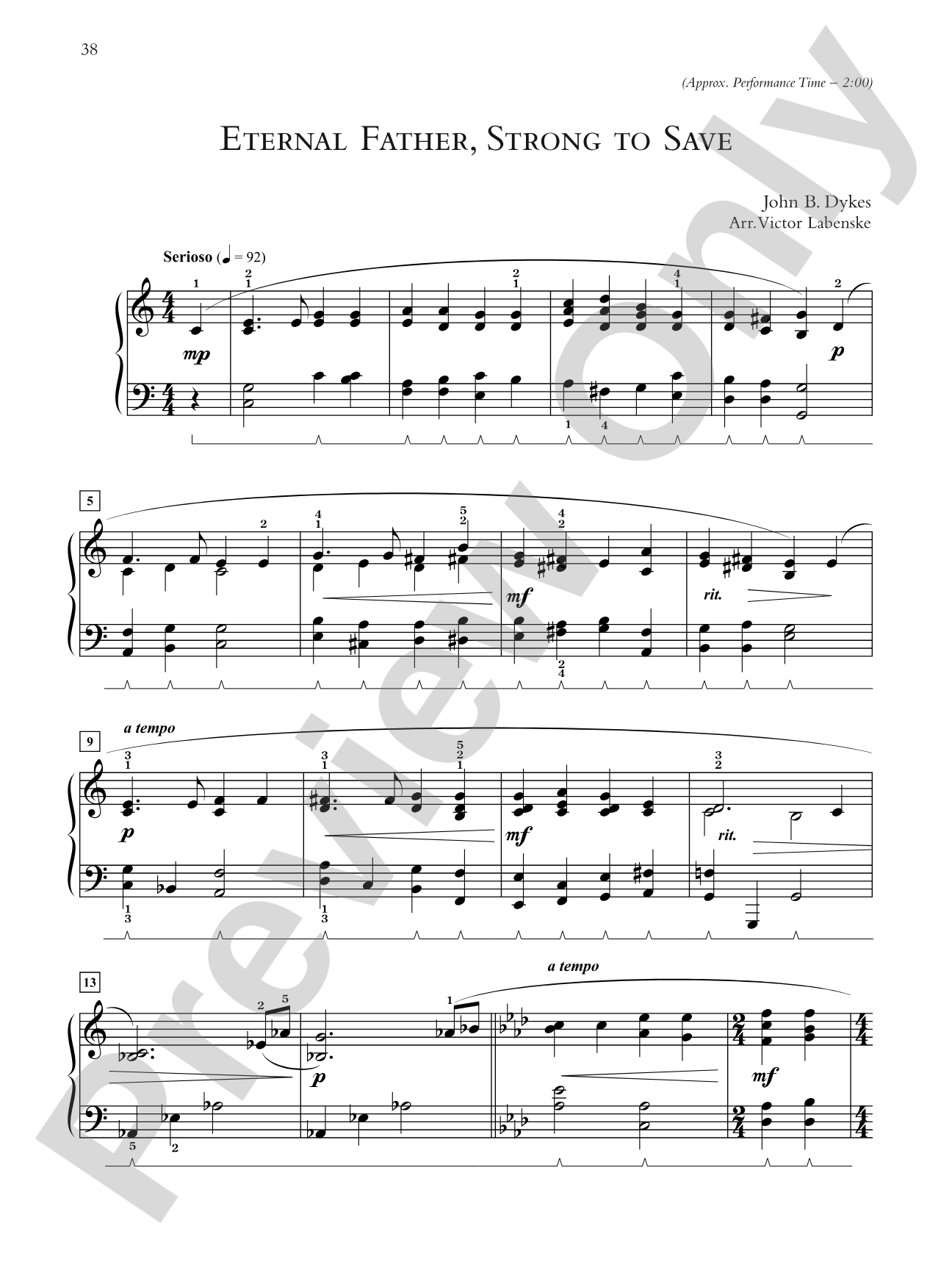

Eternal Father, Strong to Save - Piano Solo: Piano Solo
33 of the Greatest Hymns of All Time
Arranged by Victor Labenske
Level: Intermediate / Late Intermediate
Item: 00-PS-0017427
$4.99
Pickup currently not available
Related Items
A Mighty Fortress Is Our God - Piano Solo: Piano Solo |
$4.99
|
View | |
All Creatures of Our God and King - Piano Solo: Piano Solo |
$4.99
|
View | |
All Hail the Power of Jesus' Name - Piano Solo: Piano Solo |
$4.99
|
View | |
Amazing Grace - Piano Solo: Piano Solo |
$4.99
|
View | |
And Can It Be That I Should Gain? - Piano Solo: Piano Solo |
$4.99
|
View | |
Be Thou My Vision - Piano Solo: Piano Solo |
$4.99
|
View | |
Blessed Assurance - Piano Solo: Piano Solo |
$4.99
|
View | |
Come Thou Fount of Every Blessing - Piano Solo: Piano Solo |
$4.99
|
View | |
Come, Christians, Join to Sing - Piano Solo: Piano Solo |
$4.99
|
View | |
Doxology - Piano Solo: Piano Solo |
$4.99
|
View | |
Fairest Lord Jesus - Piano Solo: Piano Solo |
$4.99
|
View | |
For the Beauty of the Earth - Piano Solo: Piano Solo |
$4.99
|
View | |
Glorious Things of Thee Are Spoken - Piano Solo: Piano Solo |
$4.99
|
View | |
His Eye Is on the Sparrow - Piano Solo: Piano Solo |
$4.99
|
View | |
Holy, Holy, Holy - Piano Solo: Piano Solo |
$4.99
|
View | |
How Firm a Foundation - Piano Solo: Piano Solo |
$4.99
|
View | |
I Need Thee Every Hour - Piano Solo: Piano Solo |
$4.99
|
View | |
It Is Well with My Soul - Piano Solo: Piano Solo |
$4.99
|
View | |
Jesus Loves Me - Piano Solo: Piano Solo |
$4.99
|
View | |
Joyful, Joyful, We Adore Thee - Piano Solo: Piano Solo |
$4.99
|
View | |
My Faith Has Found a Resting Place... - Piano Solo: Piano Solo |
$4.99
|
View | |
My Jesus, I Love Thee - Piano Solo: Piano Solo |
$4.99
|
View | |
O God, Our Help in Ages Past - Piano Solo: Piano Solo |
$4.99
|
View | |
O Sacred Head, Now Wounded - Piano Solo: Piano Solo |
$4.99
|
View | |
O Worship the King - Piano Solo: Piano Solo |
$4.99
|
View | |
Praise to the Lord, the Almighty - Piano Solo: Piano Solo |
$4.99
|
View | |
Savior, Like a Shepherd Lead Us - Piano Solo: Piano Solo |
$4.99
|
View | |
Take My Life and Let It Be - Piano Solo: Piano Solo |
$4.99
|
View | |
This Is My Father's World - Piano Solo: Piano Solo |
$4.99
|
View | |
We Gather Together - Piano Solo: Piano Solo |
$4.99
|
View | |
What a Friend We Have in Jesus - Piano Solo: Piano Solo |
$4.99
|
View | |
When I Survey the Wondrous Cross - Piano Solo: Piano Solo |
$4.99
|
View | |
Sunday Morning Companion: Piano Comb-Bound Book |
$27.99
|
View |
Description
Including more than 30 of the greatest hymns of all time, Sunday Morning Companion is designed as a practical resource for church pianists. These arrangements are appropriate for preludes, offertories and postludes, and are written so that minimal preparation time is required. Additionally, the pieces are arranged in a variety of styles that will fit many different worship settings. The comb binding creates a lay-flat experience that is perfect for students and performers. Titles: All Creatures of Our God and King * All Hail the Power of Jesus' Name * Amazing Grace * And Can It Be That I Should Gain? * Be Thou My Vision * Blessed Assurance * Come Thou Fount of Every Blessing * Come, Christians, Join to Sing * Doxology * Eternal Father, Strong to Save * Fairest Lord Jesus * For the Beauty of the Earth * Glorious Things of Thee Are Spoken * His Eye Is On the Sparrow * Holy, Holy, Holy * How Firm a Foundation * I Need Thee Every Hour * It Is Well with My Soul * Jesus Loves Me * Joyful, Joyful, We Adore Thee * Mighty Fortress Is Our God, A * My Faith Has Found a Resting Place * My Jesus, I Love Thee * O God, Our Help in Ages Past * O Sacred Head, Now Wounded * O Worship the King * Praise Ye the Lord * Savior, Like a Shepherd Lead Us * Take My Life and Let It Be * This Is My Father's World * We Gather Together * What a Friend We Have in Jesus * When I Survey the Wondrous Cross. A Federation Festivals 2024-2028 selection.


Eternal Father, Strong to Save - Piano Solo: Piano Solo isn't in MakeMusic Cloud just yet...but it could be. Let us know you'd like to see it, and you'll help shape what comes next. In the meantime, start a free trial and dive into thousands of interactive titles your students can play along with today.
Request This Title
Tell us you want it.
Start Your Free Trial
Explore everything that's ready to play right now.
Sample Audio
No sample audio found.
Sample Video
No sample videos found.
Additional Details
Series:
Sacred Performer Collections
Publisher:
Alfred Music
Page Count:
128
SKU:
00-PS-0017427
More about this title
About the Composer: John B. Dykes
John B. Dykes (1823, 1876) was an English composer and organist whose gift for melody shaped congregational singing across the English-speaking world. His hymn tunes became standards in worship spaces because they sit naturally in the voice while remaining musically substantial. For pianists, his work demands both technical fluency and interpretive restraint, the arrangements here showcase why his melodies have endured for nearly two centuries.
Why we love this
Victor Labenske's arrangements strip away excess while honoring the harmonic sophistication Dykes built into these tunes. Each piece reads fluidly on the page and translates instantly to the instrument; there's no fussy writing that demands hours of woodshedding before a Sunday service. The stylistic variety across the collection keeps the repertoire fresh, so you're not playing the same accompaniment texture week after week.
What to expect
These arrangements honor the reverent character of sacred music while keeping the language accessible. Playing them feels grounded, purposeful, and connected to a living tradition of congregational song. The writing breathes naturally, making space for both technical clarity and spiritual expression.
Who it's for
Church pianists who need reliable, immediate-ready material for the liturgical year. Pianists at the intermediate level who want to build fluency with hymn-based repertoire. Students preparing for church music positions or festival competitions.
How to get the most out of it
- Anchor the melody line without overpowering it. These tunes are meant to sing, so voice the top note clearly even when it sits in the middle of a chord voicing.
- Let the harmonic rhythm guide your tempo choices. Dykes' progressions often move deliberately; rushing through them flattens the emotional arc.
- Shape each arrangement's intro and coda deliberately. A ten-second prelude gains presence when you use silence and register changes to establish the piece's character.
- Read the style markings carefully. Moving between hymn treatments (a lyrical ballad style, a march-influenced setting, a flowing accompanimental texture) requires adjusting your approach to touch and articulation.
How to use it
Draw from this collection for your entire church year rather than selecting isolated pieces. Assign one or two pieces weekly as part of a student's regular practice, building facility with hymn-based accompaniment over months. Use individual arrangements as festival selections or student recital pieces.
Skills your students will build
- Voicing hymn progressions idiomatically for keyboard
- Reading and performing across varied harmonic styles within a single genre
- Sight-reading hymn-based arrangements fluently
- Shaping introductions and codas for liturgical settings
- Balancing accompaniment texture with melodic clarity