
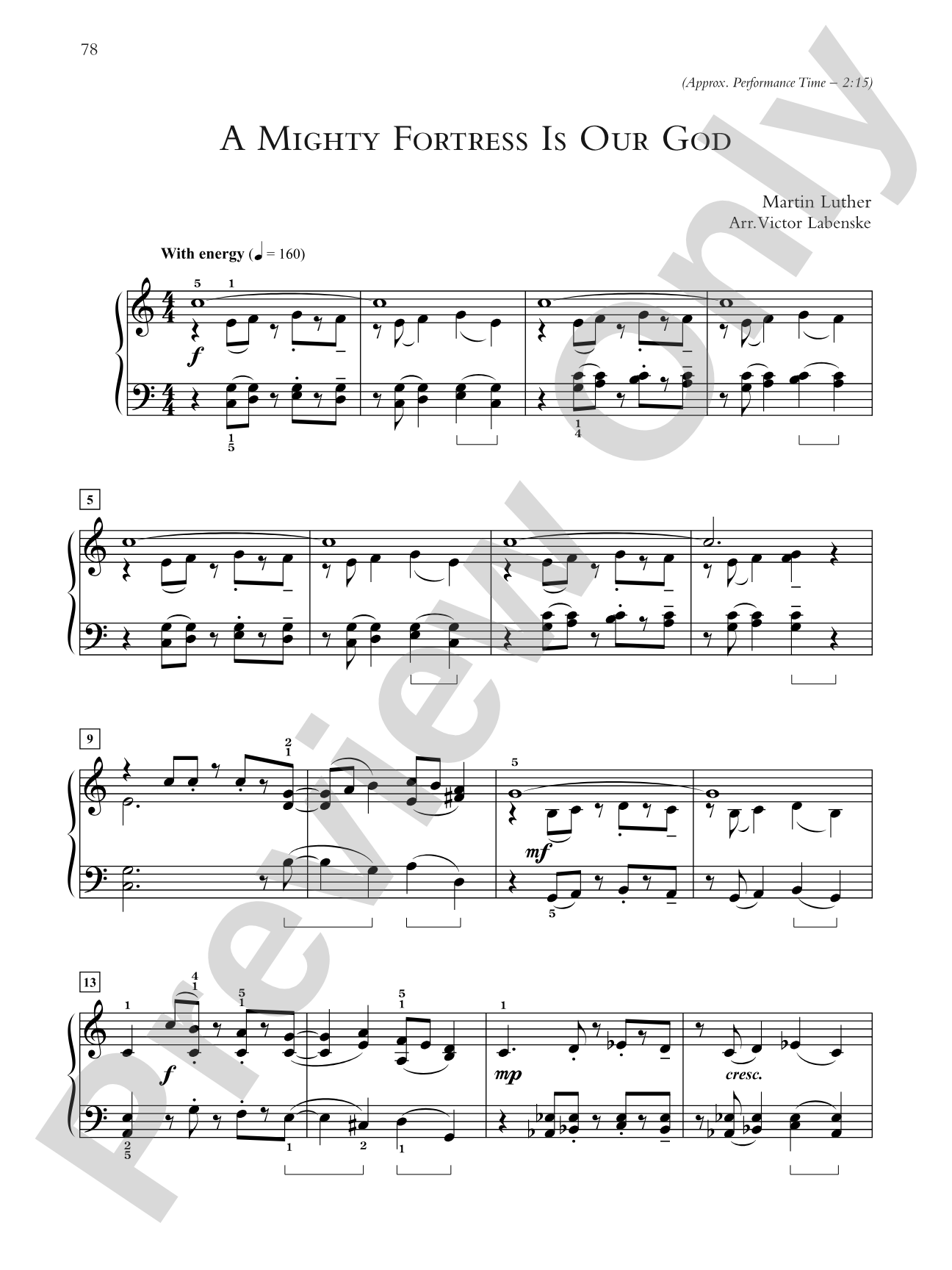

A Mighty Fortress Is Our God - Piano Solo: Piano Solo
33 of the Greatest Hymns of All Time
Arranged by Victor Labenske
Level: Intermediate / Late Intermediate
Item: 00-PS-0017417
$4.99
Pickup currently not available
Related Items
All Creatures of Our God and King - Piano Solo: Piano Solo |
$4.99
|
View | |
All Hail the Power of Jesus' Name - Piano Solo: Piano Solo |
$4.99
|
View | |
Amazing Grace - Piano Solo: Piano Solo |
$4.99
|
View | |
And Can It Be That I Should Gain? - Piano Solo: Piano Solo |
$4.99
|
View | |
Be Thou My Vision - Piano Solo: Piano Solo |
$4.99
|
View | |
Blessed Assurance - Piano Solo: Piano Solo |
$4.99
|
View | |
Come Thou Fount of Every Blessing - Piano Solo: Piano Solo |
$4.99
|
View | |
Come, Christians, Join to Sing - Piano Solo: Piano Solo |
$4.99
|
View | |
Doxology - Piano Solo: Piano Solo |
$4.99
|
View | |
Eternal Father, Strong to Save - Piano Solo: Piano Solo |
$4.99
|
View | |
Fairest Lord Jesus - Piano Solo: Piano Solo |
$4.99
|
View | |
For the Beauty of the Earth - Piano Solo: Piano Solo |
$4.99
|
View | |
Glorious Things of Thee Are Spoken - Piano Solo: Piano Solo |
$4.99
|
View | |
His Eye Is on the Sparrow - Piano Solo: Piano Solo |
$4.99
|
View | |
Holy, Holy, Holy - Piano Solo: Piano Solo |
$4.99
|
View | |
How Firm a Foundation - Piano Solo: Piano Solo |
$4.99
|
View | |
I Need Thee Every Hour - Piano Solo: Piano Solo |
$4.99
|
View | |
It Is Well with My Soul - Piano Solo: Piano Solo |
$4.99
|
View | |
Jesus Loves Me - Piano Solo: Piano Solo |
$4.99
|
View | |
Joyful, Joyful, We Adore Thee - Piano Solo: Piano Solo |
$4.99
|
View | |
My Faith Has Found a Resting Place... - Piano Solo: Piano Solo |
$4.99
|
View | |
My Jesus, I Love Thee - Piano Solo: Piano Solo |
$4.99
|
View | |
O God, Our Help in Ages Past - Piano Solo: Piano Solo |
$4.99
|
View | |
O Sacred Head, Now Wounded - Piano Solo: Piano Solo |
$4.99
|
View | |
O Worship the King - Piano Solo: Piano Solo |
$4.99
|
View | |
Praise to the Lord, the Almighty - Piano Solo: Piano Solo |
$4.99
|
View | |
Savior, Like a Shepherd Lead Us - Piano Solo: Piano Solo |
$4.99
|
View | |
Take My Life and Let It Be - Piano Solo: Piano Solo |
$4.99
|
View | |
This Is My Father's World - Piano Solo: Piano Solo |
$4.99
|
View | |
We Gather Together - Piano Solo: Piano Solo |
$4.99
|
View | |
What a Friend We Have in Jesus - Piano Solo: Piano Solo |
$4.99
|
View | |
When I Survey the Wondrous Cross - Piano Solo: Piano Solo |
$4.99
|
View | |
Sunday Morning Companion: Piano Comb-Bound Book |
$27.99
|
View |
Description
Including more than 30 of the greatest hymns of all time, Sunday Morning Companion is designed as a practical resource for church pianists. These arrangements are appropriate for preludes, offertories and postludes, and are written so that minimal preparation time is required. Additionally, the pieces are arranged in a variety of styles that will fit many different worship settings. The comb binding creates a lay-flat experience that is perfect for students and performers. Titles: All Creatures of Our God and King * All Hail the Power of Jesus' Name * Amazing Grace * And Can It Be That I Should Gain? * Be Thou My Vision * Blessed Assurance * Come Thou Fount of Every Blessing * Come, Christians, Join to Sing * Doxology * Eternal Father, Strong to Save * Fairest Lord Jesus * For the Beauty of the Earth * Glorious Things of Thee Are Spoken * His Eye Is On the Sparrow * Holy, Holy, Holy * How Firm a Foundation * I Need Thee Every Hour * It Is Well with My Soul * Jesus Loves Me * Joyful, Joyful, We Adore Thee * Mighty Fortress Is Our God, A * My Faith Has Found a Resting Place * My Jesus, I Love Thee * O God, Our Help in Ages Past * O Sacred Head, Now Wounded * O Worship the King * Praise Ye the Lord * Savior, Like a Shepherd Lead Us * Take My Life and Let It Be * This Is My Father's World * We Gather Together * What a Friend We Have in Jesus * When I Survey the Wondrous Cross. A Federation Festivals 2024-2028 selection.


A Mighty Fortress Is Our God - Piano Solo: Piano Solo isn't in MakeMusic Cloud just yet...but it could be. Let us know you'd like to see it, and you'll help shape what comes next. In the meantime, start a free trial and dive into thousands of interactive titles your students can play along with today.
Request This Title
Tell us you want it.
Start Your Free Trial
Explore everything that's ready to play right now.
Sample Audio
No sample audio found.
Sample Video
No sample videos found.
Additional Details
Series:
Sacred Performer Collections
Publisher:
Alfred Music
Page Count:
128
SKU:
00-PS-0017417
More about this title
About the Composer: Martin Luther
Martin Luther (1483, 1546) fundamentally changed Christian worship through his conviction that congregations should sing in their native language rather than Latin. His hymn texts and melodies became the foundation of Protestant sacred music, combining theological depth with memorable, singable lines that ordinary people could learn and perform. Luther believed music was essential to faith and education, making him one of the most influential figures in the development of congregational hymnody.
For music educators, Luther's legacy matters because his hymns remain central to worship across denominations and appear constantly in festival selections and curriculum standards. His melodies, often sturdy and direct, provide excellent material for students learning to voice harmonies and understand how strong melodic writing serves a text.
Why we love this
Victor Labenske has arranged these 30+ hymns with genuine church musician practicality in mind. The intermediate-level writing balances accessibility with musical substance, so pianists gain real interpretive responsibility without drowning in technical difficulty. From preludes to postludes, these arrangements give your church music program depth and variety without demanding weeks of preparation.
What to expect
These arrangements honor the directness and emotional clarity that made Luther's hymns endure for five centuries. You'll find yourself playing words, even without singing them, because Labenske's voicings reinforce the text's meaning and shape.
Who it's for
Church pianists at all career stages will find immediate use here, from volunteers filling in on Sunday mornings to experienced musicians building a reliable preservice library. Music teachers can draw these pieces into repertoire study, festival preparation, or piano lessons focused on interpreting standard sacred literature.
How to get the most out of it
- Match your registration choices to the liturgical function: lighter textures and simpler voicings work well for preludes when the sanctuary is still settling, while fuller arrangements suit postludes when congregational participation has ended.
- Respect the hymn melody's origin in congregational singing. Keep the tune audible and unhurried, even when the arrangement adds inner voices or harmonic complexity.
- Use the lay-flat binding practically during service. Mark your page turns in advance and practice transitions so you're not fumbling during a live setting.
- Explore how pedal can enhance these arrangements without muddying the acoustic. Church organs often bloom with resonance that piano needs help achieving; selective pedal use creates warmth without sacrificing clarity.
How to use it
Build a full year of Sunday music from this single volume, rotating between different arrangements and styles to keep the preservice experience fresh. Assign individual hymns as festival selections or sight-reading studies, leveraging the familiar melodies so students focus on technique and interpretation rather than deciphering unfamiliar tunes.
Skills your students will build
- Voicing hymn melodies within four-part harmony
- Sustaining interpretive control at slow tempos
- Managing page turns and preparation in performance settings
- Recognizing variations in harmonic treatment of the same melodic material
- Reading and performing from comb-bound liturgical music