
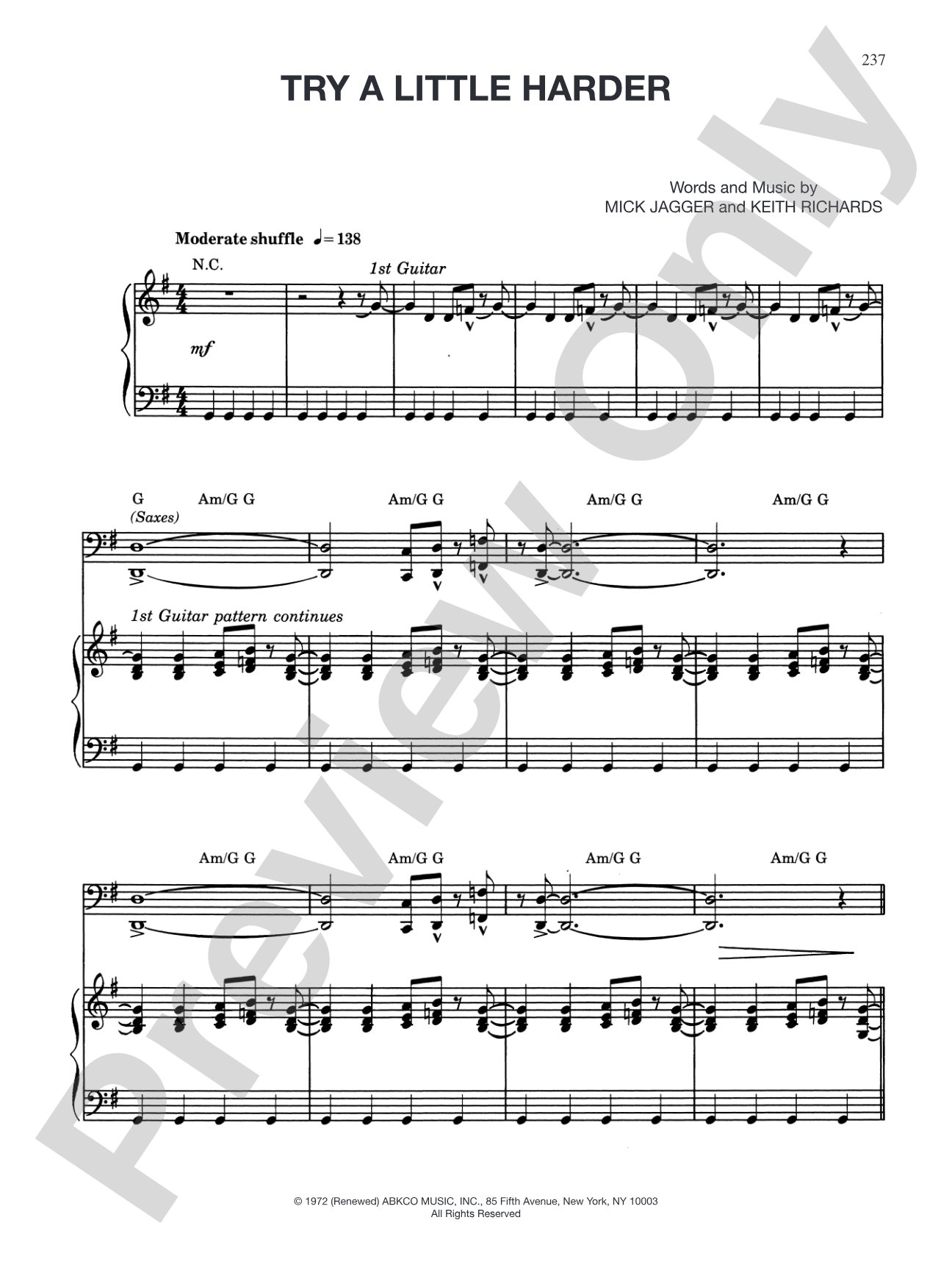

Try a Little Harder: Piano/Vocal/Chords
The Rolling Stones
Item: 00-PS-0012134
$4.99
Pickup currently not available
Related Items
(I Can't Get No) Satisfaction: Piano/Vocal/Chords |
$4.99
|
View | |
Wild Horses: Piano/Vocal/Chords |
$4.99
|
View | |
Sad Day: Piano/Vocal/Chords |
$4.99
|
View | |
The Lantern: Piano/Vocal/Chords |
$4.99
|
View | |
Have You Seen Your Mother, Baby, Standing in the Shadow?: Piano/Vocal/Chords |
$5.99
|
View | |
Street Fighting Man: Piano/Vocal/Chords |
$5.99
|
View | |
Stupid Girl: Piano/Vocal/Chords |
$4.99
|
View | |
Get Off of My Cloud: Piano/Vocal/Chords |
$4.99
|
View | |
Memo From Turner: Piano/Vocal/Chords |
$9.99
|
View | |
We Love You: Piano/Vocal/Chords |
$5.99
|
View | |
Off the Hook: Piano/Vocal/Chords |
$4.99
|
View | |
Child of the Moon: Piano/Vocal/Chords |
$4.99
|
View | |
Jiving Sister Fanny: Piano/Vocal/Chords |
$4.99
|
View | |
The Singer Not the Song: Piano/Vocal/Chords |
$4.99
|
View | |
Time is on My Side: Piano/Vocal/Chords |
$4.99
|
View | |
Little By Little: Piano/Vocal/Chords |
$4.99
|
View | |
The Under Assistant West Coast Promotion Man: Piano/Vocal/Chords |
$4.99
|
View | |
In Another Land: Piano/Vocal/Chords |
$4.99
|
View | |
Good Times, Bad Times: Piano/Vocal/Chords |
$4.99
|
View | |
Gotta Get Away: Piano/Vocal/Chords |
$4.99
|
View | |
Congratulations: Piano/Vocal/Chords |
$4.99
|
View | |
Spider and the Fly: Piano/Vocal/Chords |
$4.99
|
View | |
Long, Long While: Piano/Vocal/Chords |
$5.99
|
View | |
Jumpin' Jack Flash: Piano/Vocal/Chords |
$5.99
|
View | |
Surprise, Surprise: Piano/Vocal/Chords |
$5.99
|
View | |
Who's Driving Your Plane?: Piano/Vocal/Chords |
$5.99
|
View | |
What a Shame: Piano/Vocal/Chords |
$4.99
|
View | |
Sympathy for the Devil: Piano/Vocal/Chords |
$9.99
|
View | |
Brown Sugar: Piano/Vocal/Chords |
$5.99
|
View | |
The Rolling Stones: Singles Collection* The London Years: Piano/Vocal/Chords Book |
$29.95
|
View | |
The Rolling Stones: Singles Collection* The London Years: Guitar/TAB/Vocal Book |
$44.99
|
View |
Description
For keyboardists and singers, this is THE must-own Rolling Stones songbook! This massive collection of nearly 300 pages of piano/vocal/chord sheet music captures 58 of their legendary hits, including "She's a Rainbow," "We Love You," and "You Can't Always Get What You Want."
Titles: 19th Nervous Breakdown * 2000 Light Years from Home * As Tears Go By * Brown Sugar * Child of the Moon * Come On * Congratulations * Dandelion * Get Off of My Cloud * Good Times, Bad Times * Gotta Get Away * Have You Seen Your Mother, Baby, Standing in the Shadow? * Heart of Stone * Honky Tonk Women * (I Can't Get No) Satisfaction * I Don't Know Why * I Just Want to Make Love to You * I Wanna Be Your Man * I Want to Be Loved * I'm Free * In Another Land * It's All Over Now * Jiving Sister Fanny * Jumpin' Jack Flash * Lady Jane * Let's Spend the Night Together * Little by Little * Little Red Rooster * Long Long While * Memo from Turner * Mother's Little Helper * No Expectations * Not Fade Away * Off the Hook * Out of Time * Paint It, Black * Play with Fire * Ruby Tuesday * Sad Day * She's a Rainbow * Stoned * Street Fighting Man * Stupid Girl * Surprise, Surprise * Sympathy for the Devil * Tell Me (You're Coming Back) * The Lantern * The Last Time * The Singer Not the Song * The Spider and the Fly * The Under Assistant West Coast Promotion Man * Time Is on My Side * Try a Little Harder * We Love You * What a Shame * Who's Driving Your Plane? * Wild Horses * You Can't Always Get What You Want.


Titles: 19th Nervous Breakdown * 2000 Light Years from Home * As Tears Go By * Brown Sugar * Child of the Moon * Come On * Congratulations * Dandelion * Get Off of My Cloud * Good Times, Bad Times * Gotta Get Away * Have You Seen Your Mother, Baby, Standing in the Shadow? * Heart of Stone * Honky Tonk Women * (I Can't Get No) Satisfaction * I Don't Know Why * I Just Want to Make Love to You * I Wanna Be Your Man * I Want to Be Loved * I'm Free * In Another Land * It's All Over Now * Jiving Sister Fanny * Jumpin' Jack Flash * Lady Jane * Let's Spend the Night Together * Little by Little * Little Red Rooster * Long Long While * Memo from Turner * Mother's Little Helper * No Expectations * Not Fade Away * Off the Hook * Out of Time * Paint It, Black * Play with Fire * Ruby Tuesday * Sad Day * She's a Rainbow * Stoned * Street Fighting Man * Stupid Girl * Surprise, Surprise * Sympathy for the Devil * Tell Me (You're Coming Back) * The Lantern * The Last Time * The Singer Not the Song * The Spider and the Fly * The Under Assistant West Coast Promotion Man * Time Is on My Side * Try a Little Harder * We Love You * What a Shame * Who's Driving Your Plane? * Wild Horses * You Can't Always Get What You Want.
Discover MakeMusic Cloud: thousands of interactive titles your students can play along with today.
Sample Audio
No sample audio found.
Sample Video
No sample videos found.
Additional Details
Publisher:
Alfred Music
Page Count:
292
SKU:
00-PS-0012134
More about this title
About the Composer: Mick Jagger
Mick Jagger stands as one of rock music's defining songwriters and performers. His partnership with Keith Richards produced some of the most influential rock compositions of the 20th century, spanning blues interpretations, provocative social commentary, and intricately crafted pop songs that have shaped popular music pedagogy and performance for decades.
As a composer, Jagger's work demonstrates sophisticated songwriting across multiple idioms: blues-based grooves, orchestral arrangements, and harmonic progressions that reward close study by musicians working across genres. His catalog remains essential repertoire for pianists and vocalists exploring rock music composition and performance.
Why we love this
This collection captures the breadth of one of rock's most enduring catalogs in a single, practical volume. The 58 songs span the band's evolution from early blues covers to orchestral arrangements and experimental studio work, giving pianists and singers a comprehensive resource for understanding how songwriting, arrangement, and production techniques developed over decades. Whether you're building a rock repertoire or teaching students to analyze successful songwriting across eras, having these pieces together eliminates the hunt for scattered arrangements.
What to expect
These songs carry swagger, humor, desperation, and invention in equal measure. You'll move from the primal energy of early recordings to lush arrangements, from straightforward blues progressions to strings and elaborate production, all within one collection. The sound is immediate and compelling, with melodies that stick and harmonic structures that feel both accessible and sophisticated.
Who it's for
Pianists and singers performing in rock, pop, and musical theater contexts will find this collection invaluable for auditions, gigs, and setlist building. It serves students learning to read lead sheets and understand how chord symbols translate to performance, as well as musicians developing interpretive skills across the rock canon. Music educators using rock repertoire in curricula benefit from having nearly 300 pages of familiar, recognizable material in one standardized format.
How to get the most out of it
- Study the chord symbols carefully; many songs use relatively simple harmonic frameworks that create power through rhythmic placement and vocal phrasing rather than complex changes. Locking those rhythms into your hands builds the foundation the vocals can sit on.
- Balance vocal melody with piano texture. The Stones' arrangements frequently feature sparse piano work that serves the song rather than fills it. Resist the urge to over-accompany; let space work for you.
- Examine the original recordings of unfamiliar titles. The sheet music captures melody and harmony, but Jagger's phrasing, timing, and production details shape these songs fundamentally. Listening informs how you shape your own interpretation.
- Pay attention to key relationships across the collection. Transposing songs into your comfortable range is standard practice, but notice how certain keys serve specific moods in the originals. That awareness deepens your interpretive choices.
How to use it
Use this as a repertoire source for rock-focused recitals, cabaret performances, or contemporary music programs where students perform outside traditional classical frameworks. The breadth makes it ideal for sampling assignments where musicians select and prepare unfamiliar titles from a single era or style. Keyboardists can draw solo piano arrangements from pieces originally featuring full arrangements, while vocalists pair songs with piano accompaniment or chord-chart collaboration in ensemble settings.
Skills your students will build
- Reading and interpreting lead sheets with chord symbols and melody lines
- Translating written chords into idiomatic piano voicings for rock contexts
- Analyzing song structure across blues-based, pop, and experimentally arranged compositions
- Shaping vocal phrasing in syncopated, rhythm-driven contexts
- Adapting arrangements and keys to match performer range and ensemble instrumentation