
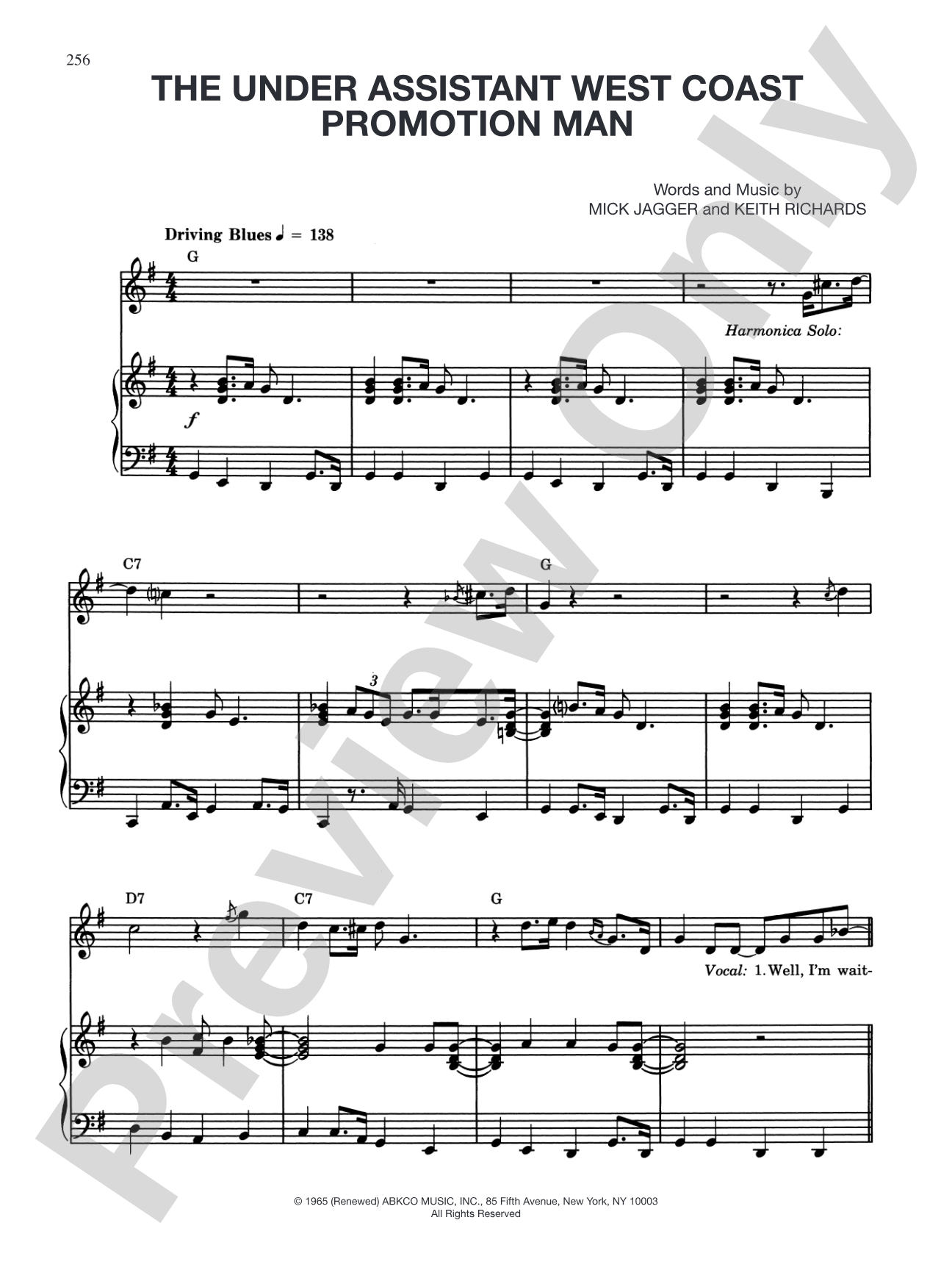

The Under Assistant West Coast Promotion Man: Piano/Vocal/Chords
The Rolling Stones
Item: 00-PS-0012124
$4.99
Pickup currently not available
Related Items
(I Can't Get No) Satisfaction: Piano/Vocal/Chords |
$4.99
|
View | |
Wild Horses: Piano/Vocal/Chords |
$4.99
|
View | |
Sad Day: Piano/Vocal/Chords |
$4.99
|
View | |
The Lantern: Piano/Vocal/Chords |
$4.99
|
View | |
Have You Seen Your Mother, Baby, Standing in the Shadow?: Piano/Vocal/Chords |
$5.99
|
View | |
Street Fighting Man: Piano/Vocal/Chords |
$5.99
|
View | |
Stupid Girl: Piano/Vocal/Chords |
$4.99
|
View | |
Get Off of My Cloud: Piano/Vocal/Chords |
$4.99
|
View | |
Memo From Turner: Piano/Vocal/Chords |
$9.99
|
View | |
We Love You: Piano/Vocal/Chords |
$5.99
|
View | |
Off the Hook: Piano/Vocal/Chords |
$4.99
|
View | |
Child of the Moon: Piano/Vocal/Chords |
$4.99
|
View | |
Jiving Sister Fanny: Piano/Vocal/Chords |
$4.99
|
View | |
The Singer Not the Song: Piano/Vocal/Chords |
$4.99
|
View | |
Time is on My Side: Piano/Vocal/Chords |
$4.99
|
View | |
Little By Little: Piano/Vocal/Chords |
$4.99
|
View | |
In Another Land: Piano/Vocal/Chords |
$4.99
|
View | |
Good Times, Bad Times: Piano/Vocal/Chords |
$4.99
|
View | |
Gotta Get Away: Piano/Vocal/Chords |
$4.99
|
View | |
Congratulations: Piano/Vocal/Chords |
$4.99
|
View | |
Spider and the Fly: Piano/Vocal/Chords |
$4.99
|
View | |
Long, Long While: Piano/Vocal/Chords |
$5.99
|
View | |
Try a Little Harder: Piano/Vocal/Chords |
$4.99
|
View | |
Jumpin' Jack Flash: Piano/Vocal/Chords |
$5.99
|
View | |
Surprise, Surprise: Piano/Vocal/Chords |
$5.99
|
View | |
Who's Driving Your Plane?: Piano/Vocal/Chords |
$5.99
|
View | |
What a Shame: Piano/Vocal/Chords |
$4.99
|
View | |
Sympathy for the Devil: Piano/Vocal/Chords |
$9.99
|
View | |
Brown Sugar: Piano/Vocal/Chords |
$5.99
|
View | |
The Rolling Stones: Singles Collection* The London Years: Piano/Vocal/Chords Book |
$29.95
|
View | |
The Rolling Stones: Singles Collection* The London Years: Guitar/TAB/Vocal Book |
$44.99
|
View |
Description
For keyboardists and singers, this is THE must-own Rolling Stones songbook! This massive collection of nearly 300 pages of piano/vocal/chord sheet music captures 58 of their legendary hits, including "She's a Rainbow," "We Love You," and "You Can't Always Get What You Want."
Titles: 19th Nervous Breakdown * 2000 Light Years from Home * As Tears Go By * Brown Sugar * Child of the Moon * Come On * Congratulations * Dandelion * Get Off of My Cloud * Good Times, Bad Times * Gotta Get Away * Have You Seen Your Mother, Baby, Standing in the Shadow? * Heart of Stone * Honky Tonk Women * (I Can't Get No) Satisfaction * I Don't Know Why * I Just Want to Make Love to You * I Wanna Be Your Man * I Want to Be Loved * I'm Free * In Another Land * It's All Over Now * Jiving Sister Fanny * Jumpin' Jack Flash * Lady Jane * Let's Spend the Night Together * Little by Little * Little Red Rooster * Long Long While * Memo from Turner * Mother's Little Helper * No Expectations * Not Fade Away * Off the Hook * Out of Time * Paint It, Black * Play with Fire * Ruby Tuesday * Sad Day * She's a Rainbow * Stoned * Street Fighting Man * Stupid Girl * Surprise, Surprise * Sympathy for the Devil * Tell Me (You're Coming Back) * The Lantern * The Last Time * The Singer Not the Song * The Spider and the Fly * The Under Assistant West Coast Promotion Man * Time Is on My Side * Try a Little Harder * We Love You * What a Shame * Who's Driving Your Plane? * Wild Horses * You Can't Always Get What You Want.


Titles: 19th Nervous Breakdown * 2000 Light Years from Home * As Tears Go By * Brown Sugar * Child of the Moon * Come On * Congratulations * Dandelion * Get Off of My Cloud * Good Times, Bad Times * Gotta Get Away * Have You Seen Your Mother, Baby, Standing in the Shadow? * Heart of Stone * Honky Tonk Women * (I Can't Get No) Satisfaction * I Don't Know Why * I Just Want to Make Love to You * I Wanna Be Your Man * I Want to Be Loved * I'm Free * In Another Land * It's All Over Now * Jiving Sister Fanny * Jumpin' Jack Flash * Lady Jane * Let's Spend the Night Together * Little by Little * Little Red Rooster * Long Long While * Memo from Turner * Mother's Little Helper * No Expectations * Not Fade Away * Off the Hook * Out of Time * Paint It, Black * Play with Fire * Ruby Tuesday * Sad Day * She's a Rainbow * Stoned * Street Fighting Man * Stupid Girl * Surprise, Surprise * Sympathy for the Devil * Tell Me (You're Coming Back) * The Lantern * The Last Time * The Singer Not the Song * The Spider and the Fly * The Under Assistant West Coast Promotion Man * Time Is on My Side * Try a Little Harder * We Love You * What a Shame * Who's Driving Your Plane? * Wild Horses * You Can't Always Get What You Want.
Discover MakeMusic Cloud: thousands of interactive titles your students can play along with today.
Sample Audio
No sample audio found.
Sample Video
No sample videos found.
Additional Details
Publisher:
Alfred Music
Page Count:
292
SKU:
00-PS-0012124
More about this title
About the Composer: Mick Jagger
Mick Jagger stands as one of rock music's most distinctive and enduring songwriters. As the primary lyricist and frontman for The Rolling Stones since 1962, Jagger has crafted some of the genre's most memorable hooks, provocative narratives, and instantly recognizable vocal melodies. His collaborations with Keith Richards produced a songwriting partnership that defined rock and roll across multiple decades and influenced countless musicians who followed.
Beyond his work with the Stones, Jagger's compositions reveal a songwriter equally comfortable with blues-rooted storytelling, social commentary, and pop sensibility. His melodies sit naturally in the voice while remaining distinctive enough to anchor entire songs; his lyrics balance specificity with universality. For musicians learning to arrange rock material or explore classic song structure, Jagger's catalog offers direct lessons in how strong melody and lyrical clarity drive a song's identity.
Why we love this
This collection spans five decades of Rolling Stones songwriting in a single resource, making it invaluable for pianists, singers, and keyboardists who want to learn the band's essential repertoire without hunting through multiple sources. The piano/vocal/chords format gives singers their melody line while allowing accompanists to interpret voicings and arrangements; you're not locked into one interpretation. Whether you're building a classic rock recital, creating a tribute evening, or simply exploring how these songs sit on the keyboard, this book makes accessible some of rock's most structurally interesting and emotionally resonant material.
What to expect
These songs carry the swagger, wit, and bluesy edge that made the Rolling Stones essential. You'll move from the blues-inflected straightforwardness of "Little Red Rooster" to the orchestral drama of "Paint It, Black," from the cheeky provocation of "Satisfaction" to the tender resignation of "Wild Horses." The collection feels less like a Greatest Hits package and more like a tour through the band's actual songwriting evolution, capturing moments of genuine vulnerability alongside the raunchy confidence the Stones made famous.
Who it's for
Pianists and singers preparing solo recitals, keyboardists working in rock ensembles or tribute bands, and music students exploring how classic rock repertoire combines melody, harmony, and lyrical narrative. Anyone who performs covers or wants to learn these songs' structures will find 58 carefully curated titles that represent the band's range and influence.
How to get the most out of it
- Study the original recordings alongside the sheet music. Jagger's phrasing and rhythmic placement often sit slightly ahead of or behind the beat in ways that sheet music alone won't reveal; listening helps you capture the swagger that makes these songs distinctive.
- Treat the chord symbols as a starting point, not a ceiling. Many of these songs were arranged with specific textures (string orchestration on "Ruby Tuesday," harpsichord on "The Lantern"); adapting the voicings to fit your instrumentation or acoustic context keeps the song fresh while honoring the original.
- Pay attention to lyrical rhythm. Jagger often uses syllable placement as a rhythmic device, and rushing through the lyrics or placing them too squarely on beats flattens the song's energy. Align your accompaniment to support the natural phrasing of the text.
- Consider transposition intentionally. Many of these songs sit lower or higher in the original recording than in standard sheet music versions. Choose a key that lets the vocalist sit comfortably while keeping the song's character intact.
How to use it
Build a solo recital around these songs, structuring it chronologically or thematically to show how the Stones' songwriting matured. Pair selections with other classic rock material to create a period-specific concert program, or use individual titles as encores that audiences will recognize immediately. For singers studying interpretation and style, work through several contrasting songs to understand how Jagger adapted his melodic and rhythmic approach across different song types.
Skills your students will build
- Interpreting blues-influenced melody and phrasing within a rock context
- Realizing chord symbols with appropriate comping textures for rock keyboard styles
- Understanding how lyrical rhythm and vocal placement drive song momentum
- Transposing songs to suit a vocalist's range while preserving character
- Analyzing song structure and arrangement choices across different recording eras