
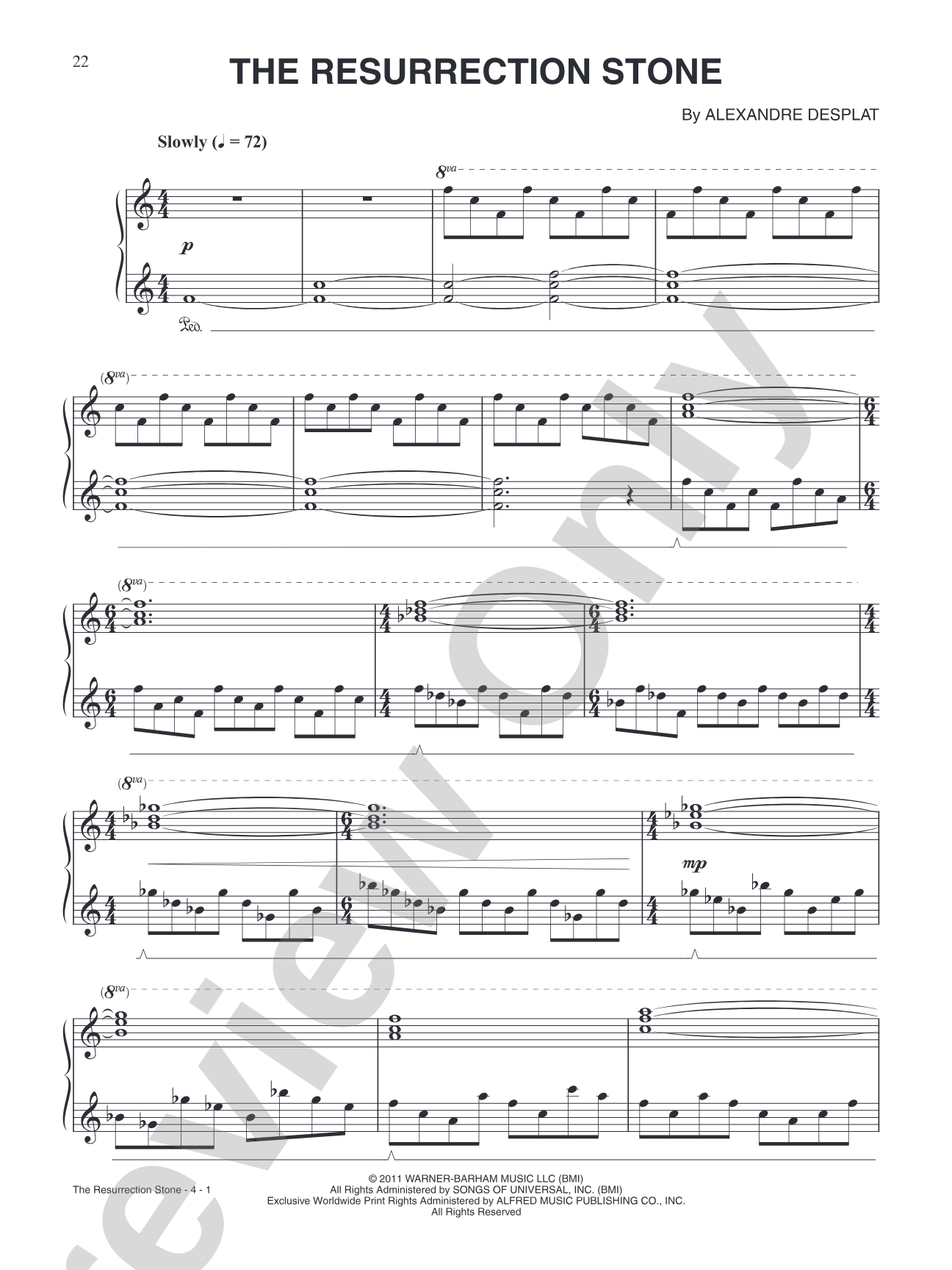

The Resurrection Stone (from "Harry Potter and the Deathly Hallows Part 2"): Piano
Selections from the Motion Picture
Music by Alexandre Desplat
Item: 00-XS-0000401
$4.99
Pickup currently not available
Related Items
Lily's Theme (from "Harry Potter and the Deathly Hallows Part 2"): Piano |
$4.99
|
View | |
Statues (from "Harry Potter and the Deathly Hallows Part 2"): Piano |
$4.99
|
View | |
Courtyard Apocalypse (from "Harry Potter and the Deathly Hallows Part 2"): Piano |
$4.99
|
View | |
Severus and Lily (from "Harry Potter and the Deathly Hallows Part 2"): Piano |
$5.99
|
View | |
Harry's Sacrifice (from "Harry Potter and the Deathly Hallows Part 2"): Piano |
$4.99
|
View | |
Neville the Hero (from "Harry Potter and the Deathly Hallows Part 2"): Piano |
$4.99
|
View | |
A New Beginning (from "Harry Potter and the Deathly Hallows Part 2"): Piano |
$4.99
|
View | |
Lily's Lullaby (from "Harry Potter and the Deathly Hallows Part 2"): Piano |
$4.99
|
View | |
Harry Potter and the Deathly Hallows, Part 2: Piano Book |
$14.99
|
View |
Description
This is the officially licensed, collectible sheet music folio from the motion picture, featuring solo piano arrangements of nine standout selections from Alexandre Desplat's acclaimed score, along with several pages of color imagery from the film. Titles: Lily's Theme * Statues * Courtyard Apocalypse * Severus and Lily * Harry's Sacrifice * The Resurrection Stone * Neville the Hero * A New Beginning * Lily's Lullaby.


The Resurrection Stone (from "Harry Potter and the Deathly Hallows Part 2"): Piano isn't in MakeMusic Cloud just yet...but it could be. Let us know you'd like to see it, and you'll help shape what comes next. In the meantime, start a free trial and dive into thousands of interactive titles your students can play along with today.
Request This Title
Tell us you want it.
Start Your Free Trial
Explore everything that's ready to play right now.
Sample Audio
No sample audio found.
Sample Video
No sample videos found.
Additional Details
Publisher:
Alfred Music
Page Count:
32
SKU:
00-XS-0000401
More about this title
About the Composer: Alexandre Desplat
Alexandre Desplat has established himself as one of cinema's most accomplished orchestral composers, known for his ability to craft emotionally resonant themes that anchor sprawling narrative worlds. His work across the Harry Potter series demonstrates a deep understanding of how musical motifs can carry character development and emotional weight, evolving alongside the story's darkness and complexity.
Why we love this
Desplat's themes translate beautifully to solo piano without losing their emotional core, and this collection captures the final film's most poignant moments. The arrangements preserve the orchestral sophistication of the originals while remaining playable at the intermediate level, making them ideal for recitals where film music belongs on concert programs.
What to expect
The music moves between intimate character moments and sweeping, orchestral grandeur. You'll find yourself inhabiting the final chapters of the Harry Potter saga: Lily's maternal love, Snape's tragic complexity, Harry's sacrifice, and the quiet hope of survival. The writing balances accessible passagework with moments of genuine harmonic and emotional depth.
Who it's for
Intermediate pianists seeking repertoire that speaks to both classical musicians and film music enthusiasts. This collection works well for students who connect emotionally with narrative music and want to perform meaningful pieces that feel contemporary while developing interpretive skills.
How to get the most out of it
- Pay close attention to dynamic shape in pieces like "Lily's Theme" and "A New Beginning"; these themes rely on subtle crescendos and diminuendos rather than dramatic jumps to convey emotion.
- Allow space in the more contemplative sections ("Severus and Lily," "Harry's Sacrifice") by resisting the urge to rush; the harmonic movement does the storytelling work.
- In "Courtyard Apocalypse" and "Neville the Hero," maintain rhythmic clarity in the accompaniment patterns so the melodic line remains transparent even when the texture thickens.
How to use it
This collection works beautifully as a solo recital suite, either performed in sequence or selected as individual pieces within a larger program. The thematic coherence and emotional arc make it compelling as a standalone segment, and the inclusion of film imagery supports programming that celebrates story-driven composition.
Skills your students will build
- Shaping long melodic lines across phrase boundaries
- Voicing block chords with clarity and warmth
- Balancing accompaniment texture so melody remains audible
- Sustaining emotional expression across slower, harmonically intricate passages
- Managing dynamic contrast without overstating emotional moments