
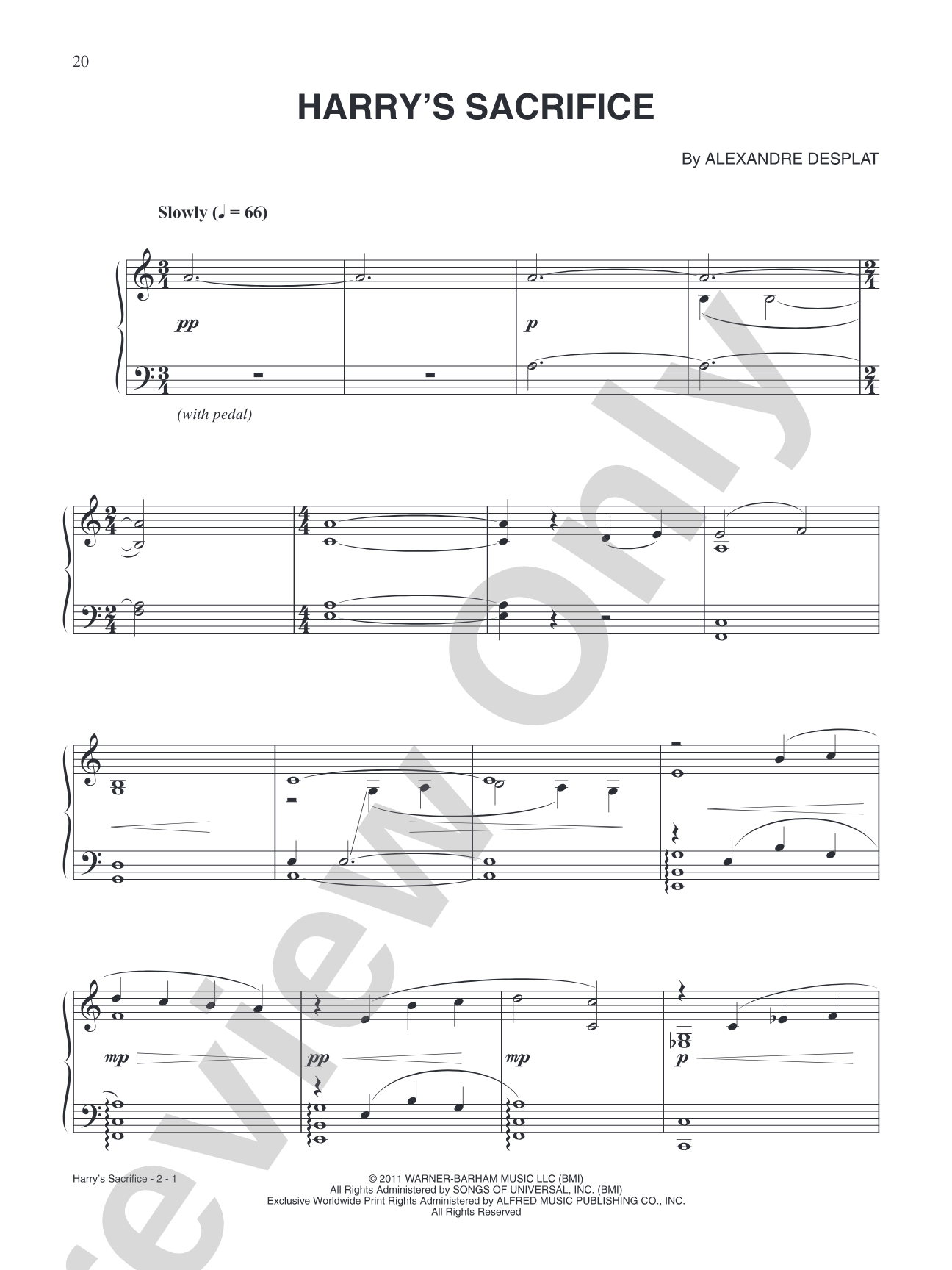

Harry's Sacrifice (from "Harry Potter and the Deathly Hallows Part 2"): Piano
Selections from the Motion Picture
Music by Alexandre Desplat
Item: 00-XS-0000400
$4.99
Pickup currently not available
Related Items
Lily's Theme (from "Harry Potter and the Deathly Hallows Part 2"): Piano |
$4.99
|
View | |
Statues (from "Harry Potter and the Deathly Hallows Part 2"): Piano |
$4.99
|
View | |
Courtyard Apocalypse (from "Harry Potter and the Deathly Hallows Part 2"): Piano |
$4.99
|
View | |
Severus and Lily (from "Harry Potter and the Deathly Hallows Part 2"): Piano |
$5.99
|
View | |
The Resurrection Stone (from "Harry Potter and the Deathly Hallows Part 2"): Piano |
$4.99
|
View | |
Neville the Hero (from "Harry Potter and the Deathly Hallows Part 2"): Piano |
$4.99
|
View | |
A New Beginning (from "Harry Potter and the Deathly Hallows Part 2"): Piano |
$4.99
|
View | |
Lily's Lullaby (from "Harry Potter and the Deathly Hallows Part 2"): Piano |
$4.99
|
View | |
Harry Potter and the Deathly Hallows, Part 2: Piano Book |
$14.99
|
View |
Description
This is the officially licensed, collectible sheet music folio from the motion picture, featuring solo piano arrangements of nine standout selections from Alexandre Desplat's acclaimed score, along with several pages of color imagery from the film. Titles: Lily's Theme * Statues * Courtyard Apocalypse * Severus and Lily * Harry's Sacrifice * The Resurrection Stone * Neville the Hero * A New Beginning * Lily's Lullaby.


Harry's Sacrifice (from "Harry Potter and the Deathly Hallows Part 2"): Piano isn't in MakeMusic Cloud just yet...but it could be. Let us know you'd like to see it, and you'll help shape what comes next. In the meantime, start a free trial and dive into thousands of interactive titles your students can play along with today.
Request This Title
Tell us you want it.
Start Your Free Trial
Explore everything that's ready to play right now.
Sample Audio
No sample audio found.
Sample Video
No sample videos found.
Additional Details
Publisher:
Alfred Music
Page Count:
32
SKU:
00-XS-0000400
More about this title
About the Composer: Alexandre Desplat
Alexandre Desplat is a French composer whose film scores have shaped the sonic landscape of contemporary cinema. His work on the Harry Potter franchise (particularly the final four films) and the Fantastic Beasts series demonstrates his mastery of orchestral storytelling, layering motifs with emotional precision and harmonic sophistication.
Desplat's approach to film composition balances accessibility with compositional depth, making his music engaging for both casual listeners and musicians serious about understanding harmonic structure and orchestration. His scores reward close listening and detailed arrangement work, which is why his piano reductions remain compelling even when stripped of their orchestral context.
Why we love this
These arrangements capture the emotional architecture of Desplat's orchestral writing while making his harmonic language available to intermediate pianists. The collection moves seamlessly between intimate character moments (Lily's Theme) and dramatic set pieces (Courtyard Apocalypse), giving pianists substantial interpretive choices within each piece.
What to expect
These arrangements evoke both intimacy and sweep, shifting from delicate introspection (Lily's Lullaby) to grandiose orchestral drama (The Resurrection Stone). The harmonic language is modern yet accessible, blending classical piano traditions with film scoring's emotional directness.
Who it's for
This folio suits intermediate to advanced pianists seeking musically substantial film music that doesn't rely on simple melodic transcription. It also appeals to Harry Potter fans who want to engage with the score's compositional craft through their own playing, and to teachers building recital programs that include contemporary film music.
How to get the most out of it
- Lean into the legato pedaling in pieces like Severus and Lily; Desplat's orchestral strings are mimicked through sustained harmonic resonance rather than bright articulation.
- Tempo flexibility serves the emotional arc. Harry's Sacrifice benefits from slight rubato in its quieter sections before building to its climax.
- Pay attention to the color imagery included in the folio; visual context often illuminates the dynamic shape Desplat intended for each cue.
- The recurring Lily's Theme motif appears across multiple pieces in varied orchestrations. Tracking how it transforms deepens your interpretation of the collection's overall narrative.
How to use it
Program this as a thematic suite in a recital focused on contemporary film music, or select individual pieces to pair with classical repertoire that shares similar harmonic language. The collection also works well as a bridge between standard piano literature and students' own musical interests, particularly for younger or adult learners motivated by film and popular culture.
Skills your students will build
- Pedal control and resonance in sustaining harmonies across registers
- Interpreting film music cues (reading and responding to emotional arc within notated music)
- Handling leitmotif development (tracking thematic transformation across pieces)
- Balancing harmonic complexity with melodic clarity in arrangements