
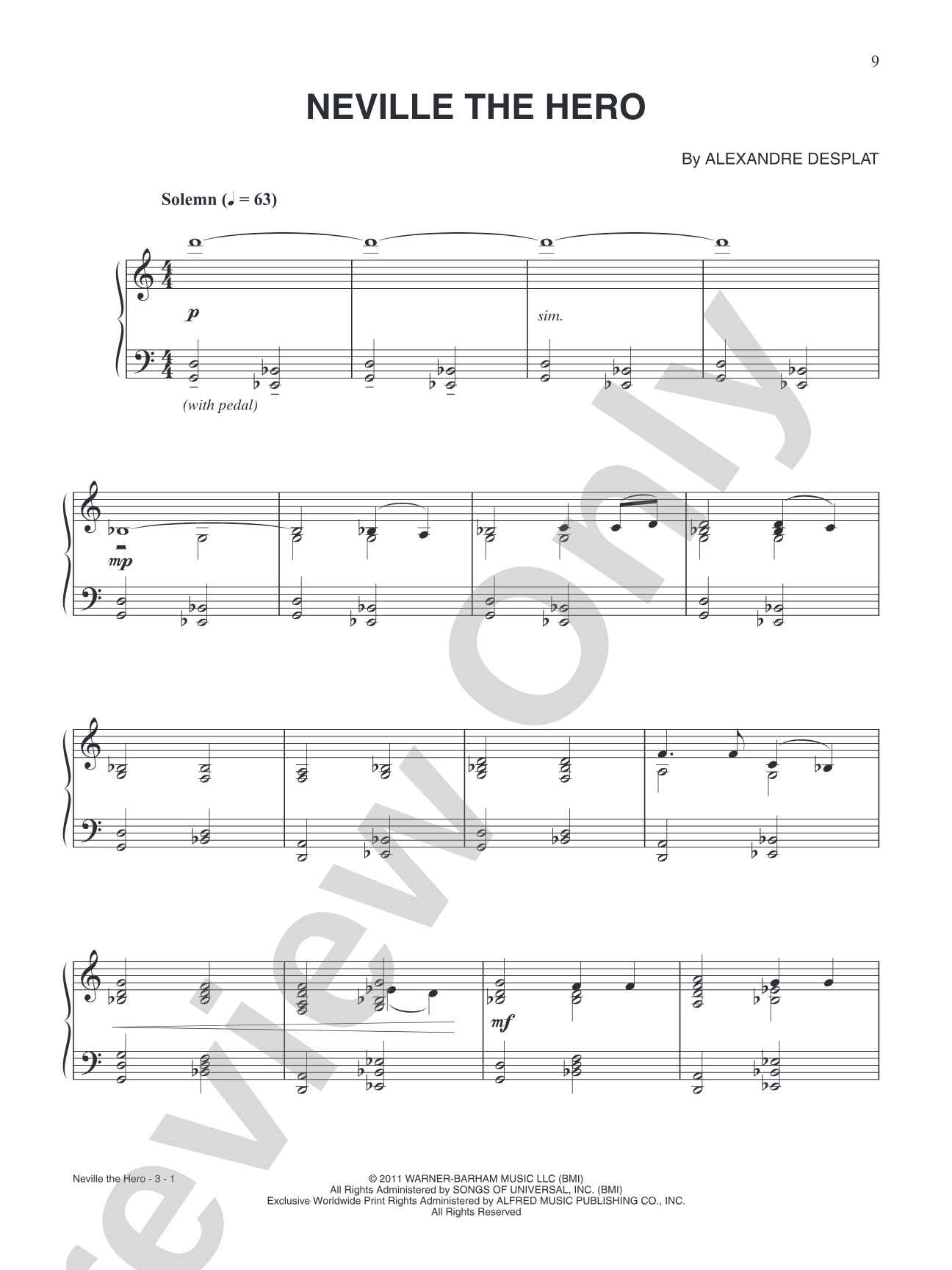

Neville the Hero (from "Harry Potter and the Deathly Hallows Part 2"): Piano
Selections from the Motion Picture
Music by Alexandre Desplat
Item: 00-XS-0000402
$4.99
Pickup currently not available
Related Items
Lily's Theme (from "Harry Potter and the Deathly Hallows Part 2"): Piano |
$4.99
|
View | |
Statues (from "Harry Potter and the Deathly Hallows Part 2"): Piano |
$4.99
|
View | |
Courtyard Apocalypse (from "Harry Potter and the Deathly Hallows Part 2"): Piano |
$4.99
|
View | |
Severus and Lily (from "Harry Potter and the Deathly Hallows Part 2"): Piano |
$5.99
|
View | |
Harry's Sacrifice (from "Harry Potter and the Deathly Hallows Part 2"): Piano |
$4.99
|
View | |
The Resurrection Stone (from "Harry Potter and the Deathly Hallows Part 2"): Piano |
$4.99
|
View | |
A New Beginning (from "Harry Potter and the Deathly Hallows Part 2"): Piano |
$4.99
|
View | |
Lily's Lullaby (from "Harry Potter and the Deathly Hallows Part 2"): Piano |
$4.99
|
View | |
Harry Potter and the Deathly Hallows, Part 2: Piano Book |
$14.99
|
View |
Description
This is the officially licensed, collectible sheet music folio from the motion picture, featuring solo piano arrangements of nine standout selections from Alexandre Desplat's acclaimed score, along with several pages of color imagery from the film. Titles: Lily's Theme * Statues * Courtyard Apocalypse * Severus and Lily * Harry's Sacrifice * The Resurrection Stone * Neville the Hero * A New Beginning * Lily's Lullaby.


Neville the Hero (from "Harry Potter and the Deathly Hallows Part 2"): Piano isn't in MakeMusic Cloud just yet...but it could be. Let us know you'd like to see it, and you'll help shape what comes next. In the meantime, start a free trial and dive into thousands of interactive titles your students can play along with today.
Request This Title
Tell us you want it.
Start Your Free Trial
Explore everything that's ready to play right now.
Sample Audio
No sample audio found.
Sample Video
No sample videos found.
Additional Details
Publisher:
Alfred Music
Page Count:
32
SKU:
00-XS-0000402
More about this title
About the Composer: Alexandre Desplat
Alexandre Desplat has composed for over 150 films, earning three Academy Award nominations and two Golden Globe awards. His orchestral writing combines structural clarity with emotional directness, making his scores accessible to musicians across skill levels while maintaining sophisticated harmonic language. Desplat's work on the Harry Potter and Fantastic Beasts franchises established him as a master of thematic storytelling, where recurring motifs anchor complex emotional arcs across multiple films.
Why we love this
These arrangements capture the emotional core of Desplat's final Potter score without requiring advanced technique, making them ideal for intermediate pianists who want to engage with film music they know and love. The nine pieces span the full emotional range of the finale, from quiet introspection (Lily's Lullaby) to epic action (Courtyard Apocalypse), giving pianists substantive material that feels rewarding to perform. The officially licensed folio with film imagery transforms practice into an immersive experience that motivates students to work through more demanding passages.
What to expect
These arrangements translate the sweeping grandeur and intimate vulnerability of Desplat's orchestral writing into the solo piano idiom with surprising elegance. Whether exploring the aching beauty of Lily's Lullaby or navigating the dramatic turbulence of Courtyard Apocalypse, the music maintains the emotional immediacy of the film score while revealing the underlying harmonic architecture. The collection feels less like transcription and more like a personal reflection on the final chapter of a story.
Who it's for
Intermediate pianists who want to explore film scoring's harmonic and melodic language through repertoire they recognize and care about. Students preparing for auditions or recitals will find pieces across multiple difficulty levels within this single folio, allowing them to build a cohesive program. Teachers seeking to engage students with contemporary classical composition will appreciate Desplat's accessible yet sophisticated approach to theme and orchestration.
How to get the most out of it
- Pay close attention to tempo and pacing shifts within pieces like Courtyard Apocalypse; Desplat's film scores use rubato to heighten dramatic impact, and these moments define the arrangement's cinematic character.
- Balance the left hand carefully in passages with sustained chords and arpeggios (particularly in Severus and Lily), where muddy texture will obscure Desplat's harmonic movement.
- Use the recurring Lily's Theme motif as an anchor point when learning multiple pieces from the folio; recognizing how it transforms across different arrangements deepens understanding of the larger narrative structure.
- Shape the melody with phrase awareness rather than note-to-note playing, especially in lyrical pieces like A New Beginning, where the emotional weight depends on vocal-like legato and intelligent breath points.
How to use it
Build a recital program around Desplat's thematic material, pairing quieter character pieces (Severus and Lily, Lily's Lullaby) with more dramatic selections (Harry's Sacrifice, The Resurrection Stone) to show interpretive range. Position this folio within a broader unit on film scoring, where students analyze how Desplat uses simple melodic shapes and harmonic progression to underscore narrative turning points. Consider assigning individual pieces throughout the year as technique milestones, allowing students to return to Desplat's language repeatedly and deepen their understanding with each encounter.
Skills your students will build
- Sustaining emotional narrative across longer multi-section forms (Courtyard Apocalypse, A New Beginning)
- Voice leading through chromatic harmony and modal mixture in Desplat's harmonic vocabulary
- Dynamic control in pieces with sparse orchestration where every note registers (Lily's Lullaby)
- Pedal technique for color and resonance without sacrificing clarity (Statues, The Resurrection Stone)
- Thematic recognition and variation, tracking Lily's Theme through multiple arrangements and transformations