
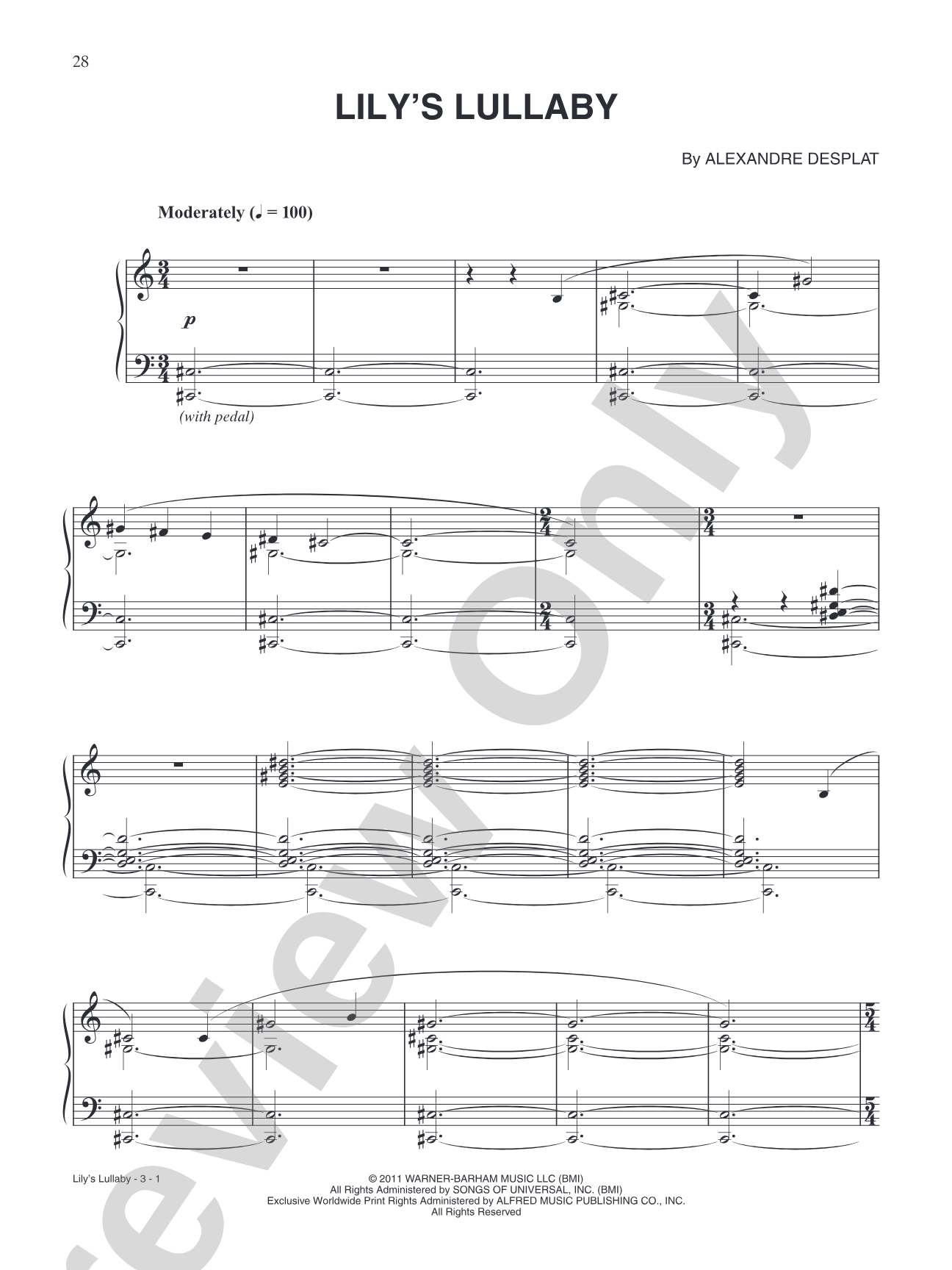

Lily's Lullaby (from "Harry Potter and the Deathly Hallows Part 2"): Piano
Selections from the Motion Picture
Music by Alexandre Desplat
Item: 00-XS-0000404
$4.99
Pickup currently not available
Related Items
Lily's Theme (from "Harry Potter and the Deathly Hallows Part 2"): Piano |
$4.99
|
View | |
Statues (from "Harry Potter and the Deathly Hallows Part 2"): Piano |
$4.99
|
View | |
Courtyard Apocalypse (from "Harry Potter and the Deathly Hallows Part 2"): Piano |
$4.99
|
View | |
Severus and Lily (from "Harry Potter and the Deathly Hallows Part 2"): Piano |
$5.99
|
View | |
Harry's Sacrifice (from "Harry Potter and the Deathly Hallows Part 2"): Piano |
$4.99
|
View | |
The Resurrection Stone (from "Harry Potter and the Deathly Hallows Part 2"): Piano |
$4.99
|
View | |
Neville the Hero (from "Harry Potter and the Deathly Hallows Part 2"): Piano |
$4.99
|
View | |
A New Beginning (from "Harry Potter and the Deathly Hallows Part 2"): Piano |
$4.99
|
View | |
Harry Potter and the Deathly Hallows, Part 2: Piano Book |
$14.99
|
View |
Description
This is the officially licensed, collectible sheet music folio from the motion picture, featuring solo piano arrangements of nine standout selections from Alexandre Desplat's acclaimed score, along with several pages of color imagery from the film. Titles: Lily's Theme * Statues * Courtyard Apocalypse * Severus and Lily * Harry's Sacrifice * The Resurrection Stone * Neville the Hero * A New Beginning * Lily's Lullaby.


Lily's Lullaby (from "Harry Potter and the Deathly Hallows Part 2"): Piano isn't in MakeMusic Cloud just yet...but it could be. Let us know you'd like to see it, and you'll help shape what comes next. In the meantime, start a free trial and dive into thousands of interactive titles your students can play along with today.
Request This Title
Tell us you want it.
Start Your Free Trial
Explore everything that's ready to play right now.
Sample Audio
No sample audio found.
Sample Video
No sample videos found.
Additional Details
Publisher:
Alfred Music
Page Count:
32
SKU:
00-XS-0000404
More about this title
About the Composer: Alexandre Desplat
Alexandre Desplat has composed film scores for some of cinema's most visually and narratively complex worlds, from the Harry Potter universe to Fantastic Beasts, The Grand Budapest Hotel, and The Shape of Water. His orchestral sensibility and gift for leitmotif work have earned him multiple Academy Award nominations and made him one of the most recorded film composers in contemporary music.
Desplat's approach to scoring emphasizes emotional clarity and thematic development. His Harry Potter work demonstrates a deep understanding of how music can anchor character arcs and emotional turning points, creating material that translates remarkably well to solo piano while retaining its narrative power.
Why we love this
These arrangements preserve the emotional weight of Desplat's original orchestration while remaining playable at intermediate-to-advanced piano levels. The collection balances accessibility with genuine compositional substance, offering pianists a chance to perform music they know and love without sacrificing musical integrity or requiring years of advanced technique.
What to expect
These pieces radiate the epic scope and emotional intimacy of Desplat's original score. You'll find sweeping orchestral gestures adapted for two hands, delicate moments of introspection, and thematic material rich enough to sustain repeated listening and interpretation.
Who it's for
This collection suits intermediate-to-advanced pianists who want to perform film music with real compositional substance, as well as students drawn to contemporary scoring and leitmotif-based composition. It also appeals to Harry Potter fans with genuine musical literacy who want playable arrangements of meaningful material from the series.
How to get the most out of it
- Approach the thematic material as a storyteller would. Each of these nine pieces carries narrative significance from the film; respecting the emotional arc of each theme shapes how you voice chords and shape phrases.
- Use the color imagery throughout the folio as a visual reference point during practice. Connecting the music to its cinematic context can inform your choices around tempo flexibility and dynamic nuance.
- Pay close attention to the sustain pedal markings, particularly in slower pieces like Lily's Lullaby. The resonance created by thoughtful pedal work is essential to these arrangements, especially when translating orchestral sonorities to solo piano.
- Balance technical clarity with expressive depth in the faster passages. Pieces like Courtyard Apocalypse contain figuration that demands precision, but rushing these moments flattens their dramatic impact.
How to use it
This collection works beautifully as a solo recital program in itself, or as a thematic block within a concert featuring contemporary film scores or character-driven repertoire. Teachers can also use individual pieces as supplementary material for students studying film music composition and orchestration.
Skills your students will build
- Translating orchestral textures to piano voicing
- Managing sustain pedal for color and resonance
- Shaping long lyrical lines without traditional melodic contour
- Interpreting leitmotif-based thematic material
- Balancing technical figuration with expressive phrasing