
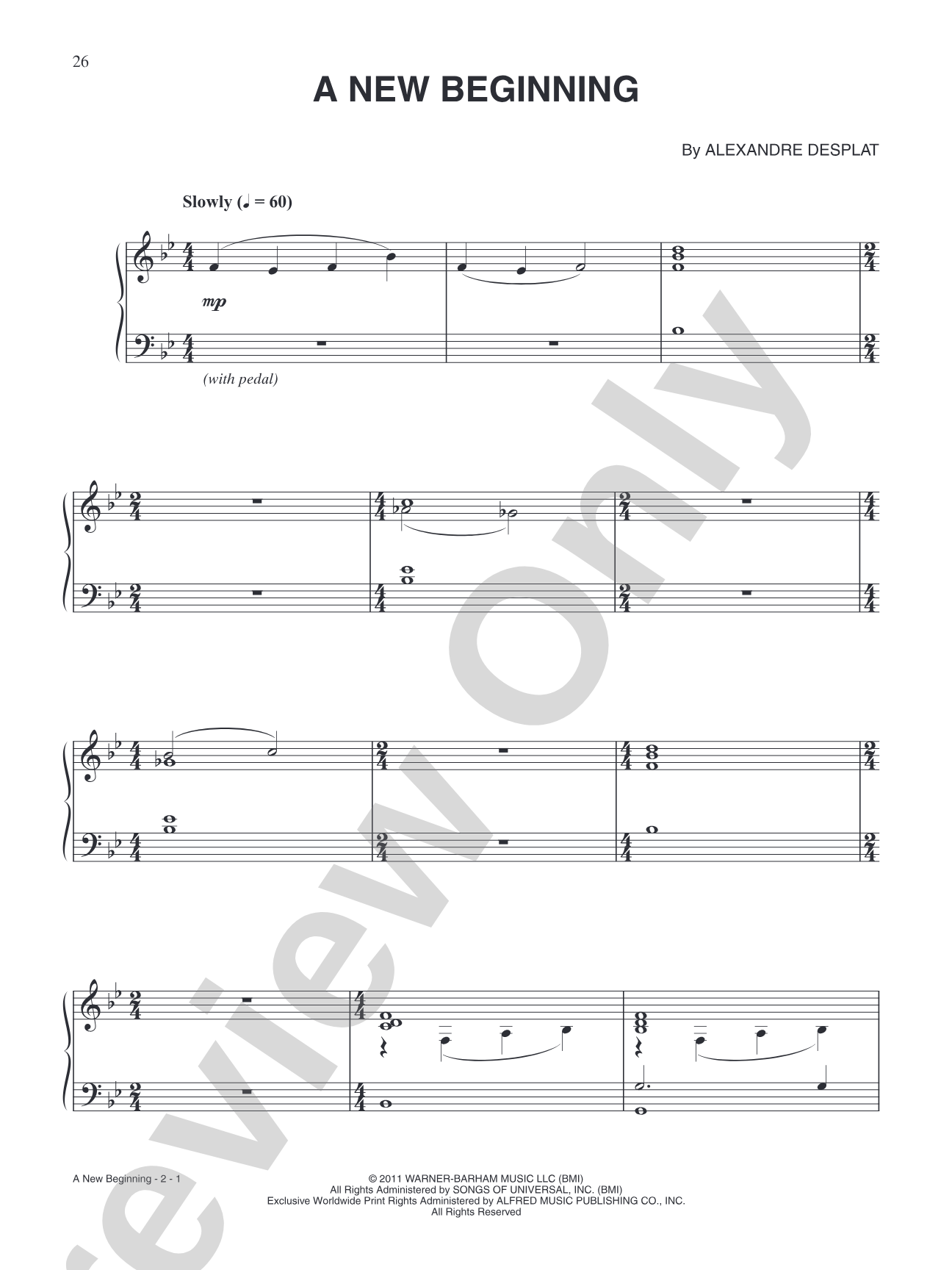

A New Beginning (from "Harry Potter and the Deathly Hallows Part 2"): Piano
Selections from the Motion Picture
Music by Alexandre Desplat
Item: 00-XS-0000403
$4.99
Pickup currently not available
Related Items
Lily's Theme (from "Harry Potter and the Deathly Hallows Part 2"): Piano |
$4.99
|
View | |
Statues (from "Harry Potter and the Deathly Hallows Part 2"): Piano |
$4.99
|
View | |
Courtyard Apocalypse (from "Harry Potter and the Deathly Hallows Part 2"): Piano |
$4.99
|
View | |
Severus and Lily (from "Harry Potter and the Deathly Hallows Part 2"): Piano |
$5.99
|
View | |
Harry's Sacrifice (from "Harry Potter and the Deathly Hallows Part 2"): Piano |
$4.99
|
View | |
The Resurrection Stone (from "Harry Potter and the Deathly Hallows Part 2"): Piano |
$4.99
|
View | |
Neville the Hero (from "Harry Potter and the Deathly Hallows Part 2"): Piano |
$4.99
|
View | |
Lily's Lullaby (from "Harry Potter and the Deathly Hallows Part 2"): Piano |
$4.99
|
View | |
Harry Potter and the Deathly Hallows, Part 2: Piano Book |
$14.99
|
View |
Description
This is the officially licensed, collectible sheet music folio from the motion picture, featuring solo piano arrangements of nine standout selections from Alexandre Desplat's acclaimed score, along with several pages of color imagery from the film. Titles: Lily's Theme * Statues * Courtyard Apocalypse * Severus and Lily * Harry's Sacrifice * The Resurrection Stone * Neville the Hero * A New Beginning * Lily's Lullaby.


A New Beginning (from "Harry Potter and the Deathly Hallows Part 2"): Piano isn't in MakeMusic Cloud just yet...but it could be. Let us know you'd like to see it, and you'll help shape what comes next. In the meantime, start a free trial and dive into thousands of interactive titles your students can play along with today.
Request This Title
Tell us you want it.
Start Your Free Trial
Explore everything that's ready to play right now.
Sample Audio
No sample audio found.
Sample Video
No sample videos found.
Additional Details
Publisher:
Alfred Music
Page Count:
32
SKU:
00-XS-0000403
More about this title
About the Composer: Alexandre Desplat
Alexandre Desplat has become one of the most sought-after film composers of our time, with a gift for crafting themes that deepen emotional storytelling. His work on the Harry Potter series spans eight films, during which he developed a musical language that balances intimacy with grandeur, making his scores equally powerful in concert settings and on screen.
Desplat's training in composition gives his film music unusual sophistication. Rather than relying on bombast alone, he builds thematic development across entire narratives, creating motifs that grow and transform as characters do. This approach makes his scores particularly rewarding for pianists who want to engage with contemporary film music as serious concert repertoire.
Why we love this
This collection captures some of the most emotionally direct moments from the final Harry Potter film in arrangements that feel intimate at the keyboard. Desplat's themes are singularly beautiful on piano; they don't rely on orchestral color but instead reveal the melodic and harmonic clarity that made them resonate in the first place. For pianists seeking contemporary material with genuine emotional weight and immediate appeal, these pieces deliver.
What to expect
Desplat's themes capture both tenderness and gravity. 'Lily's Theme' opens with a gentle, almost heartbreaking simplicity, while 'Courtyard Apocalypse' builds tension through layered textures and stark harmonic choices. Even in moments of darkness, there is clarity and beauty rather than chaos.
Who it's for
Pianists at the intermediate to early advanced level who want to explore film music beyond pop arrangements will find meaningful material here. This collection appeals equally to teachers seeking contemporary repertoire with strong melodies and to students who are drawn to music they know and care about.
How to get the most out of it
- Let the theme breathe in passages like 'Lily's Theme' and 'Lily's Lullaby.' Resist the urge to rush; Desplat's melodies gain power through spaciousness.
- Pay attention to dynamic shaping within phrases rather than treating entire sections at one volume level. The quiet intensity of 'Severus and Lily' relies on subtle gradient shifts.
- Use the pedal strategically to sustain harmonic color without muddying the melodic line, particularly in the more atmospheric selections.
- Consider the narrative arc of playing multiple pieces from this collection in sequence. Each theme connects to story moments, and honoring that emotional journey affects pacing and character interpretation.
How to use it
These pieces work beautifully as a recital set, either in full or as a thematic grouping (pairing the Lily pieces, for example). They're equally effective as individual encore selections or as a contemporary bridge in a program that otherwise spans classical and romantic-era works. They also serve as excellent motivation for intermediate pianists working on pedal control and expressive playing.
Skills your students will build
- Sustaining melodic lines with dynamic control and pedal independence
- Balancing harmonic accompaniment patterns with singing right-hand phrases
- Shaping emotional phrasing without excessive tempo variation
- Reading and interpreting contemporary film score notation and articulation marks
- Understanding thematic development and narrative connection in non-traditional repertoire