
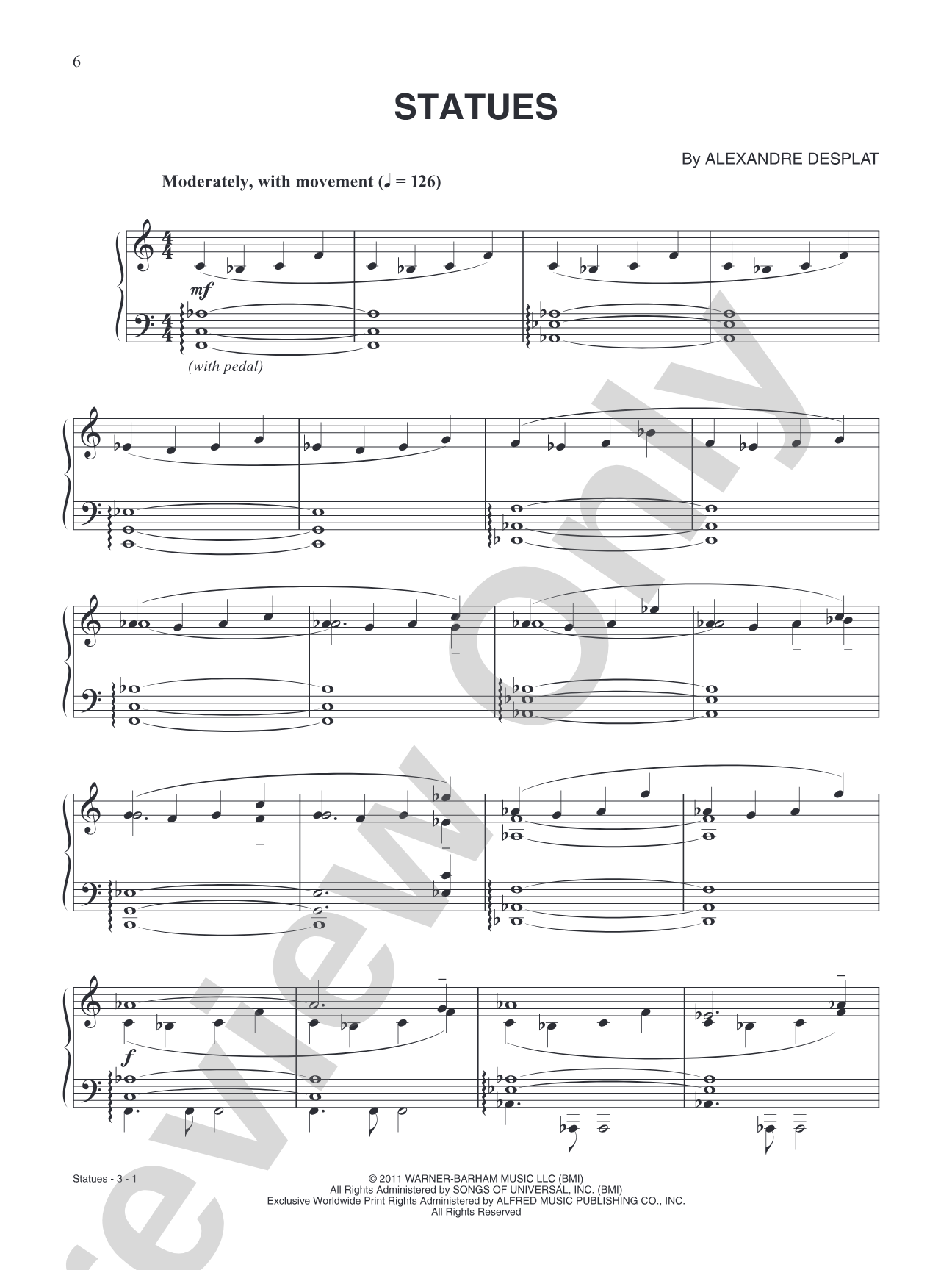

Statues (from "Harry Potter and the Deathly Hallows Part 2"): Piano
Selections from the Motion Picture
Music by Alexandre Desplat
Item: 00-XS-0000397
$4.99
Pickup currently not available
Related Items
Lily's Theme (from "Harry Potter and the Deathly Hallows Part 2"): Piano |
$4.99
|
View | |
Courtyard Apocalypse (from "Harry Potter and the Deathly Hallows Part 2"): Piano |
$4.99
|
View | |
Severus and Lily (from "Harry Potter and the Deathly Hallows Part 2"): Piano |
$5.99
|
View | |
Harry's Sacrifice (from "Harry Potter and the Deathly Hallows Part 2"): Piano |
$4.99
|
View | |
The Resurrection Stone (from "Harry Potter and the Deathly Hallows Part 2"): Piano |
$4.99
|
View | |
Neville the Hero (from "Harry Potter and the Deathly Hallows Part 2"): Piano |
$4.99
|
View | |
A New Beginning (from "Harry Potter and the Deathly Hallows Part 2"): Piano |
$4.99
|
View | |
Lily's Lullaby (from "Harry Potter and the Deathly Hallows Part 2"): Piano |
$4.99
|
View | |
Harry Potter and the Deathly Hallows, Part 2: Piano Book |
$14.99
|
View |
Description
This is the officially licensed, collectible sheet music folio from the motion picture, featuring solo piano arrangements of nine standout selections from Alexandre Desplat's acclaimed score, along with several pages of color imagery from the film. Titles: Lily's Theme * Statues * Courtyard Apocalypse * Severus and Lily * Harry's Sacrifice * The Resurrection Stone * Neville the Hero * A New Beginning * Lily's Lullaby.


Statues (from "Harry Potter and the Deathly Hallows Part 2"): Piano isn't in MakeMusic Cloud just yet...but it could be. Let us know you'd like to see it, and you'll help shape what comes next. In the meantime, start a free trial and dive into thousands of interactive titles your students can play along with today.
Request This Title
Tell us you want it.
Start Your Free Trial
Explore everything that's ready to play right now.
Sample Audio
No sample audio found.
Sample Video
No sample videos found.
Additional Details
Publisher:
Alfred Music
Page Count:
32
SKU:
00-XS-0000397
More about this title
About the Composer: Alexandre Desplat
Alexandre Desplat has composed for over 100 films across multiple genres, from intimate character studies to large-scale blockbusters. His work on the Harry Potter series spans eight films, establishing him as one of the most prolific and recognizable composers in contemporary film scoring. His gift for melodic invention and orchestral color has earned him two Academy Award nominations and a devoted following among musicians who appreciate how his themes balance accessibility with sophisticated harmonic language.
Why we love this
Desplat's melodies translate beautifully to the solo piano, where the emotional core of each theme becomes unmistakable without orchestral layering. These nine selections capture the emotional arc of the final film's most pivotal moments, making this collection a meaningful way to engage with music your students already love. The arrangement strikes a real balance between playability and authenticity, so pianists can sound like they're performing actual film score excerpts rather than simplified versions.
What to expect
These pieces move between intimate character moments and sweeping dramatic gestures. You'll find yourself navigating tender passages full of reflection alongside moments of tension and urgency, all rendered through Desplat's gift for melodic clarity and warm harmonic colors. The music feels cinematic in scope yet personal in expression.
Who it's for
Pianists at the intermediate to advanced level who want to explore film score arrangements that feel substantive rather than watered down. This collection appeals to students who are motivated by music from movies and want material that honors both the original compositions and their own developing musicianship.
How to get the most out of it
- Listen to the original orchestral recordings while learning; understanding Desplat's orchestration helps you shape phrasing and dynamics on piano, especially in pieces like 'Courtyard Apocalypse' where layered instrumental lines need clear voice separation.
- Pay attention to the subtle shifts in tempo and rubato that give these pieces their cinematic quality; rigid metronomic playing flattens the emotional impact of themes like 'Lily's Theme' and 'Severus and Lily'.
- Use the sustain pedal deliberately to create the lush harmonic atmosphere Desplat favors, but lift it frequently enough to maintain clarity in passages with moving inner voices.
- Let the repetition of themes work for you; each restatement can deepen through slight variations in dynamics, touch, or articulation rather than playing them identically.
How to use it
Program individual selections from this collection as part of a film music or contemporary music recital, pairing them with other screen composers to show how different artists approach dramatic storytelling. Students preparing pieces from this folio can perform them thematically (grouping character themes like 'Lily's Theme' and 'Severus and Lily' together) or as a complete suite if programming an evening dedicated to the Harry Potter scores.
Skills your students will build
- Voicing triadic and seventh chord progressions across the keyboard
- Sustain pedal control and release timing to balance resonance with clarity
- Phrasing across repeated harmonic patterns to create narrative momentum
- Dynamic shaping in single-staff melodies without relying on orchestral texture
- Reading and interpreting film score performance directions (tempo variations, rubato indications)