
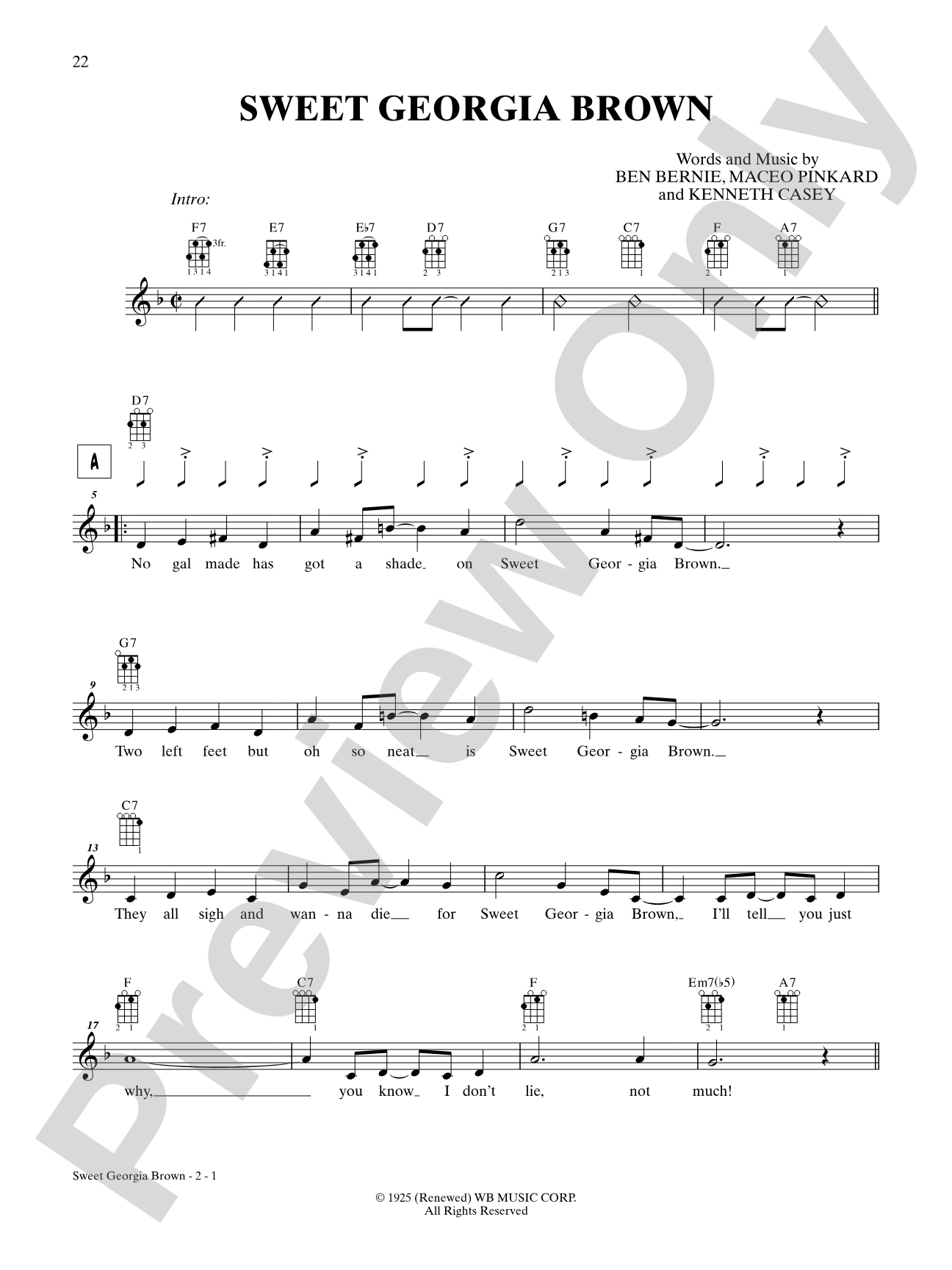

Sweet Georgia Brown: Ukulele TAB
12 Great Songs of the '20s & '30s
Item: 00-PS-0011848
$4.99
One moment…
Related Items
Makin' Whoopee: Ukulele TAB |
$4.99
|
View | |
Five Foot Two, Eyes of Blue: Ukulele TAB |
$4.99
|
View | |
Ain't Misbehavin': Ukulele TAB |
$4.99
|
View | |
It Don't Mean a Thing: Ukulele TAB |
$4.99
|
View | |
Tonight You Belong to Me: Ukulele TAB |
$4.99
|
View | |
As Time Goes By: Ukulele TAB |
$4.99
|
View | |
It Had to Be You: Ukulele TAB |
$4.99
|
View | |
Ain't She Sweet: Ukulele TAB |
$4.99
|
View | |
I'll See You in My Dreams: Ukulele TAB |
$4.99
|
View | |
Dream a Little Dream of Me: Ukulele TAB |
$4.99
|
View |
Description
Swingin' Jazz Ukulele is designed for your total enjoyment. Each song is arranged in a fun and lively way with a strum-and-sing approach. The chords are simple, yet entirely appropriate to the jazz-age style of the '20s and '30s. We've also included classic intros, endings, and turnarounds that will make you sound like an authentic early jazzer. Titles: Ain't Misbehavin' * Ain't She Sweet * As Time Goes By * Bye Bye Blackbird * Dream a Little Dream of Me * Five Foot Two, Eyes of Blue * I'll See You in My Dreams * It Don't Mean a Thing (If It Ain't Got That Swing) * It Had to Be You * Makin' Whoopee * Sweet Georgia Brown * Tonight You Belong to Me.


Sweet Georgia Brown: Ukulele TAB isn't in MakeMusic Cloud just yet...but it could be. Let us know you'd like to see it, and you'll help shape what comes next. In the meantime, start a free trial and dive into thousands of interactive titles your students can play along with today.
Request This Title
Tell us you want it.
Start Your Free Trial
Explore everything that's ready to play right now.
Sample Audio
No sample audio found.
Sample Video
No sample videos found.
Additional Details
Series:
Just for Fun
Publisher:
Alfred Music
Page Count:
40
SKU:
00-PS-0011848
More about this title
About the Composer: Ben Bernie
Ben Bernie was a bandleader, violinist, and composer central to the jazz and popular music scene of the 1920s and 1930s. Known for his smooth orchestral arrangements and charismatic stage presence, Bernie helped define the sound of the Jazz Age, composing and recording numerous standards that remain in the repertoire today.
Bernie's work emphasized accessibility and joy in performance. His compositions maintain the harmonic sophistication of early jazz while remaining singable and playable by musicians at many levels, making his music enduringly popular with educators and ensemble directors.
Why we love this
This collection captures the authentic spirit of 1920s and 1930s jazz without requiring advanced harmonic knowledge or complex fingering patterns. The TAB notation paired with chord symbols makes these classics immediately playable for ukulele students, while the arranged intros, endings, and turnarounds teach genuine early jazz vocabulary in a context students actually want to perform.
What to expect
Bright, conversational, and full of character. The straightforward arrangements let the infectious swing rhythms and jazz-age personality shine through without getting bogged down in complexity. Playing through these songs feels like stepping into a speakeasy where the music is meant to move and delight.
Who it's for
Ukulele students who have grasped basic chord changes and want to explore repertoire beyond folk and pop songs. This book works equally well for self-taught players seeking era-appropriate material and for classroom instruction where jazz history and performance can happen simultaneously.
How to get the most out of it
- Lean into the rhythmic swing feel by softening the offbeats slightly; the simple strum patterns work best when they breathe rather than metronomically.
- Study the recorded example (if available with your purchase) to hear authentic phrasing and tempo for the era; early jazz rhythm section feels quite different from contemporary playing.
- Use the classic intros and endings as muscle memory builders; these turnarounds appear across multiple standards of the period, so mastering them unlocks faster learning on similar repertoire.
How to use it
Slot these arrangements into a jazz history unit where students can hear, play, and discuss the idiom directly rather than studying it passively. They also work beautifully as standalone recital pieces for ukulele students seeking accessible yet stylistically authentic material.
Skills your students will build
- Reading TAB and chord symbols simultaneously
- Identifying and executing swing rhythm (triplet-based feel)
- Recognizing jazz-age harmonic progressions and turnaround patterns
- Phrasing vocal lines over chord changes
- Building confidence with standards repertoire