
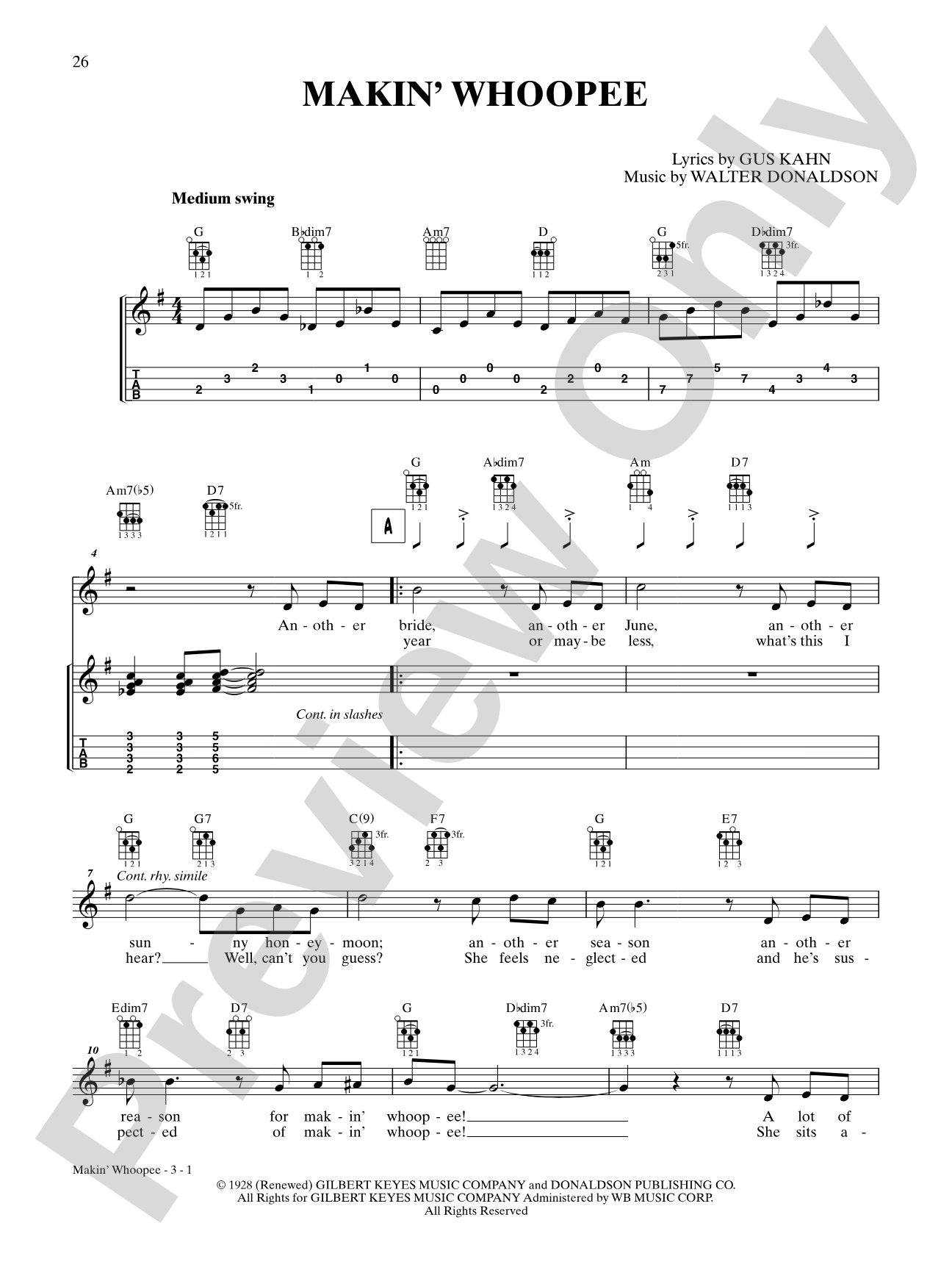

Makin' Whoopee: Ukulele TAB
12 Great Songs of the '20s & '30s
Item: 00-PS-0011775
$4.99
One moment…
Related Items
Five Foot Two, Eyes of Blue: Ukulele TAB |
$4.99
|
View | |
Ain't Misbehavin': Ukulele TAB |
$4.99
|
View | |
It Don't Mean a Thing: Ukulele TAB |
$4.99
|
View | |
Tonight You Belong to Me: Ukulele TAB |
$4.99
|
View | |
As Time Goes By: Ukulele TAB |
$4.99
|
View | |
It Had to Be You: Ukulele TAB |
$4.99
|
View | |
Sweet Georgia Brown: Ukulele TAB |
$4.99
|
View | |
Ain't She Sweet: Ukulele TAB |
$4.99
|
View | |
I'll See You in My Dreams: Ukulele TAB |
$4.99
|
View | |
Dream a Little Dream of Me: Ukulele TAB |
$4.99
|
View |
Description
Swingin' Jazz Ukulele is designed for your total enjoyment. Each song is arranged in a fun and lively way with a strum-and-sing approach. The chords are simple, yet entirely appropriate to the jazz-age style of the '20s and '30s. We've also included classic intros, endings, and turnarounds that will make you sound like an authentic early jazzer. Titles: Ain't Misbehavin' * Ain't She Sweet * As Time Goes By * Bye Bye Blackbird * Dream a Little Dream of Me * Five Foot Two, Eyes of Blue * I'll See You in My Dreams * It Don't Mean a Thing (If It Ain't Got That Swing) * It Had to Be You * Makin' Whoopee * Sweet Georgia Brown * Tonight You Belong to Me.


Makin' Whoopee: Ukulele TAB isn't in MakeMusic Cloud just yet...but it could be. Let us know you'd like to see it, and you'll help shape what comes next. In the meantime, start a free trial and dive into thousands of interactive titles your students can play along with today.
Request This Title
Tell us you want it.
Start Your Free Trial
Explore everything that's ready to play right now.
Sample Audio
No sample audio found.
Sample Video
No sample videos found.
Additional Details
Series:
Just for Fun
Publisher:
Alfred Music
Page Count:
40
SKU:
00-PS-0011775
More about this title
About the Composer: Gus Kahn
Gus Kahn (1886-1941) was one of Broadway and Tin Pan Alley's most prolific lyricists, crafting witty, singable words for some of the Jazz Age's most enduring songs. His partnership with composers like Walter Donaldson and Isham Jones produced standards that remain central to American popular music and jazz repertoire today.
Kahn's gift lay in writing lyrics that balanced sophistication with accessibility, making his songs equally at home in concert halls and casual gatherings. His influence on music education extends through the standards movement, where his texts continue to teach musicality, phrasing, and the marriage of melody and language.
Why we love this
This collection captures the genuine sound of early jazz without requiring advanced technique or complex chord voicings. The arrangement choices honor the era's spirit while keeping the ukulele part approachable, making authentic jazz feel attainable rather than aspirational for players still building their foundation.
What to expect
Stepping into a speakeasy where the energy is relaxed but never lazy. The melodies have sophistication and wit, the chords swing without pretension, and the whole affair feels like a conversation between old friends who know exactly what they're doing.
Who it's for
Ukulele players who know basic chord changes and want to explore jazz beyond folk or pop styles, whether they plan to sing along or accompany others. This book works for self-taught players and those in casual ensemble settings who want to sound historically grounded without heavy theory work.
How to get the most out of it
- Lean into the strum patterns suggested in the notation. The rhythm itself carries the swing feel, so committing to the written strums matters more than speed.
- Study how the intros and turnarounds are voiced. These small touches, lifted directly from period recordings, teach you how real accompanists shaped these songs.
- Sing through the melodies before playing them. These standards were written for singers first; understanding the vocal line shapes how you voice the chords underneath.
- Pay attention to chord changes that anticipate the melody. Jazz-age harmony often moves a beat or two ahead of where a newer player might expect it.
How to use it
Perfect for community ukulele circles, informal jam sessions, or school programs exploring American music history. One or two pieces work well in a casual variety concert, while the full collection could frame a themed evening celebrating the Jazz Age.
Skills your students will build
- Reading jazz chord symbols and voicings idiomatic to ukulele
- Executing rhythmic strum patterns that convey swing feel
- Recognizing and executing classic jazz intros, endings, and turnarounds
- Pairing melody with harmonic accompaniment in ensemble settings
- Connecting lyrics to melody phrasing and chord movement