
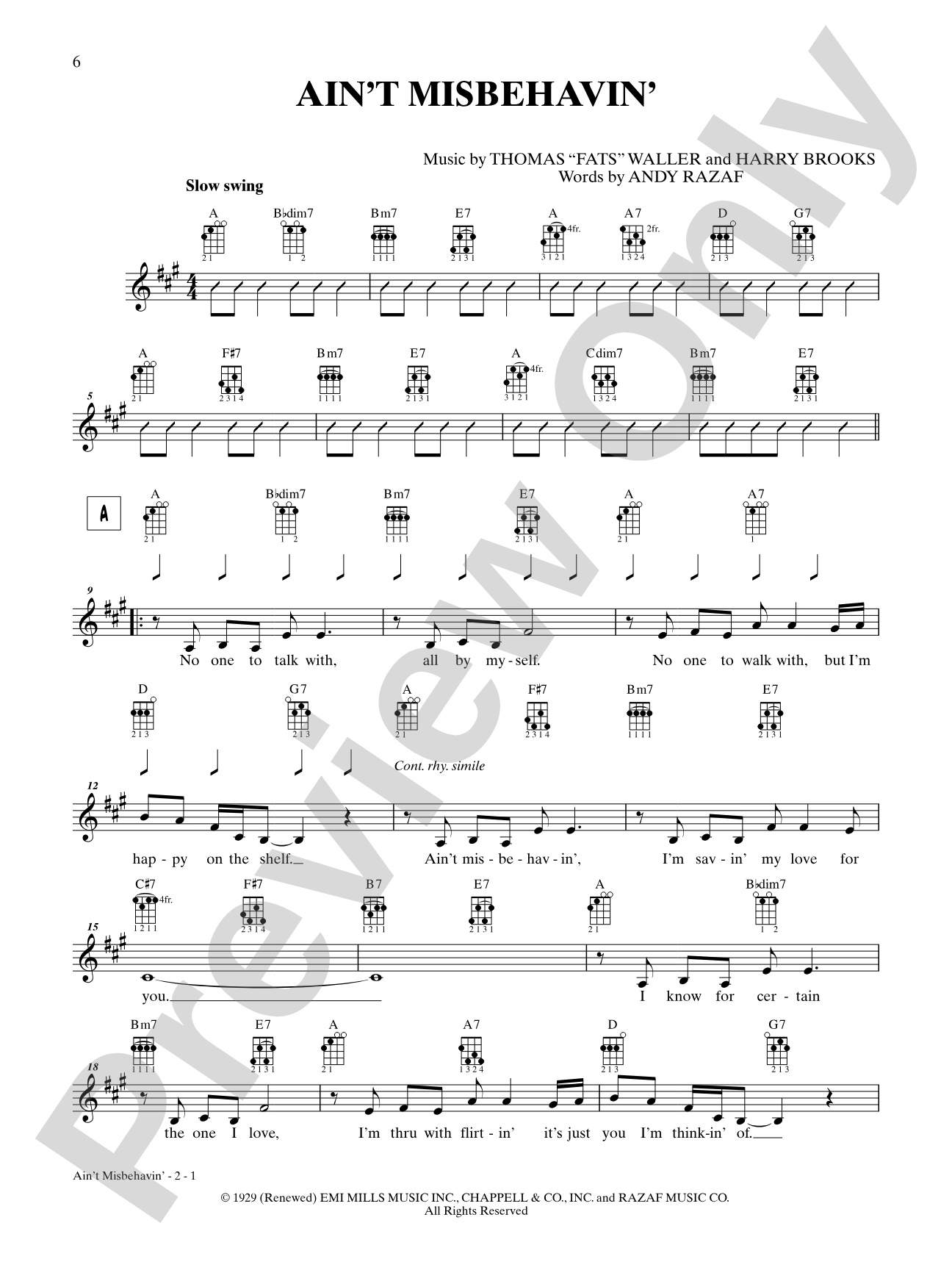

Ain't Misbehavin': Ukulele TAB
12 Great Songs of the '20s & '30s
Item: 00-PS-0011795
$4.99
Pickup currently not available
Related Items
Makin' Whoopee: Ukulele TAB |
$4.99
|
View | |
Five Foot Two, Eyes of Blue: Ukulele TAB |
$4.99
|
View | |
It Don't Mean a Thing: Ukulele TAB |
$4.99
|
View | |
Tonight You Belong to Me: Ukulele TAB |
$4.99
|
View | |
As Time Goes By: Ukulele TAB |
$4.99
|
View | |
It Had to Be You: Ukulele TAB |
$4.99
|
View | |
Sweet Georgia Brown: Ukulele TAB |
$4.99
|
View | |
Ain't She Sweet: Ukulele TAB |
$4.99
|
View | |
I'll See You in My Dreams: Ukulele TAB |
$4.99
|
View | |
Dream a Little Dream of Me: Ukulele TAB |
$4.99
|
View |
Description
Swingin' Jazz Ukulele is designed for your total enjoyment. Each song is arranged in a fun and lively way with a strum-and-sing approach. The chords are simple, yet entirely appropriate to the jazz-age style of the '20s and '30s. We've also included classic intros, endings, and turnarounds that will make you sound like an authentic early jazzer. Titles: Ain't Misbehavin' * Ain't She Sweet * As Time Goes By * Bye Bye Blackbird * Dream a Little Dream of Me * Five Foot Two, Eyes of Blue * I'll See You in My Dreams * It Don't Mean a Thing (If It Ain't Got That Swing) * It Had to Be You * Makin' Whoopee * Sweet Georgia Brown * Tonight You Belong to Me.


Ain't Misbehavin': Ukulele TAB isn't in MakeMusic Cloud just yet...but it could be. Let us know you'd like to see it, and you'll help shape what comes next. In the meantime, start a free trial and dive into thousands of interactive titles your students can play along with today.
Request This Title
Tell us you want it.
Start Your Free Trial
Explore everything that's ready to play right now.
Sample Audio
No sample audio found.
Sample Video
No sample videos found.
Additional Details
Series:
Just for Fun
Publisher:
Alfred Music
Page Count:
40
SKU:
00-PS-0011795
More about this title
About the Composer: Fats Waller
Fats Waller (1904–1943) was a pianist, organist, singer, and composer who shaped the sound of swing and stride piano in Harlem during the Jazz Age. His gift for witty, infectious melodies and his ability to blend virtuosic musicianship with pure entertainment made him one of the most recorded artists of the 1920s and 1930s. Waller's compositions remain staples of jazz repertoire, prized for their harmonic sophistication and irresistible rhythmic drive.
As both a performer and songwriter, Waller understood exactly what audiences wanted to hear and play. His tunes are constructed to be immediately memorable yet harmonically rewarding, making them ideal for learners who want to experience authentic jazz language without getting lost in complexity. His influence on popular music and jazz standards continues to be felt across generations of musicians.
Why we love this
This collection captures the genuine voice of early swing without condescension or oversimplification. The arrangements preserve the harmonic color and rhythmic character of the Jazz Age while keeping the ukulele part singable and manageable, which is exactly what makes jazz history feel alive in a learner's hands. The inclusion of period-appropriate intros, endings, and turnarounds gives players the tools to sound authentic rather than merely competent.
What to expect
Stepping into a smoky jazz club where the piano is bouncy, the rhythm is infectious, and the melodies stick with you immediately. These tunes radiate charm and wit, with a sprightly energy that makes playing them feel like a conversation between friends rather than a formal performance.
Who it's for
Ukulele players who want to explore jazz vocabulary and history beyond folk or pop genres. This book works well for self-teaching musicians and for teachers introducing students to the standards and language of early swing.
How to get the most out of it
- Treat the strums as conversations with the lyrics. The rhythm section drives the swing feel, so anchor your strum pattern to the beat rather than rushing ahead.
- Use the notated turnarounds as practice opportunities to lock in the jazz phrasing specific to each tune. They sound deceptively simple but carry the characteristic syncopation of the era.
- Lean into the chord voicings exactly as written. Even though the chords themselves are labeled simply, their placement on the fretboard creates the harmonic texture that says 'authentic 1920s–30s jazz.'
How to use it
Pair this collection with a jazz history unit or use individual tunes as recital pieces that introduce students to standards they'll encounter in any jazz ensemble context. These arrangements also work beautifully as informal performance pieces at senior centers, community events, or themed concerts celebrating American music from the early 20th century.
Skills your students will build
- Reading jazz chord notation and understanding voice leading within a jazz harmonic vocabulary
- Executing period-appropriate rhythmic swing in strum patterns and phrasing
- Playing turnarounds and jazz-specific intros and endings
- Interpreting simple chord symbols with authenticity and historical awareness