
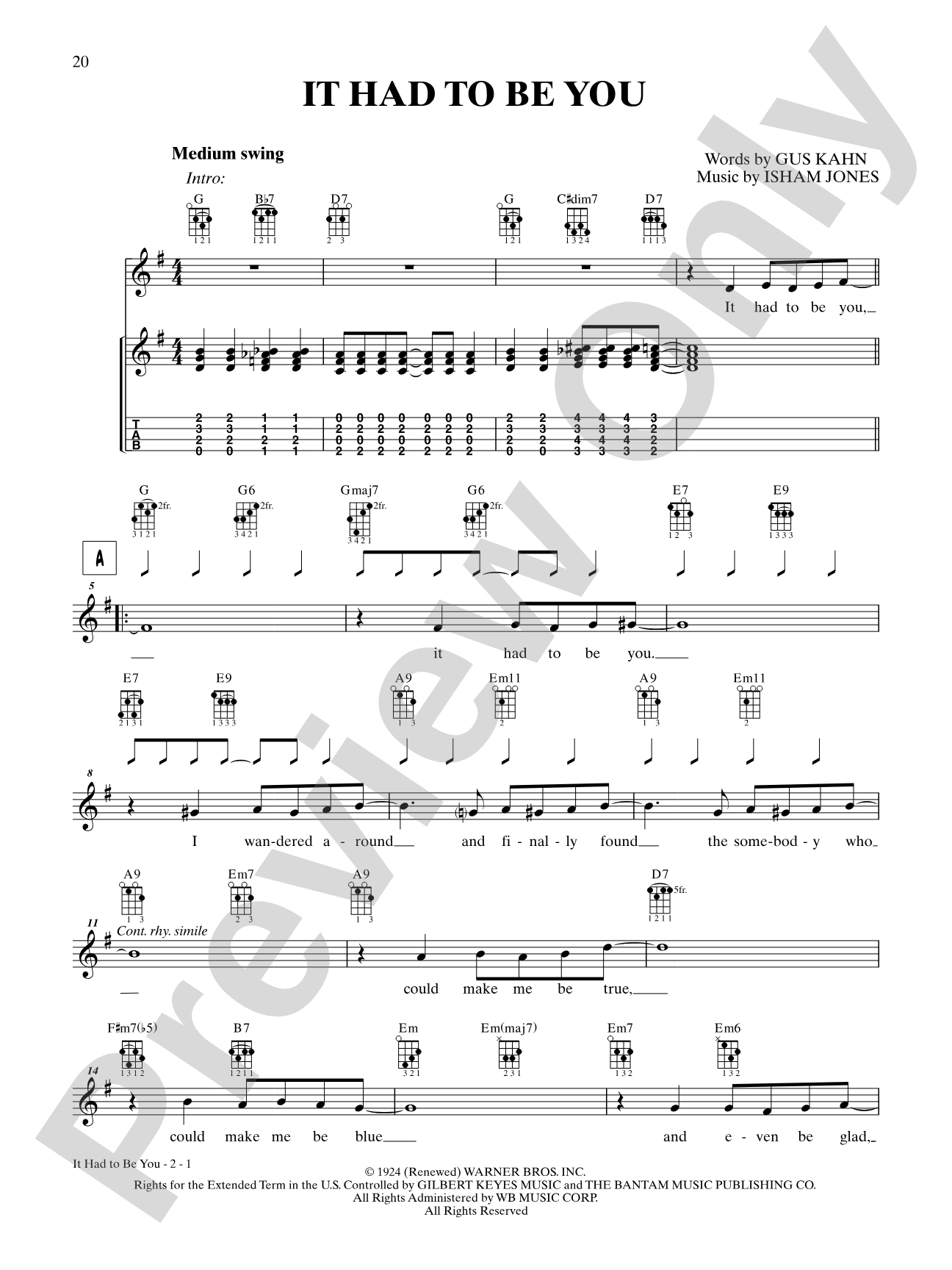

It Had to Be You: Ukulele TAB
12 Great Songs of the '20s & '30s
Item: 00-PS-0011845
$4.99
One moment…
Related Items
Makin' Whoopee: Ukulele TAB |
$4.99
|
View | |
Five Foot Two, Eyes of Blue: Ukulele TAB |
$4.99
|
View | |
Ain't Misbehavin': Ukulele TAB |
$4.99
|
View | |
It Don't Mean a Thing: Ukulele TAB |
$4.99
|
View | |
Tonight You Belong to Me: Ukulele TAB |
$4.99
|
View | |
As Time Goes By: Ukulele TAB |
$4.99
|
View | |
Sweet Georgia Brown: Ukulele TAB |
$4.99
|
View | |
Ain't She Sweet: Ukulele TAB |
$4.99
|
View | |
I'll See You in My Dreams: Ukulele TAB |
$4.99
|
View | |
Dream a Little Dream of Me: Ukulele TAB |
$4.99
|
View |
Description
Swingin' Jazz Ukulele is designed for your total enjoyment. Each song is arranged in a fun and lively way with a strum-and-sing approach. The chords are simple, yet entirely appropriate to the jazz-age style of the '20s and '30s. We've also included classic intros, endings, and turnarounds that will make you sound like an authentic early jazzer. Titles: Ain't Misbehavin' * Ain't She Sweet * As Time Goes By * Bye Bye Blackbird * Dream a Little Dream of Me * Five Foot Two, Eyes of Blue * I'll See You in My Dreams * It Don't Mean a Thing (If It Ain't Got That Swing) * It Had to Be You * Makin' Whoopee * Sweet Georgia Brown * Tonight You Belong to Me.


It Had to Be You: Ukulele TAB isn't in MakeMusic Cloud just yet...but it could be. Let us know you'd like to see it, and you'll help shape what comes next. In the meantime, start a free trial and dive into thousands of interactive titles your students can play along with today.
Request This Title
Tell us you want it.
Start Your Free Trial
Explore everything that's ready to play right now.
Sample Audio
No sample audio found.
Sample Video
No sample videos found.
Additional Details
Series:
Just for Fun
Publisher:
Alfred Music
Page Count:
40
SKU:
00-PS-0011845
More about this title
About the Composer: Gus Kahn
Gus Kahn (1886-1941) was one of the most prolific lyricists of the early twentieth century, collaborating with composers like Isham Jones to create standards that defined the Jazz Age. His gift for crafting singable, memorable lyrics paired with jazz-inflected melodies made him essential to American popular music during the 1920s and 1930s. Several of his songs, including "It Had to Be You" and "Ain't Misbehavin'," remain teaching repertoire today because of their clear melodic lines and authentic period flavor.
Isham Jones (1894-1956) was a composer, bandleader, and violinist whose orchestrations captured the sophistication and swing of early jazz. His collaboration with Kahn produced some of the era's most enduring melodies, and his arrangements emphasized both accessibility and authentic style. Jones's influence on jazz pedagogy comes through in how his songs balance simple harmonic structures with genuine period character.
Why we love this
This collection brings authentic 1920s-30s jazz style within reach of ukulele players without requiring complex fingerings or jazz theory knowledge. The arrangement choices—simple chords paired with period-specific intros, endings, and turnarounds—let students hear and play the real harmonic language of early jazz rather than a flattened version. It's refreshing repertoire that teaches musicianship through genuine jazz standards, not simplified substitutes.
What to expect
Warm, conversational, and genuinely fun. These songs carry the ease and sophistication of the Jazz Age without pretension; you're not working against the music to make it happen. The arrangements support a relaxed, swinging feel that comes from simple chords and natural phrasing.
Who it's for
Ukulele students ready to move beyond beginner strum patterns and explore real jazz repertoire, as well as players looking for singable material with authentic style and limited technical demands. This works for hobbyists, casual performers, and music students seeking period-appropriate jazz standards for recital or ensemble settings.
How to get the most out of it
- Study the classic intros and turnarounds provided; they're the signature sound of the era and the easiest way to establish authenticity in your playing.
- Let the swing rhythm live in the strumming pattern rather than rushing the tempo; these songs are written to relax, not sprint.
- Sing or hum the melody as you play to internalize the phrasing; many of these songs depend on lyrical, conversational delivery.
- Use the chord changes as your guide to shape dynamics and articulation within each phrase, rather than playing all chords equally.
How to use it
Build a ukulele-focused recital or coffeehouse concert around these standards, or use them as accessible jazz repertoire for music students learning about the 1920s-30s era. They also pair well with vocals or ensemble arrangements if you're programming interdisciplinary performance events.
Skills your students will build
- Jazz-age harmonic vocabulary and chord progression recognition
- Authentic swing strumming and rhythmic phrasing
- Jazz turnarounds and cadential phrases
- Connecting melody, harmony, and lyric in performance
- Sight-reading chord charts and TAB notation together