
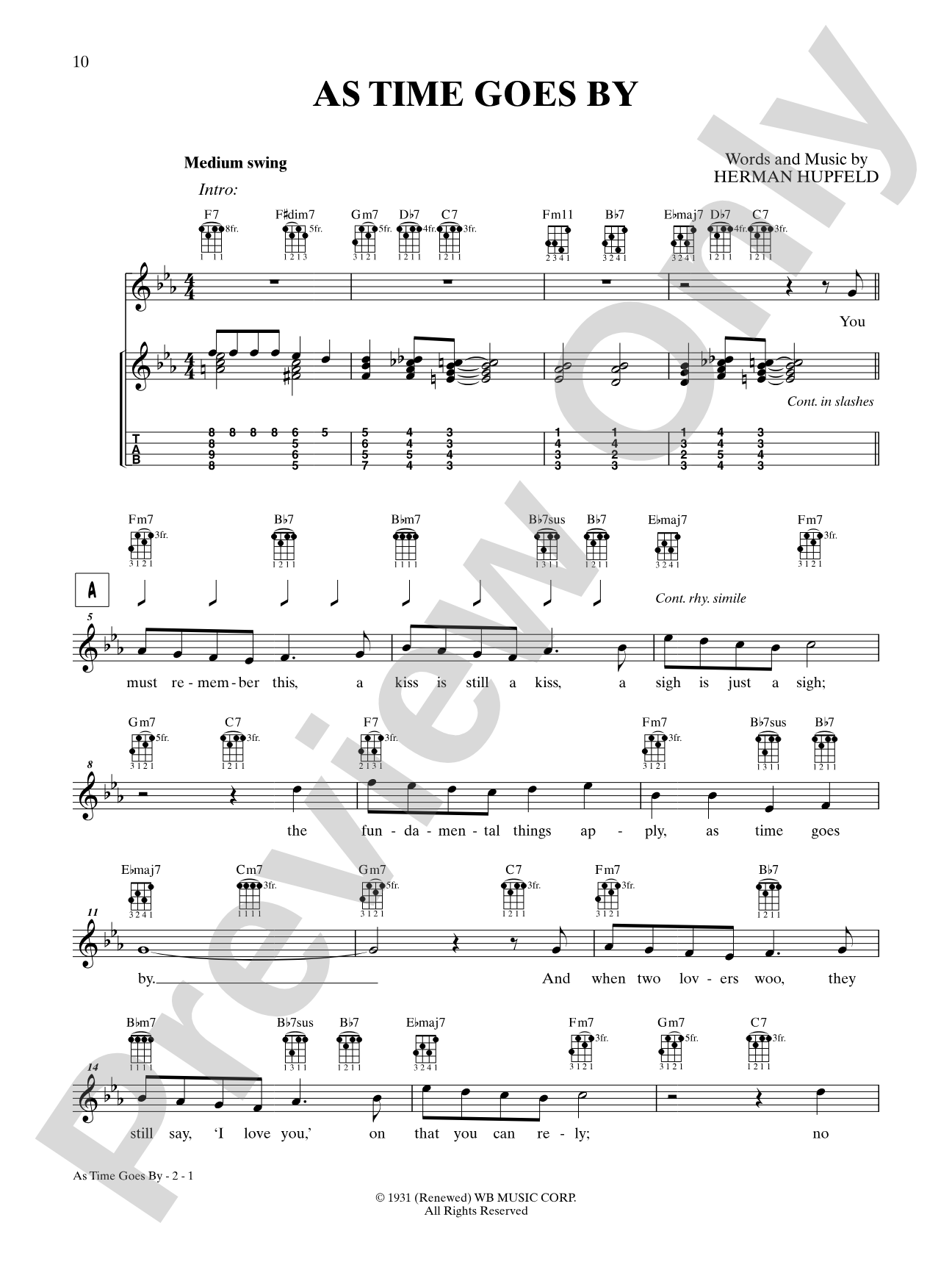

As Time Goes By: Ukulele TAB
12 Great Songs of the '20s & '30s
Item: 00-PS-0011841
$4.99
One moment…
Related Items
Makin' Whoopee: Ukulele TAB |
$4.99
|
View | |
Five Foot Two, Eyes of Blue: Ukulele TAB |
$4.99
|
View | |
Ain't Misbehavin': Ukulele TAB |
$4.99
|
View | |
It Don't Mean a Thing: Ukulele TAB |
$4.99
|
View | |
Tonight You Belong to Me: Ukulele TAB |
$4.99
|
View | |
It Had to Be You: Ukulele TAB |
$4.99
|
View | |
Sweet Georgia Brown: Ukulele TAB |
$4.99
|
View | |
Ain't She Sweet: Ukulele TAB |
$4.99
|
View | |
I'll See You in My Dreams: Ukulele TAB |
$4.99
|
View | |
Dream a Little Dream of Me: Ukulele TAB |
$4.99
|
View |
Description
Swingin' Jazz Ukulele is designed for your total enjoyment. Each song is arranged in a fun and lively way with a strum-and-sing approach. The chords are simple, yet entirely appropriate to the jazz-age style of the '20s and '30s. We've also included classic intros, endings, and turnarounds that will make you sound like an authentic early jazzer. Titles: Ain't Misbehavin' * Ain't She Sweet * As Time Goes By * Bye Bye Blackbird * Dream a Little Dream of Me * Five Foot Two, Eyes of Blue * I'll See You in My Dreams * It Don't Mean a Thing (If It Ain't Got That Swing) * It Had to Be You * Makin' Whoopee * Sweet Georgia Brown * Tonight You Belong to Me.


As Time Goes By: Ukulele TAB isn't in MakeMusic Cloud just yet...but it could be. Let us know you'd like to see it, and you'll help shape what comes next. In the meantime, start a free trial and dive into thousands of interactive titles your students can play along with today.
Request This Title
Tell us you want it.
Start Your Free Trial
Explore everything that's ready to play right now.
Sample Audio
No sample audio found.
Sample Video
No sample videos found.
Additional Details
Series:
Just for Fun
Publisher:
Alfred Music
Page Count:
40
SKU:
00-PS-0011841
More about this title
About the Composer: Herman Hupfeld
Herman Hupfeld (1894-1951) was an American composer and lyricist who became a master of the jazz age standard. Best known for "As Time Goes By," which gained immortal status in the 1942 film Casablanca, Hupfeld had an instinct for melodies that felt both sophisticated and singable, anchored in the swing idiom of the 1920s and 1930s.
Hupfeld's compositions remain central to early jazz pedagogy because they balance accessibility with authenticity. His melodies sit naturally on any instrument, his harmonic progressions teach real jazz vocabulary, and his songs have endured long enough to become touchstones for anyone learning to navigate the jazz repertoire.
Why we love this
These 12 standards are ideal for ukulele players ready to step beyond simple strumming into genuine jazz phrasing and style. The arrangements respect both the ukulele's gentle timbre and the swinging character of the era, avoiding the trap of over-simplification while keeping the chords approachable. The included intros, endings, and turnarounds transform what could be a straightforward cover version into something that actually sounds like jazz.
What to expect
These songs breathe with the relaxed sophistication of a '20s jazz room. There's a lightness to them, a playfulness that never descends into novelty, paired with genuine harmonic interest and the kind of melodic craft that rewards close listening. Playing through these 12 pieces, you'll feel the arc from intimate ballads to full-throttle swingers, all of them drenched in the warmth of a style that hasn't aged a day.
Who it's for
Ukulele players with basic strumming skills who are ready to tackle jazz standards and learn period-appropriate jazz style. This collection works for solo performers building a recital repertoire, ensemble musicians adding jazz to their performance mix, or anyone drawn to the sophisticated swing sound of the early 20th century.
How to get the most out of it
- Work the turnarounds and intros first, before memorizing the full melody. These are the musical signatures that signal "we're playing real jazz," and they'll anchor your confidence in the piece.
- Strum rhythm matters as much as chord accuracy. Listen to recordings from the '20s and '30s to internalize the bounce and lift of swing feel, then let your left hand control that pulse.
- Treat the chord symbols as a starting point for exploration. Once you own the basic progression, experiment with rhythmic variations and subtle chord voicings that fit the ukulele's range.
- Sing the melody as you play. These songs were written for the voice first, and your phrasing will improve dramatically when you're listening to yourself as both a vocalist and instrumentalist.
How to use it
Program a set of three to four titles in a recital that celebrates jazz standards, or use individual pieces as bridge moments in a concert that spans multiple genres. These arrangements also work well as ensemble pieces if you have multiple ukulele players, creating opportunities to explore comping and melody-trading. The shorter, punchier titles like "Bye Bye Blackbird" and "Five Foot Two, Eyes of Blue" pair naturally with vocal performances of the same era.
Skills your students will build
- Jazz chord progressions and jazz harmony (ii-V-I, tritone substitution foundations)
- Swing rhythm and syncopation on stringed instruments
- Improvisation within jazz standards using provided changes
- Interpretation of period-appropriate jazz style and phrasing
- Chord-melody playing and comping fundamentals
- Reading chord charts alongside TAB notation