
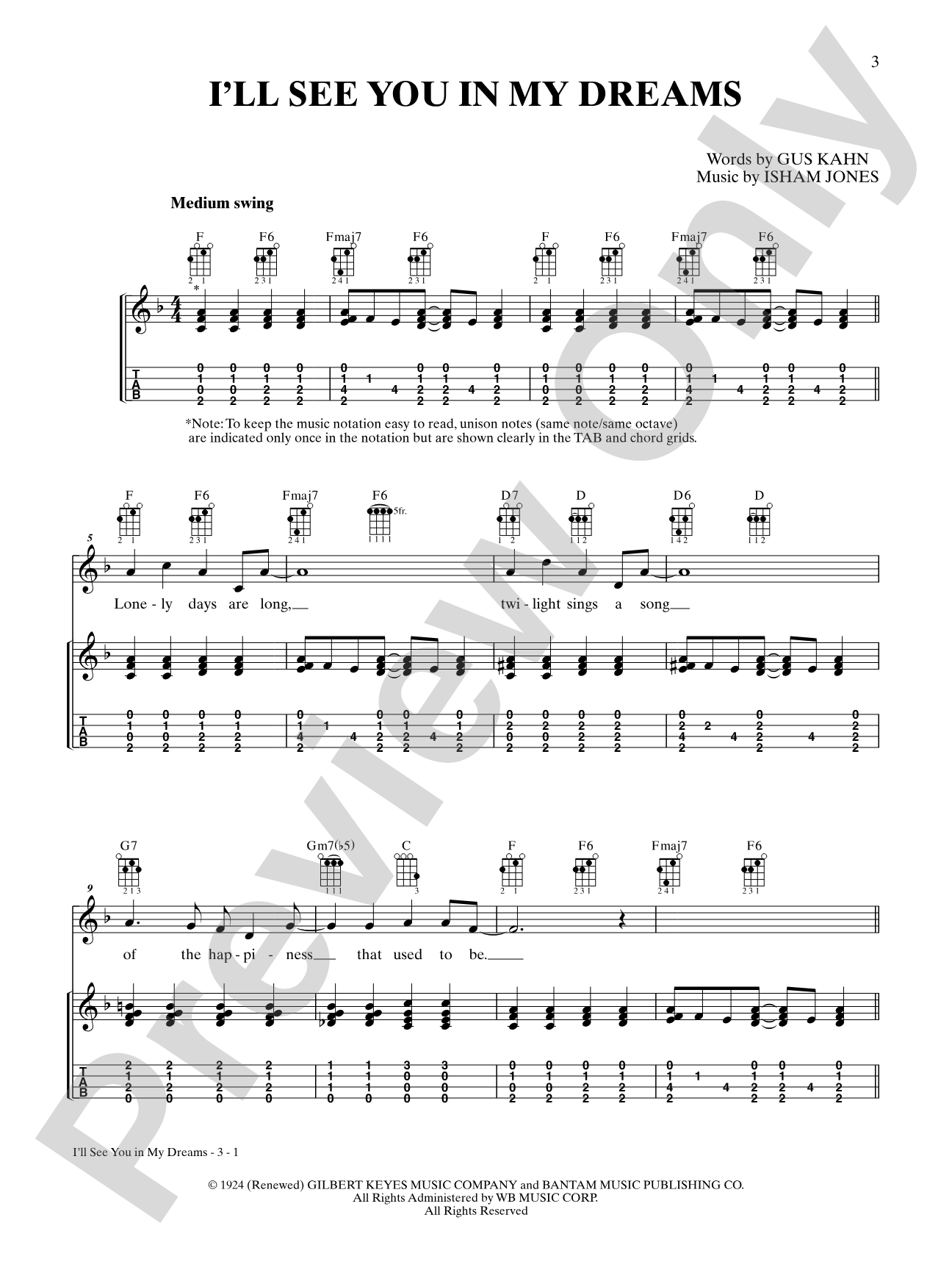

I'll See You in My Dreams: Ukulele TAB
12 Great Songs of the '20s & '30s
Item: 00-PS-0011939
$4.99
Pickup currently not available
Related Items
Makin' Whoopee: Ukulele TAB |
$4.99
|
View | |
Five Foot Two, Eyes of Blue: Ukulele TAB |
$4.99
|
View | |
Ain't Misbehavin': Ukulele TAB |
$4.99
|
View | |
It Don't Mean a Thing: Ukulele TAB |
$4.99
|
View | |
Tonight You Belong to Me: Ukulele TAB |
$4.99
|
View | |
As Time Goes By: Ukulele TAB |
$4.99
|
View | |
It Had to Be You: Ukulele TAB |
$4.99
|
View | |
Sweet Georgia Brown: Ukulele TAB |
$4.99
|
View | |
Ain't She Sweet: Ukulele TAB |
$4.99
|
View | |
Dream a Little Dream of Me: Ukulele TAB |
$4.99
|
View |
Description
Swingin' Jazz Ukulele is designed for your total enjoyment. Each song is arranged in a fun and lively way with a strum-and-sing approach. The chords are simple, yet entirely appropriate to the jazz-age style of the '20s and '30s. We've also included classic intros, endings, and turnarounds that will make you sound like an authentic early jazzer. Titles: Ain't Misbehavin' * Ain't She Sweet * As Time Goes By * Bye Bye Blackbird * Dream a Little Dream of Me * Five Foot Two, Eyes of Blue * I'll See You in My Dreams * It Don't Mean a Thing (If It Ain't Got That Swing) * It Had to Be You * Makin' Whoopee * Sweet Georgia Brown * Tonight You Belong to Me.


I'll See You in My Dreams: Ukulele TAB isn't in MakeMusic Cloud just yet...but it could be. Let us know you'd like to see it, and you'll help shape what comes next. In the meantime, start a free trial and dive into thousands of interactive titles your students can play along with today.
Request This Title
Tell us you want it.
Start Your Free Trial
Explore everything that's ready to play right now.
Sample Audio
No sample audio found.
Sample Video
No sample videos found.
Additional Details
Series:
Just for Fun
Publisher:
Alfred Music
Page Count:
40
SKU:
00-PS-0011939
More about this title
About the Composer: Gus Kahn
Gus Kahn (1886-1941) was one of the most prolific lyricists of the early twentieth century, composing the words to hundreds of standards that defined the jazz age and early Hollywood sound. Working alongside composers like Isham Jones, Walter Donaldson, and Harry Akst, Kahn crafted lyrics that captured the wit, sophistication, and emotional directness of the era. His ability to match perfectly crafted words to memorable melodies made songs like "I'll See You in My Dreams" and "Ain't Misbehavin'" instant classics that remain central to American popular music.
Kahn's influence extends deeply into music education because his songs represent the accessible yet artistically rich side of jazz repertoire. Teachers and students value his work for its singability, clear harmonic structure, and cultural significance. His lyrics reward careful attention to phrasing and interpretation, making his compositions ideal for performers learning to balance technical facility with musical storytelling.
Why we love this
This collection captures the ukulele's natural home in the jazz age while keeping technical demands manageable. The simplified yet stylistically authentic chords mean players spend energy on phrasing, swing feel, and ensemble timing rather than fighting difficult shapes. Programming 1920s-1930s standards offers your students a genuine connection to early jazz history without requiring them to read complex arrangements.
What to expect
Stepping into a smoky 1920s speakeasy. The chords are unpretentious but characterful, the melodies instantly recognizable, and the overall mood sophisticated yet playful. You're not fighting the instrument; instead, the ukulele's bright tone becomes the perfect vehicle for capturing the wit and charm these standards were written to deliver.
Who it's for
Ukulele players with basic chord knowledge who want to explore jazz standards in an approachable format. Ensemble players building a combo repertoire will find these arrangements straightforward enough to focus on ensemble blend and swing feel. Solo performers and classroom musicians benefit equally from the clear chord progression and strum-and-sing design.
How to get the most out of it
- Focus on the lyric rhythm and phrasing first, then layer in the strum pattern. Jazz standards live in the space between the beat, so match your strumming dynamics to the natural breath points of the melody.
- Use the included intros and turnarounds to frame each song like a real combo would. These aren't decoration; they establish authenticity and give you rehearsal anchors for ensemble entries.
- Keep chord changes clean and unrushed. The simplicity of these voicings means timing and clarity become your main expressive tools. A slightly delayed change lands the swing feel; a sloppy one just sounds uncertain.
- Sing and play simultaneously to internalize how melody and harmony relate. Jazz age standards rely on understanding the lyric's emotional arc, and that shapes how you voice each chord and where you place rhythmic accents.
How to use it
Build a jazz history unit around these twelve standards, pairing them with historical recordings and brief biographical context for each composer and lyricist. They work equally well as informal performance material for a spring concert, small ensemble showcase, or classroom sing-along that draws non-musicians into listening. Consider using selections as warm-up repertoire for ensemble rehearsals, since the melodic clarity and chord simplicity help younger players develop listening and intonation skills.
Skills your students will build
- Reading TAB and chord symbols simultaneously
- Executing consistent strum patterns with rhythmic independence from melody
- Phrasing within a jazz idiom and understanding lyric-driven interpretation
- Reading and performing classic jazz turnarounds and intros
- Matching chord changes to vocal phrasing for ensemble synchronization