
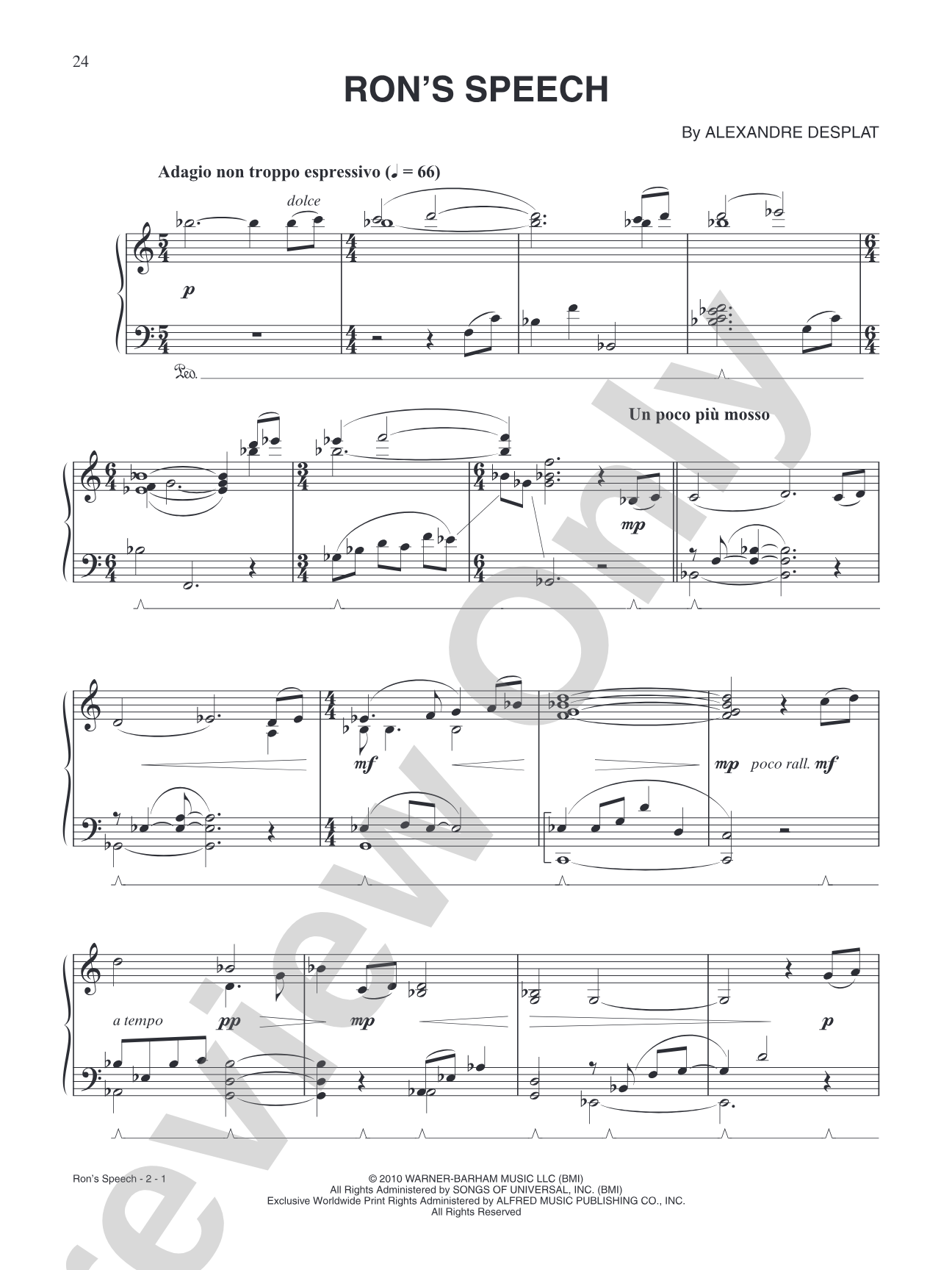

Ron’s Speech (from "Harry Potter & The Deathly Hallows: Part 1"): Piano
Selections from the Motion Picture
Music by Alexandre Desplat
Item: 00-XS-0000134
$4.99
Pickup currently not available
Related Items
Snape to Malfoy Manor (from "Harry Potter & The Deathly Hallows: Part 1"): Piano |
$4.99
|
View | |
Polyjuice Potion (from "Harry Potter & The Deathly Hallows: Part 1"): Piano |
$4.99
|
View | |
Ron Leaves (from "Harry Potter & The Deathly Hallows: Part 1"): Piano |
$4.99
|
View | |
Obliviate (from "Harry Potter & The Deathly Hallows: Part 1"): Piano |
$4.99
|
View | |
At the Burrow (from "Harry Potter & The Deathly Hallows: Part 1"): Piano |
$4.99
|
View | |
Harry and Ginny (from "Harry Potter & The Deathly Hallows: Part 1"): Piano |
$4.99
|
View | |
Godric's Hollow Graveyard (from "Harry Potter & The Deathly Hallows: Part 1"): Piano |
$4.99
|
View | |
Lovegood (from "Harry Potter & The Deathly Hallows: Part 1"): Piano |
$5.99
|
View | |
Farewell to Dobby (from "Harry Potter & The Deathly Hallows: Part 1"): Piano |
$4.99
|
View | |
Harry Potter and the Deathly Hallows, Part 1: Piano Book |
$14.99
|
View |
Description
Complete with pages of color screen shots from the film, this collectible book of 10 superb solo piano transcriptions from Alexandre Desplat's dramatic score will thrill pianists and their audiences alike. Titles: * Obliviate * Snape to Malfoy Manor * Polyjuice Potion * At the Burrow * Harry and Ginny * Ron Leaves * Godric's Hollow Graveyard * Ron's Speech * Lovegood * Farewell to Dobby.


Ron’s Speech (from "Harry Potter & The Deathly Hallows: Part 1"): Piano isn't in MakeMusic Cloud just yet...but it could be. Let us know you'd like to see it, and you'll help shape what comes next. In the meantime, start a free trial and dive into thousands of interactive titles your students can play along with today.
Request This Title
Tell us you want it.
Start Your Free Trial
Explore everything that's ready to play right now.
Sample Audio
No sample audio found.
Sample Video
No sample videos found.
Additional Details
Publisher:
Alfred Music
Page Count:
40
SKU:
00-XS-0000134
More about this title
About the Composer: Alexander Desplat
Alexander Desplat is a French film composer whose work spans the Harry Potter franchise, the Fantastic Beasts series, The Grand Budapest Hotel, and dozens of other major motion pictures. His orchestral writing combines classical sophistication with dramatic storytelling, making his scores both emotionally resonant and technically engaging for pianists of all levels.
Desplat's approach to film music emphasizes melody and harmonic richness, qualities that translate beautifully to solo piano. His works have earned Grammy nominations and Academy Award recognition, cementing his place among the most respected contemporary film composers.
Why we love this
These transcriptions capture the emotional weight of Desplat's score while remaining accessible to advanced pianists. The collection spans intimate character moments and grand orchestral sequences, giving pianists genuinely varied material to interpret rather than simplified "movie favorites" arrangements. Programming material from a beloved film adds audience appeal without sacrificing musical substance.
What to expect
These transcriptions evoke the film's emotional range: moments of intimacy and vulnerability alternate with sequences of tension and loss. The writing often features sustained harmonic progressions beneath flowing melodies, creating a contemplative mood that rewards careful pedaling and attention to voice leading. Each piece tells a story through purely musical means.
Who it's for
Pianists preparing recital programs who want recent, accessible material with broad audience recognition. Teachers seeking repertoire that engages students through film connection while building interpretive and technical skills. Advanced amateur pianists looking for substantial solo work that balances emotional engagement with realistic performance demands.
How to get the most out of it
- Attend to the color changes between pieces. "Ron's Speech" requires a different tonal quality than "Harry and Ginny," so use the shifts in key, register, and texture to shape your program arc.
- Balance the demands of sustaining long melodic lines with clarity in accompaniment figures, especially in pieces like "Godric's Hollow Graveyard" where atmosphere depends on both elements.
- Reference the film stills included in the book to ground your interpretive choices. Visual context often clarifies the emotional temperature Desplat intended at each moment.
- Resist the urge to rush passages marked with rubato or those featuring syncopated rhythms. These moments define Desplat's orchestral idiom and need space to breathe.
How to use it
Program individual pieces as recital selections rather than performing the collection in sequence. Pairing "Harry and Ginny" with another romantic work, or "Farewell to Dobby" with a classical-era slow movement, creates unexpected musical dialogues. These pieces also work well as contemporary supplements in survey recitals that otherwise feature standard repertoire.
Skills your students will build
- Pedal control and tone color differentiation across dynamic ranges
- Sustaining legato melody lines while maintaining accompaniment clarity
- Interpretation of film music that relies on harmonic atmosphere rather than obvious surface drama
- Sight-reading contemporary notational conventions in film-derived transcriptions
- Building narrative arc across multiple pieces with different emotional centers