
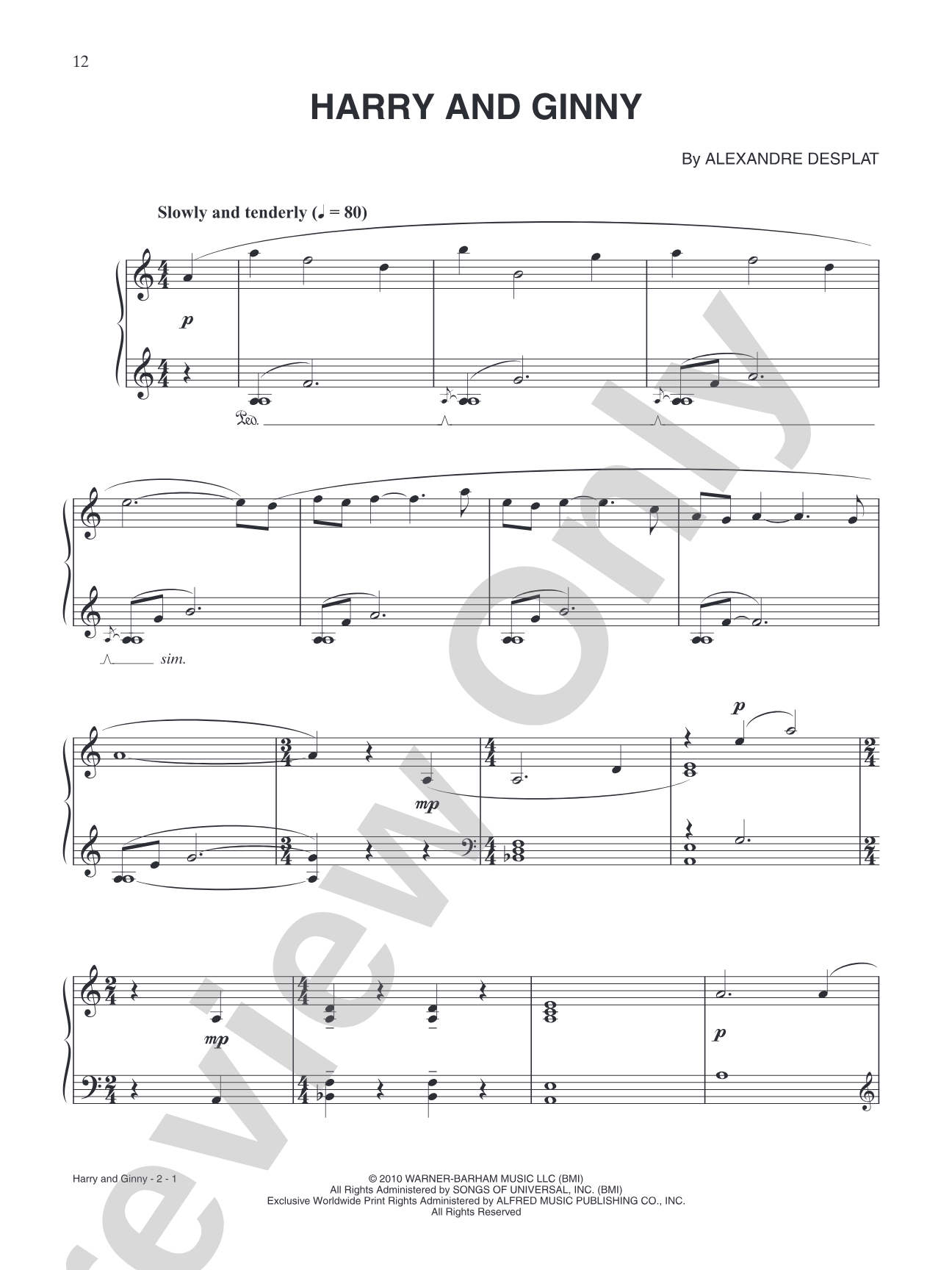

Harry and Ginny (from "Harry Potter & The Deathly Hallows: Part 1"): Piano
Selections from the Motion Picture
Music by Alexandre Desplat
Item: 00-XS-0000137
$4.99
Pickup currently not available
Related Items
Snape to Malfoy Manor (from "Harry Potter & The Deathly Hallows: Part 1"): Piano |
$4.99
|
View | |
Polyjuice Potion (from "Harry Potter & The Deathly Hallows: Part 1"): Piano |
$4.99
|
View | |
Ron Leaves (from "Harry Potter & The Deathly Hallows: Part 1"): Piano |
$4.99
|
View | |
Ron’s Speech (from "Harry Potter & The Deathly Hallows: Part 1"): Piano |
$4.99
|
View | |
Obliviate (from "Harry Potter & The Deathly Hallows: Part 1"): Piano |
$4.99
|
View | |
At the Burrow (from "Harry Potter & The Deathly Hallows: Part 1"): Piano |
$4.99
|
View | |
Godric's Hollow Graveyard (from "Harry Potter & The Deathly Hallows: Part 1"): Piano |
$4.99
|
View | |
Lovegood (from "Harry Potter & The Deathly Hallows: Part 1"): Piano |
$5.99
|
View | |
Farewell to Dobby (from "Harry Potter & The Deathly Hallows: Part 1"): Piano |
$4.99
|
View | |
Harry Potter and the Deathly Hallows, Part 1: Piano Book |
$14.99
|
View |
Description
Complete with pages of color screen shots from the film, this collectible book of 10 superb solo piano transcriptions from Alexandre Desplat's dramatic score will thrill pianists and their audiences alike. Titles: * Obliviate * Snape to Malfoy Manor * Polyjuice Potion * At the Burrow * Harry and Ginny * Ron Leaves * Godric's Hollow Graveyard * Ron's Speech * Lovegood * Farewell to Dobby.


Harry and Ginny (from "Harry Potter & The Deathly Hallows: Part 1"): Piano isn't in MakeMusic Cloud just yet...but it could be. Let us know you'd like to see it, and you'll help shape what comes next. In the meantime, start a free trial and dive into thousands of interactive titles your students can play along with today.
Request This Title
Tell us you want it.
Start Your Free Trial
Explore everything that's ready to play right now.
Sample Audio
No sample audio found.
Sample Video
No sample videos found.
Additional Details
Publisher:
Alfred Music
Page Count:
40
SKU:
00-XS-0000137
More about this title
About the Composer: Alexander Desplat
Alexander Desplat has composed the scores for eight of the Harry Potter films, establishing himself as one of the most significant voices in contemporary film music. His work on the Wizarding World franchise demonstrates a mastery of orchestral storytelling, blending classical sophistication with narrative clarity that serves character and emotion without overwhelming the drama on screen.
Why we love this
These transcriptions capture the emotional specificity of Desplat's film score in a format accessible to serious pianists. Rather than simplifications, they preserve the harmonic language and textural detail that make the original orchestration work, offering pianists genuine interpretive challenges alongside the immediate pleasure of recognizable, beautifully crafted music.
What to expect
The music moves between intimate vulnerability and cinematic grandeur. Desplat's harmonic language feels both modern and timeless, often exploring ambiguous tonalities that mirror the uncertainty and moral complexity of the source material, then resolving into moments of genuine warmth and connection.
Who it's for
Intermediate to advanced pianists seeking contemporary repertoire with narrative depth and strong emotional through-lines. This collection appeals equally to dedicated film music fans and to teachers building programs around meaningful storytelling in music.
How to get the most out of it
- Attend closely to the dynamic and articulation markings. Film scores rely on subtle shifts in color and weight to convey emotional nuance; translating the orchestra to solo piano means these details become your primary tool for storytelling.
- Balance the modal and contemporary harmonic language Desplat favors. These pieces sit comfortably neither in straight classical tonality nor in modern minimalism; find the middle ground where both elements coexist.
- Use the color screenshots from the film strategically. Reference them during preparation to ground your interpretation in a specific moment and emotional context, but perform from memory of the music itself, not as visual accompaniment.
How to use it
Use individual pieces as recital selections, particularly "Harry and Ginny" or "Farewell to Dobby" for programming centered on character development through music. The complete collection also works as a thematic concert program, grouping pieces by emotional trajectory to tell a coherent narrative across the recital.
Skills your students will build
- Interpreting film music notation and understanding how orchestral textures translate to piano
- Playing with harmonic ambiguity and modal interchange
- Balancing melody and accompaniment when both occupy the right hand
- Sustaining emotional coherence across pieces connected by dramatic narrative
- Reading and responding to detailed dynamic and articulation markings