
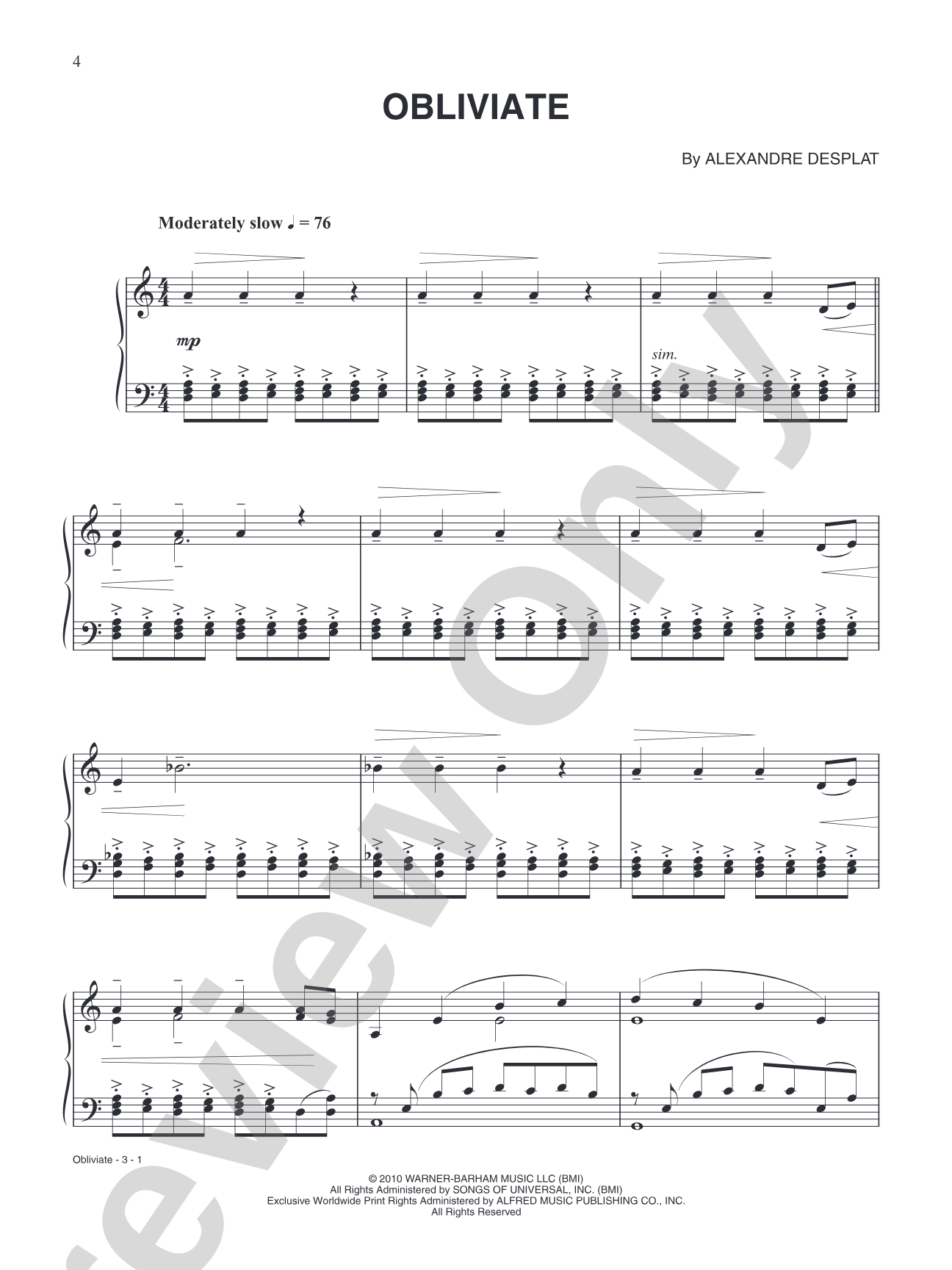

Obliviate (from "Harry Potter & The Deathly Hallows: Part 1"): Piano
Selections from the Motion Picture
Music by Alexandre Desplat
Item: 00-XS-0000135
$4.99
Pickup currently not available
Related Items
Snape to Malfoy Manor (from "Harry Potter & The Deathly Hallows: Part 1"): Piano |
$4.99
|
View | |
Polyjuice Potion (from "Harry Potter & The Deathly Hallows: Part 1"): Piano |
$4.99
|
View | |
Ron Leaves (from "Harry Potter & The Deathly Hallows: Part 1"): Piano |
$4.99
|
View | |
Ron’s Speech (from "Harry Potter & The Deathly Hallows: Part 1"): Piano |
$4.99
|
View | |
At the Burrow (from "Harry Potter & The Deathly Hallows: Part 1"): Piano |
$4.99
|
View | |
Harry and Ginny (from "Harry Potter & The Deathly Hallows: Part 1"): Piano |
$4.99
|
View | |
Godric's Hollow Graveyard (from "Harry Potter & The Deathly Hallows: Part 1"): Piano |
$4.99
|
View | |
Lovegood (from "Harry Potter & The Deathly Hallows: Part 1"): Piano |
$5.99
|
View | |
Farewell to Dobby (from "Harry Potter & The Deathly Hallows: Part 1"): Piano |
$4.99
|
View | |
Harry Potter and the Deathly Hallows, Part 1: Piano Book |
$14.99
|
View |
Description
Complete with pages of color screen shots from the film, this collectible book of 10 superb solo piano transcriptions from Alexandre Desplat's dramatic score will thrill pianists and their audiences alike. Titles: * Obliviate * Snape to Malfoy Manor * Polyjuice Potion * At the Burrow * Harry and Ginny * Ron Leaves * Godric's Hollow Graveyard * Ron's Speech * Lovegood * Farewell to Dobby.


Obliviate (from "Harry Potter & The Deathly Hallows: Part 1"): Piano isn't in MakeMusic Cloud just yet...but it could be. Let us know you'd like to see it, and you'll help shape what comes next. In the meantime, start a free trial and dive into thousands of interactive titles your students can play along with today.
Request This Title
Tell us you want it.
Start Your Free Trial
Explore everything that's ready to play right now.
Sample Audio
No sample audio found.
Sample Video
No sample videos found.
Additional Details
Publisher:
Alfred Music
Page Count:
40
SKU:
00-XS-0000135
More about this title
About the Composer: Alexander Desplat
Alexandre Desplat has established himself as one of contemporary film's most accomplished composers, bringing psychological depth and emotional nuance to narratives across multiple genres. His work on the Harry Potter franchise demonstrates his mastery of thematic writing and orchestral color, crafting musical identities that deepen character moments and amplify dramatic stakes.
Why we love this
These transcriptions capture the intimate storytelling of Desplat's score without requiring an orchestra. The collection balances reflective, character-driven pieces with moments of darker tension, giving pianists a chance to explore the emotional architecture of one of cinema's most beloved soundtracks while remaining performable in intimate settings.
What to expect
These pieces evoke intimacy within larger narrative contexts. You'll find tender moments of reflection (Harry and Ginny, Farewell to Dobby) alongside darker, more unsettled passages (Godric's Hollow Graveyard) that capture the emotional texture of the film without oversimplifying it.
Who it's for
Pianists with intermediate to advanced technique who connect with film music and want accessible entry points into Desplat's compositional voice. This collection appeals equally to teachers seeking repertoire that engages students through familiar storytelling and to performers building recital programs outside the classical canon.
How to get the most out of it
- Pay attention to pedal markings as a compositional tool rather than mere decoration; Desplat's orchestrations often suggest harmonic resonance that the sustain pedal must honor.
- Vary your dynamic palette within passages marked at the same general level. Film music relies on micro-dynamics to create emotional depth, and these transcriptions retain that subtlety.
- Treat the screen shots as performance research. Watching the corresponding film scenes will illuminate the emotional subtext of each piece and guide your interpretive choices.
How to use it
Pair individual pieces with classical repertoire to demonstrate thematic development across musical traditions, or program several transcriptions together as a mini-suite exploring different emotional territories. These work particularly well in recitals aimed at younger audiences or those new to classical music.
Skills your students will build
- Sustain pedal control and harmonic clarity in dense, impressionistic textures
- Interpretive flexibility within film music's emotional specificity
- Left-hand independence in accompaniment patterns that support melodic storytelling
- Sensitivity to micro-dynamic shifts and rubato in contemporary composition