
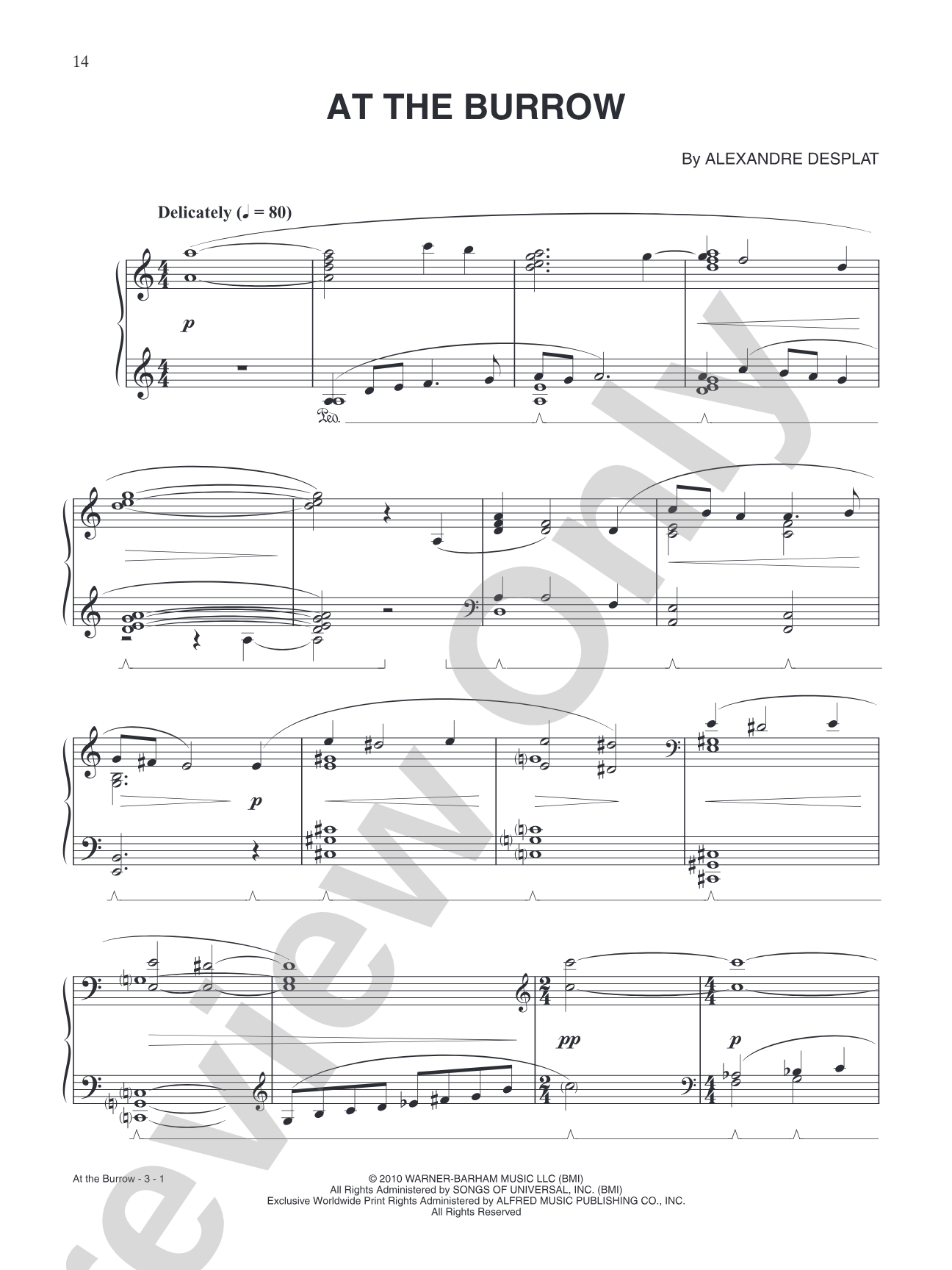

At the Burrow (from "Harry Potter & The Deathly Hallows: Part 1"): Piano
Selections from the Motion Picture
Music by Alexandre Desplat
Item: 00-XS-0000136
$4.99
Pickup currently not available
Related Items
Snape to Malfoy Manor (from "Harry Potter & The Deathly Hallows: Part 1"): Piano |
$4.99
|
View | |
Polyjuice Potion (from "Harry Potter & The Deathly Hallows: Part 1"): Piano |
$4.99
|
View | |
Ron Leaves (from "Harry Potter & The Deathly Hallows: Part 1"): Piano |
$4.99
|
View | |
Ron’s Speech (from "Harry Potter & The Deathly Hallows: Part 1"): Piano |
$4.99
|
View | |
Obliviate (from "Harry Potter & The Deathly Hallows: Part 1"): Piano |
$4.99
|
View | |
Harry and Ginny (from "Harry Potter & The Deathly Hallows: Part 1"): Piano |
$4.99
|
View | |
Godric's Hollow Graveyard (from "Harry Potter & The Deathly Hallows: Part 1"): Piano |
$4.99
|
View | |
Lovegood (from "Harry Potter & The Deathly Hallows: Part 1"): Piano |
$5.99
|
View | |
Farewell to Dobby (from "Harry Potter & The Deathly Hallows: Part 1"): Piano |
$4.99
|
View | |
Harry Potter and the Deathly Hallows, Part 1: Piano Book |
$14.99
|
View |
Description
Complete with pages of color screen shots from the film, this collectible book of 10 superb solo piano transcriptions from Alexandre Desplat's dramatic score will thrill pianists and their audiences alike. Titles: * Obliviate * Snape to Malfoy Manor * Polyjuice Potion * At the Burrow * Harry and Ginny * Ron Leaves * Godric's Hollow Graveyard * Ron's Speech * Lovegood * Farewell to Dobby.


At the Burrow (from "Harry Potter & The Deathly Hallows: Part 1"): Piano isn't in MakeMusic Cloud just yet...but it could be. Let us know you'd like to see it, and you'll help shape what comes next. In the meantime, start a free trial and dive into thousands of interactive titles your students can play along with today.
Request This Title
Tell us you want it.
Start Your Free Trial
Explore everything that's ready to play right now.
Sample Audio
No sample audio found.
Sample Video
No sample videos found.
Additional Details
Publisher:
Alfred Music
Page Count:
40
SKU:
00-XS-0000136
More about this title
About the Composer: Alexander Desplat
Alexander Desplat has become one of the most prominent film composers of the 21st century, earning multiple Academy Award nominations for his work across diverse genres. His approach to orchestration balances lyrical melodicism with intricate harmonic color, making his scores immediately recognizable and deeply musical.
Desplat's eight Harry Potter film scores represent some of his most celebrated work. His ability to weave thematic material through emotionally complex scenes while maintaining accessibility for concert performance has made his Potter transcriptions popular with pianists seeking narrative depth beyond simple soundtrack arrangements.
Why we love this
Desplat's orchestral writing translates beautifully to the solo piano, preserving the emotional architecture of the film moments while creating genuinely pianistic passages. This collection captures some of the score's most poignant scenes—the intimacy of a burrow visit, the melancholy of departures, the weight of loss—giving advanced pianists material that sounds sophisticated without requiring virtuosic fireworks.
What to expect
These transcriptions evoke the intimate and bittersweet emotional landscape of the final Harry Potter film. You'll encounter tender moments of refuge, the sting of separation, and profound grief rendered through lush harmonies and carefully placed silences that let the emotional weight settle.
Who it's for
Advanced pianists and serious hobbyists who connect with film music and appreciate emotionally narrative repertoire will find this collection rewarding. Teachers seeking contemporary solo material that engages students' own musical interests can use these transcriptions to build performance confidence in students preparing for recitals or competitions.
How to get the most out of it
- Attend closely to dynamic gradation in the quieter passages; these transcriptions thrive on subtle shifts in volume rather than dramatic contrasts.
- Use the color film stills as visual anchors for phrasing. Let the emotional content of each scene inform your tempo choices and rubato.
- Layer the harmonic accompaniment patterns without allowing them to overwhelm the melody; think orchestral balance rather than keyboard thickness.
- Practice the transitions between pieces as if programming a concert; Desplat's themes often reappear across multiple cues, and connective flow matters.
How to use it
Open a recital with one of the more reflective pieces to establish atmosphere, or program a sequence of three shorter cues as a mini-suite that tells its own story. Senior or advanced student recitals benefit from the narrative coherence of Desplat's thematic work; audiences often recognize and respond to the emotional spine of the music even without prior familiarity with the films.
Skills your students will build
- Voicing four-part harmony across two hands while maintaining melodic independence
- Controlling dynamics in dense harmonic textures without excess pedal
- Interpreting cinematically inspired phrasing and rubato
- Reading chromatic and modal harmonic movement
- Sustaining emotional narrative across a multi-piece program